













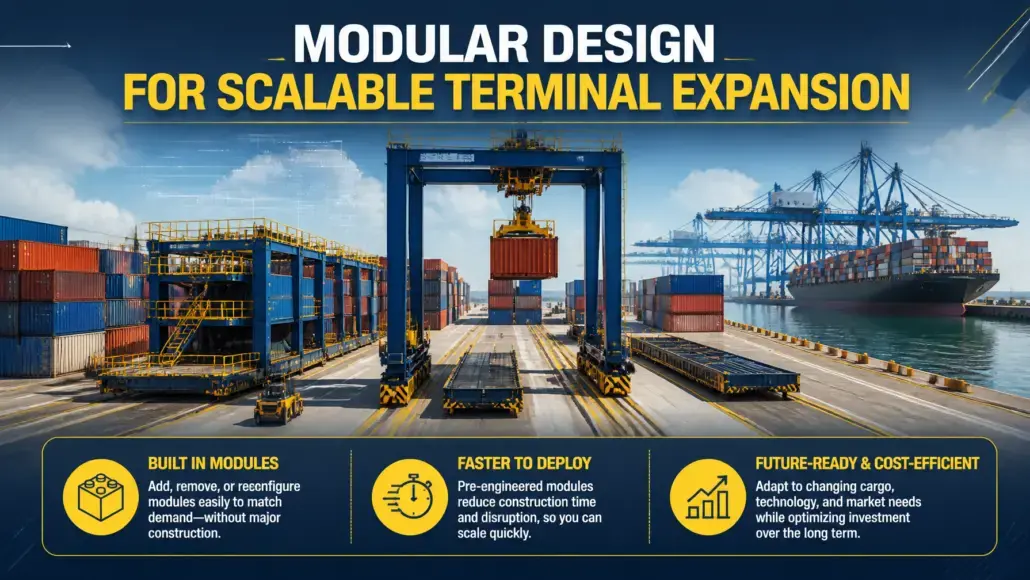
In the rapidly changing landscape of global trade, terminal operators face a constant challenge: how to build for today while planning for an uncertain tomorrow. Traditionally, terminal expansions were massive, monolithic projects that required years of planning, significant capital investment, and extensive construction periods. However, the volatility of modern shipping—characterized by sudden shifts in cargo volumes and the rapid evolution of technology—has made these rigid structures increasingly risky. Modular design for scalable terminal expansion has emerged as a strategic alternative, offering a more flexible and efficient way to grow. Transport Advancement believes that by breaking down terminal components into standardized, prefabricated modules, operators can add capacity incrementally, responding to market demand as it happens rather than trying to predict it years in advance. This approach not only reduces financial risk but also ensures that the terminal remains agile and adaptable in a hyper-competitive environment.
The concept of modularity extends to both the physical structures and the operational systems of a terminal. For instance, quay extensions, stacking yards, and even administrative buildings can be designed as modular units that are manufactured off-site and then quickly assembled at the port. This significantly reduces the disruption to existing operations, as the on-site construction time is minimized. Furthermore, modular design for scalable terminal expansion allows for a more sustainable growth model. Instead of building massive facilities that may sit underutilized for years, operators can scale their infrastructure in lockstep with their business growth. This lean approach to development is becoming the new standard for ports and inland hubs that prioritize long-term viability and operational excellence.
Architectural Principles of Modular Port Infrastructure
To understand why modular design for scalable terminal expansion is so effective, one must look at the architectural principles that underpin it. At its core, modular design relies on standardization and interoperability. Each module is designed to a specific set of dimensions and technical requirements, allowing it to be easily integrated with other modules or existing infrastructure. In a port setting, this might involve the use of pre-cast concrete blocks for wharf construction or standardized steel frames for warehouse expansion. These components act like industrial building blocks, providing the terminal with a level of physical flexibility that was previously unimaginable.
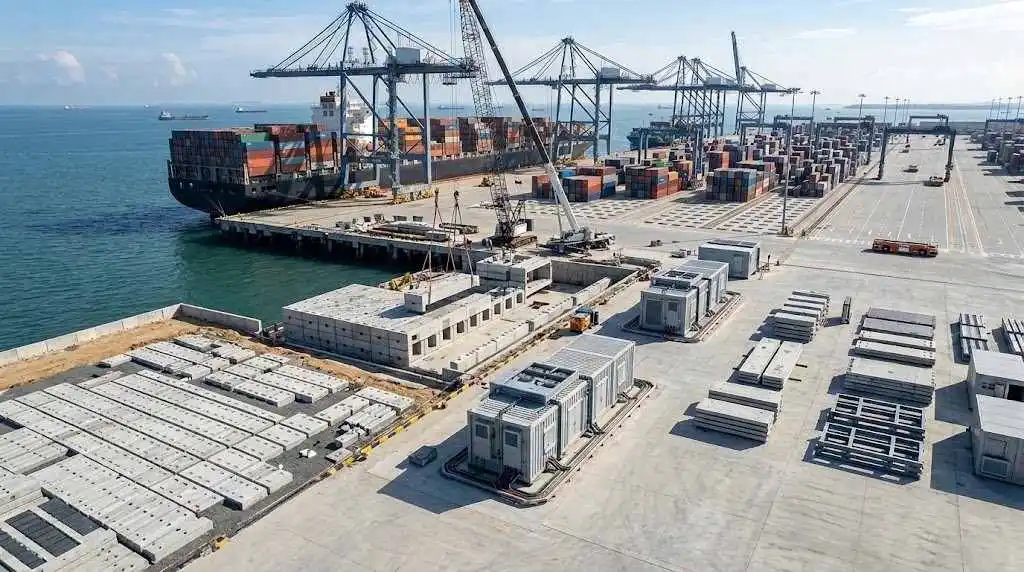
Furthermore, modular design incorporates the concept of serviceability. Because each module is a discrete unit, it can be individually maintained, upgraded, or replaced without affecting the rest of the terminal. This is particularly important for high-wear areas, such as the crane rail foundations or the pavement in high-traffic yard corridors. By designing these elements as modular units, operators can perform repairs during scheduled downtime, ensuring that the terminal’s overall throughput is never compromised. This focus on durability and ease of maintenance is a key driver for the long-term economic viability of the modular approach. In the 2030s, the most successful ports will be those that view their infrastructure as a living, evolving system rather than a static monument.
Economic and Operational Benefits of Modular Construction
One of the most compelling arguments for modular design for scalable terminal expansion is the significant reduction in construction costs and timelines. Because modules are built in a controlled factory environment, they are not subject to the delays caused by weather or difficult site conditions that often plague traditional construction projects. This industrialization of the building process leads to higher quality control and more predictable costs. For a terminal operator, this means a faster return on investment, as new capacity can be brought online in a fraction of the time required for conventional builds. Additionally, the standardized nature of modular components makes them easier to maintain and replace, further lowering the total cost of ownership over the life of the asset.
Beyond the financial gains, modularity provides a superior level of operational flexibility. In a traditional terminal, the layout is often fixed, making it difficult to incorporate new technologies like automated guided vehicles (AGVs) or robotic cranes. A modular terminal, however, is designed to be reconfigured. As operational needs change, modules can be moved, upgraded, or even disassembled and relocated to another part of the port. This plug-and-play capability is essential for future-proofing infrastructure against technological obsolescence. For example, if a terminal transitions from manual to fully automated operations, the modular yard layout can be adjusted to accommodate the new flow of traffic and equipment without the need for extensive demolition and rebuilding. This adaptability ensures that the terminal remains a cutting-edge facility throughout its operational life.
Modular Data Centers and the Smart Terminal Spine
As terminals become more digitized, the need for robust computing power at the edge of the network has grown exponentially. Modular design for scalable terminal expansion now includes the deployment of modular data centers—self-contained units that house the servers, storage, and networking equipment needed to run the terminal’s AI-driven operating systems. These units can be deployed exactly where they are needed, such as near the quay cranes or in the middle of a stacking yard, providing the low-latency connectivity required for real-time autonomous operations. Because they are modular, these data centers can be easily scaled up as the terminal’s data needs grow, ensuring that the digital infrastructure never becomes a bottleneck.
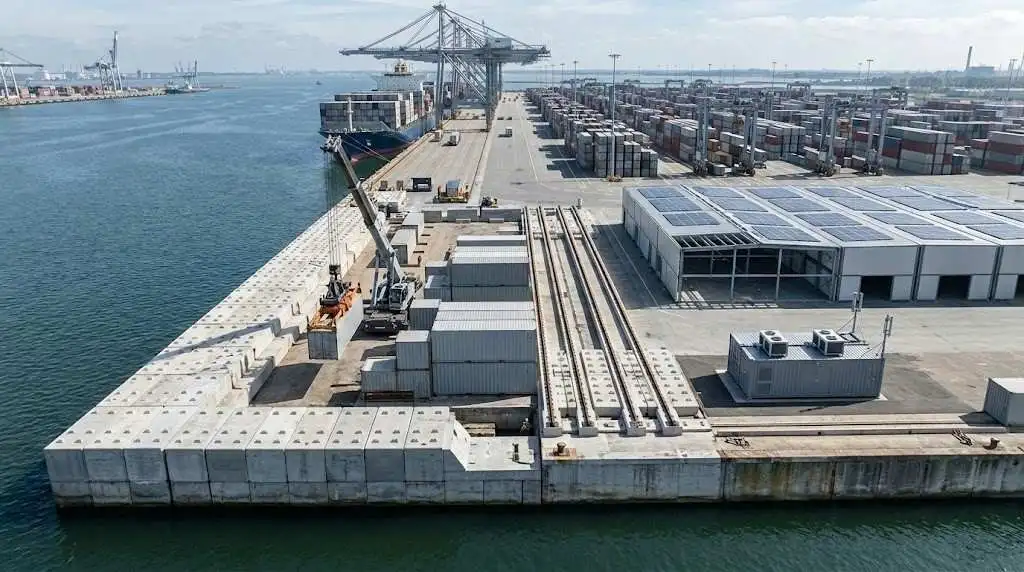
The integration of these digital modules creates a smart terminal spine that supports everything from predictive maintenance to autonomous vehicle coordination. By housing these systems in standardized, climate-controlled modules, operators can protect their sensitive electronic assets from the harsh environment of a container terminal. This modular approach also simplifies the process of upgrading software and hardware, as individual modules can be updated without taking the entire terminal’s digital network offline. As we look toward the future of Industry 4.0 in logistics, the modular data center will be as essential a component of the terminal as the quay crane or the berth itself.
Sustainability and Future-Proofing Global Trade Hubs
Sustainability is no longer an optional extra in terminal design; it is a fundamental requirement driven by both regulation and corporate responsibility. Modular design for scalable terminal expansion contributes to a greener logistics sector by minimizing construction waste and reducing the carbon footprint of the building process. The precision of factory manufacturing ensures that materials are used more efficiently, and the ability to reuse or recycle modules at the end of their life cycle supports a more circular economy. Furthermore, modular hubs are often designed to integrate renewable energy systems, such as solar panels on modular warehouse roofs or energy storage units built into the infrastructure. By building smaller, smarter, and more efficiently, terminal operators can significantly reduce their overall environmental impact.
The future-proofing benefits of modular design are perhaps most evident in the face of environmental shifts, such as rising sea levels. A modular terminal can be designed with the capability to be elevated or reinforced more easily than a solid concrete structure. This resilience is crucial for protecting long-term investments in coastal regions. As global cargo volumes continue to grow and diversify, the ability to scale up quickly and sustainably will be the defining characteristic of successful terminals. Ultimately, the shift toward flexible building techniques is a foundational element in designing resilient infrastructure for mega hubs that can withstand both economic volatility and environmental shifts. The commitment to modular design reflects a broader shift toward a more intelligent and responsive global supply chain, where infrastructure is treated as a dynamic asset rather than a static burden. Transport Advancement believes that by embracing scalability and flexibility, the logistics industry is ensuring it can meet the challenges of the future while maintaining the highest standards of efficiency and reliability.
Expanding Capacity Through Modular Engineering
Terminal operators are moving away from massive, inflexible mega-projects in favor of modular growth. DP World’s BoxBay system exemplifies this by utilizing a modular steel high-bay structure to stack containers up to 11 tiers high, radically scaling terminal capacity vertically rather than horizontally.
References
- DP WORLD INTRODUCES GROUNDBREAKING CONTAINER HANDLING TECHNOLOGY AT LONDON GATEWAY
