















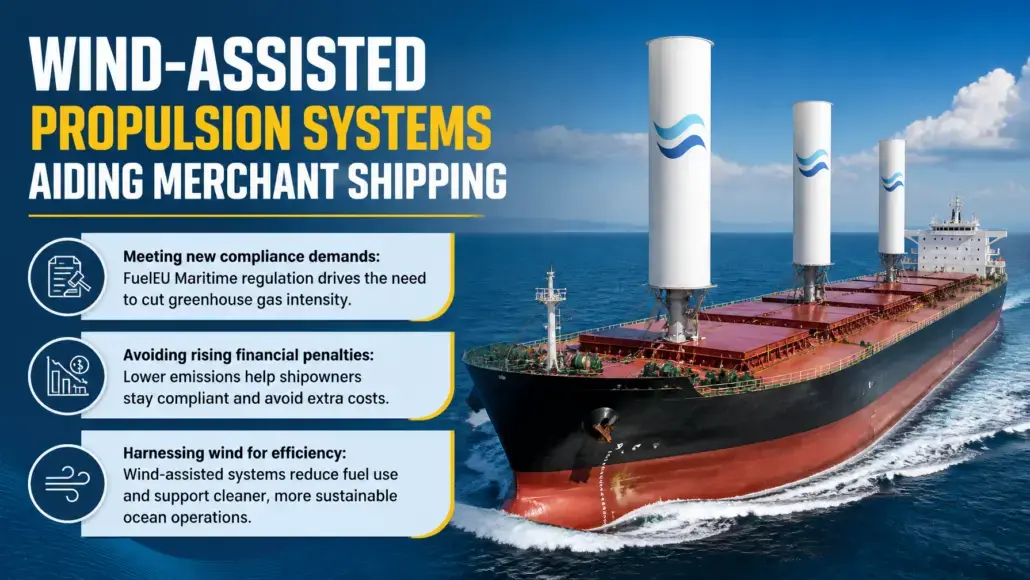
International ocean shipping is undergoing a structural operational realignment as rising compliance costs force commercial fleet operators to harness aerodynamic thrust. With the entry into force of the FuelEU Maritime regulation on 1st January 2025, commercial shipowners face escalating financial penalties unless they systematically reduce the greenhouse gas intensity of marine energy. Consequently, commercial operators are installing wind-assisted propulsion systems across dry bulk carriers, tankers, and roll-on roll-off vessels to achieve immediate bunker fuel reductions without waiting for unproven alternative fuel supply chains.
Modern mechanical sails represent an industrial evolution rather than a nostalgic return to historical canvas. Automated wing sails, rotating Flettner cylinders, and boundary-layer suction foils now communicate directly with vessel automation networks. Transport Advancement notes that by integrating dynamic weather routing and automated trimming algorithms, modern wind-assisted propulsion systems adjust their aerodynamic angles to changing sea states in milliseconds, delivering supplemental forward thrust directly to the vessel hull.
Regulatory Pressures and Economic Drivers Accelerating Adoption
Regulatory deadlines established by the International Maritime Organization and the European Union have transformed aerodynamic propulsion from an experimental curiosity into a board-level commercial hedge. Under the FuelEU Maritime framework, vessels over 5,000 gross tonnage calling at European ports must reduce average greenhouse gas intensity by two percent starting in 2025, with penalties compounding significantly through 2030 and 2050. At the same time, the European Union Emissions Trading System requires shipowners to surrender emissions allowances for verified vessel emissions, creating a direct financial cost for every ton of heavy fuel oil or marine diesel burned at sea.
Alternative low-carbon marine fuels such as green methanol and e-ammonia command substantial price premiums over conventional fossil fuels. Moreover, production infrastructure for zero-emission fuels remains severely constrained across major bunkering hubs. In contrast, wind energy requires no offshore bunkering network, produces zero direct emissions, and incurs zero commodity price volatility. Mechanical wind assist technologies allow commercial vessels to lower their daily fuel consumption while remaining compliant with tightened Carbon Intensity Indicator ratings.
Investment cycles across the maritime sector increasingly reflect these economic realities. Retrofitting aerodynamic hardware onto existing bulk carriers and tankers typically requires an amortized capital expenditure that can be recovered through bunker savings across three to seven operating years, depending on prevailing sea lanes and average wind density. In newbuild designs, integrating structural deck reinforcements and reinforced foundation pillars during shipyard construction reduces installation overhead even further.
Core Aerodynamic Technologies Reshaping Hull Performance
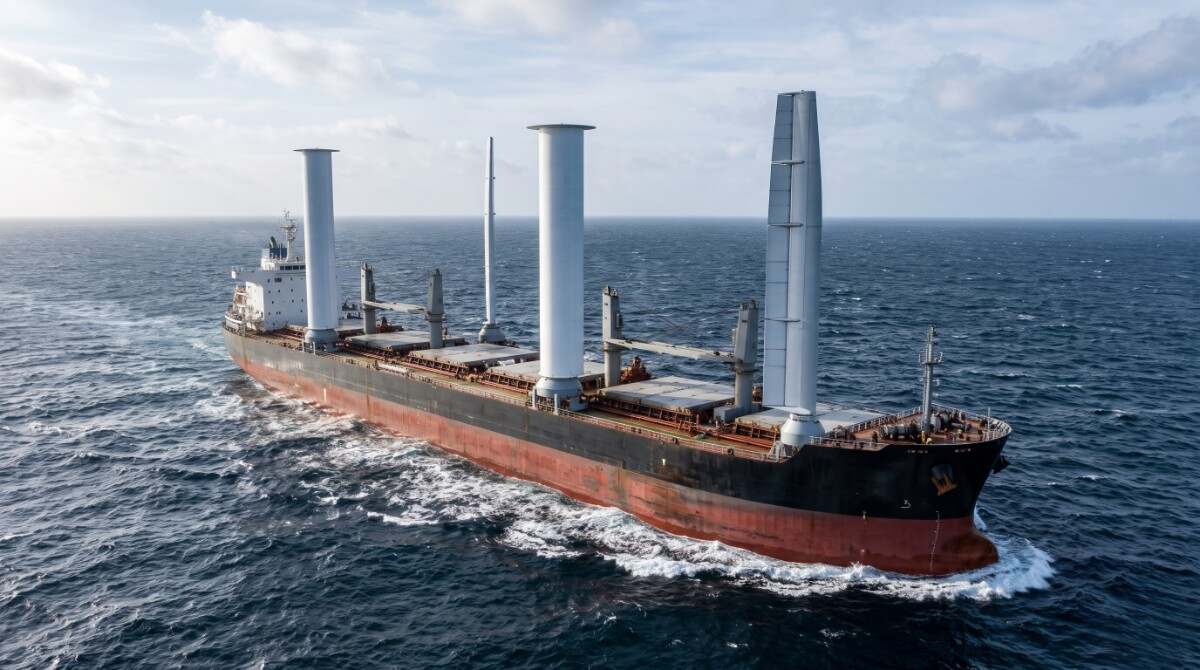
Commercial shipyards and marine equipment manufacturers currently supply three primary mechanical categories of wind-assisted propulsion systems, each designed to address distinct vessel deck layouts and operational profiles:
- Rotor sails, operating on the aerodynamic Magnus effect, utilize motorized rotating vertical cylinders. As ambient wind passes the spinning cylinder, pressure differentials generate perpendicular thrust that pushes the vessel forward.
- Rigid wing sails, constructed from lightweight composite materials, function like vertical aircraft wings with articulating flaps that generate lift across broad apparent wind angles.
- Suction wings and ventilated foil systems combine compact aerofoils with internal electric fans that draw in air through surface perforations, preventing airflow boundary-layer separation and producing high lift coefficients relative to their small footprint.
Each aerodynamic approach presents specific operational trade-offs for commercial cargo operations. Bulk carriers and roll-on roll-off vessels, which feature unobstructed open weather decks, offer ideal platforms for tall rigid wings and rotor assemblies. Conversely, container vessels present severe line-of-sight constraints and require unrestricted overhead clearance for shore-based gantry cranes during harbor container moves. To resolve these logistical hurdles, naval architects have engineered automated tilting, folding, and rail-mounted sliding mechanisms that stow the aerodynamic structures flat against the deck or slide them along coamings during port berthing.
Autonomous control software serves as the vital link translating raw wind energy into verified fuel savings. Shipboard sensor arrays constantly sample true wind speed, barometric pressure, apparent wind direction, and wave slamming moments. Using machine learning models trained on hydrodynamic hull data, the automated control system trims each mechanical sail to the optimal angle of attack, feathering or reefing the units whenever atmospheric conditions exceed structural safety envelopes.
Operational Challenges and Voyage Optimization Dynamics
Despite verified fuel efficiency gains, operating wind-assisted propulsion systems introduces complex navigational and mechanical variables that master mariners and fleet superintendents must carefully balance. Added topside weight alters the vessel center of gravity, requiring ballast water optimization to maintain intact stability and satisfy International Maritime Organization grain stability standards. Bridge visibility regulations also govern structural sail placement, ensuring that deck equipment does not obstruct forward navigation sectors.
Route planning represents another profound operational shift. Historical merchant shipping prioritized shortest-distance great circle routes to minimize ocean transit times. Conversely, vessels harnessing auxiliary wind thrust achieve optimal commercial returns through dynamic weather routing algorithms that chart corridors of high wind density. Ocean voyages optimized for wind assist frequently cover greater absolute nautical mileage while consuming significantly less bunker fuel and emitting substantially lower aggregate carbon.
Crew training and preventative maintenance regimes must adapt to specialized mechanical systems operating continuously in corrosive salt-spray environments. Composite sail skins require non-destructive structural ultrasonic testing during scheduled drydocks, while hydraulic tilting rams and high-torque electric rotation motors demand strict lubrication intervals. Commercial insurance underwriters have updated marine hull and machinery policies to reflect these mechanical assets, treating verified aerodynamic hardware as standard auxiliary marine equipment rather than unrated experimental risk.
Beyond vessel hydrodynamic efficiency, cargo preservation inside cargo holds is also entering a digital phase, as detailed in Smart Containers: Real-Time IoT Monitoring of Temperature and Humidity Globally.
Scalability and Technical Integration Across Future Fleets
Shipbuilders across Europe and East Asia are standardizing structural interfaces for mechanical wind assist systems. Major shipyards now market wind-ready vessel notations, integrating reinforced deck doubler plates, high-capacity electrical switchboards, and dedicated data cabling trunks directly into newbuild blueprints. This advance preparation enables vessel owners to defer the capital commitment of hardware installation until operational trade routes require compliance upgrades, slashing subsequent yard retrofit downtime from weeks to days.
Sensor telemetry from operating fleets continuously feeds back into naval architecture design loops. Ship design offices utilize high-performance computational fluid dynamics to study the aerodynamic interaction between multiple sails on a shared weather deck, mitigating turbulent wake interference that previously reduced downwind wing efficiency. Advanced boundary-layer suction units and composite materials engineered to resist extreme torsional twisting are pushing aerodynamic efficiency higher while reducing structural weight.
Transport Advancement observes that maritime emissions regulations tighten through the coming decade, aerodynamic assist is solidifying its role as an indispensable efficiency baseline. Vessel owners who master the integration of physical wind thrust alongside digital weather intelligence are decoupling their operating balance sheets from volatile bunker markets and positioning their merchant fleets for sustained commercial viability across international trade corridors.
