










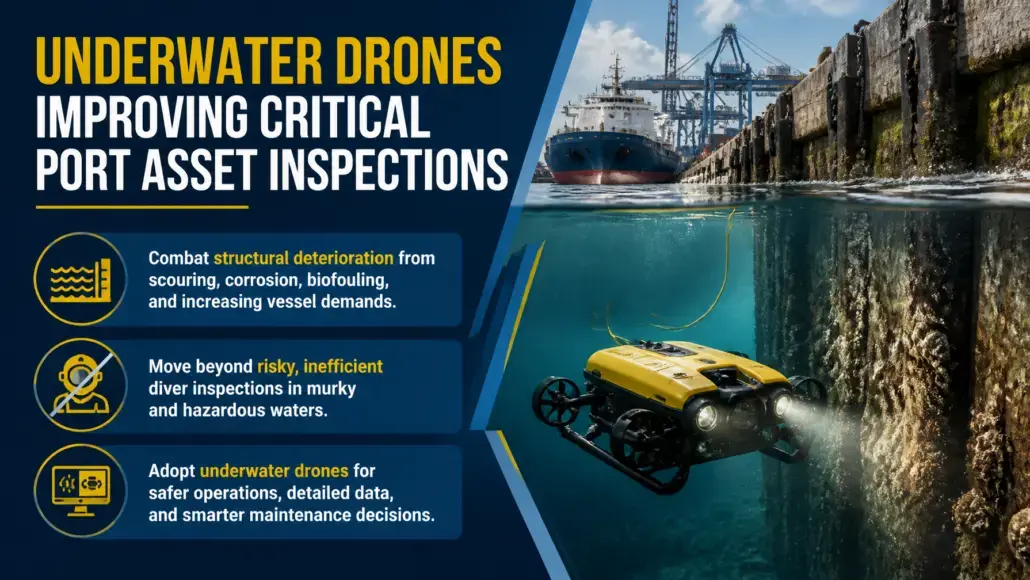
Aging maritime terminals across the world are grappling with severe structural deterioration as increasing vessel drafts and turbulent propeller wash accelerate underwater erosion. Deep-water quay walls, sheet pilings, dolphin berths, and concrete foundation jackets endure relentless scouring, corrosive seawater exposure, and biofouling. Historically, port civil engineers relied on human commercial divers to conduct tactile inspections in murky harbor basins. Today, port authorities are phasing out high-risk diving operations in favor of robotic inspection fleets, deploying autonomous underwater vehicles and tethered micro-crawlers to survey submerged assets with millimeter precision.
This transition from manual diving to robotic surveillance addresses acute safety liabilities and intense commercial pressures. Commercial diving in active commercial shipping berths is exceptionally hazardous, exposing personnel to zero-visibility silt, strong tidal currents, heavy industrial contamination, and catastrophic differential pressure suction near intake pipes. Furthermore, conducting diver sweeps requires marine terminals to shut down container handling and suspend vessel movements at adjacent berths, incurring hundreds of thousands of dollars in commercial demurrage. Transport Advancement observes that deploying underwater drones for port inspections eliminates human physical risk while allowing structural asset inspections to proceed continuously alongside normal cargo operations.
High-Resolution Sensing Payloads and Robotic Navigation
Operating autonomous robotic systems in congested harbor environments demands specialized acoustic and optical technologies engineered to overcome extreme turbidity. Commercial ports frequently exhibit near-zero optical visibility due to continuous sediment dredging, stormwater runoff, and turbulent ship movements. Consequently, modern inspection drones utilize multi-sensor fusion architecture that blends acoustic soundings with digital optical enhancement.
The primary instrumentation payload on modern port inspection drones includes:
- High-frequency multibeam imaging sonars that emit acoustic pulses to reconstruct dense, photographic-like three-dimensional acoustic point clouds of submerged structures through impenetrable mud and silt.
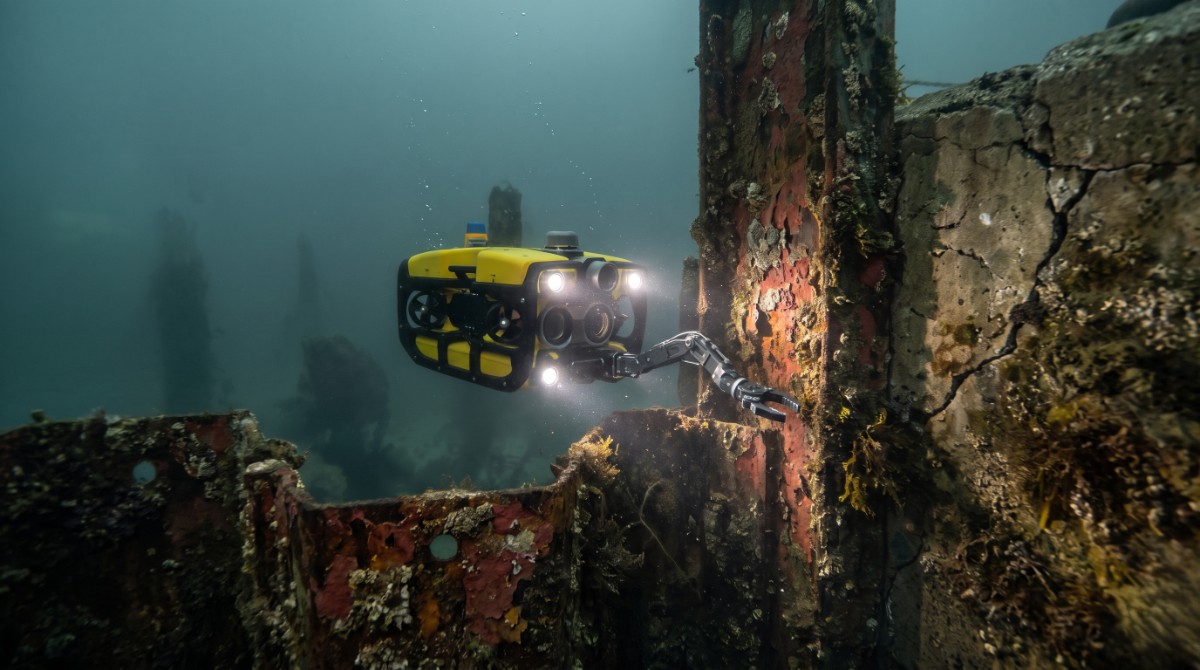
- Ultrasonic thickness testing probes mounted on articulating robotic arms that press firmly against steel sheet pilings to measure remaining metal thickness and identify severe subsurface corrosion without divers scraping biofouling.
- Laser profiling scanners and high-definition optical stereo cameras integrated with high-intensity polarized LED arrays that capture detailed close-up imagery of concrete cracks, spalling, and rebar exposure.
- Cathodic protection measurement sensors that record electrochemical voltage potentials along submerged steel pilings, verifying that sacrificial zinc anodes or impressed-current systems are functioning correctly.
Navigating robotic drones along vertical quay walls requires sophisticated acoustic positioning infrastructure. Because satellite positioning signals attenuate within centimeters of penetrating seawater, underwater drones utilize Doppler velocity logs paired with ultra-short baseline acoustic transceivers deployed from the wharf deck. Automated station-keeping algorithms allow the drone to lock onto structural coordinates, compensating for surging vessel wake and tidal currents while maintaining a fixed stand-off distance of centimeters from concrete surfaces.
Asset Integrity Management and Digital Twin Integration
Data captured by underwater inspection robotics is transforming how port authorities budget and execute structural maintenance. In traditional manual diving inspections, civil engineers received subjective written logs and sparse underwater photographs from divers operating under severe bottom-time limits. In contrast, robotic survey drones harvest millions of spatial data points on every dive, which specialized asset management software automatically aligns into comprehensive three-dimensional digital twins of harbor infrastructure.
Engineering software compares time-stamped digital twins over multi-year operational cycles to quantify structural degradation rates. Advanced machine learning models automatically detect progressive concrete spalling, scour holes beneath toe walls, and structural deformation caused by heavy ship berthing impacts. Port engineering teams can identify localized foundation voids years before settlement cracks appear on the surface container yard, shifting maintenance expenditure from expensive emergency rebuilds to targeted, low-cost preventive repairs.
Commercial port insurance underwriters and marine financing institutions increasingly require validated digital twin records as a condition for terminal underwriting. Verifiable subsea structural data reassures institutional investors that aging maritime terminals can safely accommodate mega-container vessels exceeding twenty-four thousand twenty-foot equivalent units without risking catastrophic quay wall collapses.
Operational Complexities and Marine Terminal Interface
Deploying robotic underwater vehicles within bustling commercial harbors involves distinct operational frictions that port operations managers must coordinate. Active harbor basins present complex hydrodynamics, including sudden localized surges generated by bow thrusters of maneuvering tugboats and massive container carriers. These high-velocity water jets can destabilize lightweight robotic drones, requiring heavy-duty thruster configurations and robust dynamic positioning software capable of rapid hydrodynamic counter-thrust.
Biofouling accumulation represents another continuous physical barrier. Submerged concrete and steel structures are encrusted with dense layers of marine barnacles, mussels, and macroalgae. To perform accurate ultrasonic metal thickness measurements or detect fine hairline cracks in concrete, robotic drones must carry high-pressure cavitation water jets or rotating wire brushes to clean structural surfaces prior to acoustic sensing.
Data management and regulatory compliance also impose new administrative responsibilities on port infrastructure teams. A single autonomous quay wall survey generates terabytes of raw sonar files, acoustic point clouds, and high-resolution video streams. Port authorities must maintain secure cloud computing pipelines capable of processing and archiving these immense data volumes, ensuring that inspection records comply with national maritime infrastructure safety regulations.
Even when submerged pilings and bulkheads receive rigorous robotic maintenance, older harbors still confront absolute physical land boundaries, creating urgent demand for floating logistics hubs.
Long-Term Harbor Lifecycle Economics and Diver Replacement
The financial case for transitioning port maintenance to autonomous robotic platforms is compelling. While high-specification underwater drones represent a substantial upfront capital acquisition, their long-term operating costs are vastly lower than maintaining specialized commercial diving vessels, decompression chambers, and multi-person dive support teams. By amortizing robotic hardware over thousands of inspection hours, port operators lower the per-meter cost of structural asset monitoring by forty to sixty percent.
More importantly, autonomous robotics enable continuous asset monitoring rather than sporadic multi-year audits. Traditional diver inspections occurred once every five to ten years due to cost and logistical disruption, often allowing hidden corrosion and foundation voids to reach critical structural failure before detection. Autonomous underwater drones allow port authorities to conduct quarterly or semi-annual baseline sweeps, catching structural defects in their infancy when minor grouting or localized cathodic reinforcement can permanently arrest degradation.
As global supply chains place higher throughput demands on maritime terminals, the physical foundations of world trade must remain structurally resilient. Transport Advancement notes that underwater drones used for port inspections provide port authorities with the continuous, high-fidelity engineering intelligence required to safeguard critical marine assets, protect public infrastructure investments, and ensure uninterrupted commercial cargo flow.
