
















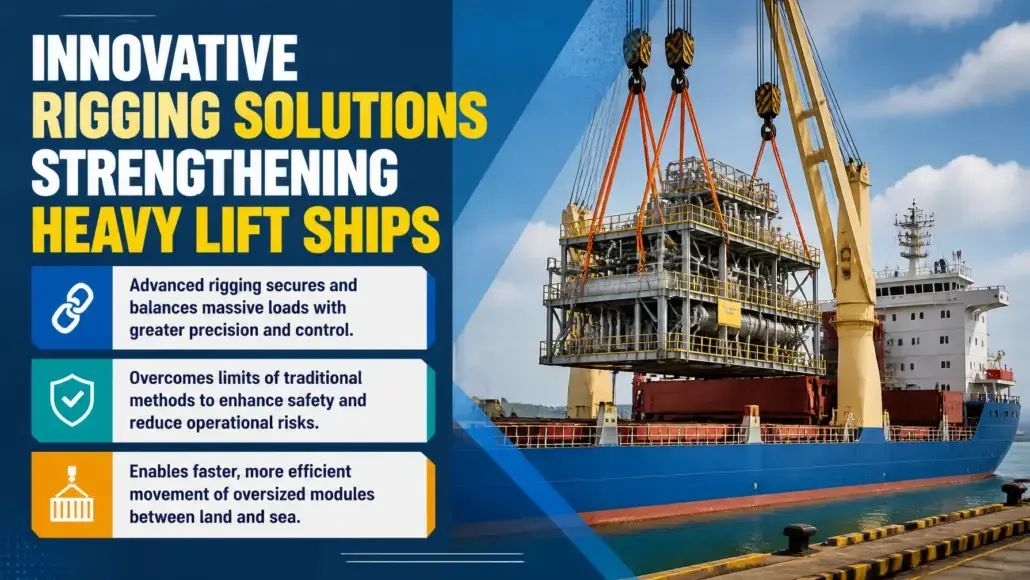
The maritime heavy lift industry is currently witnessing a technical revolution in how massive objects are secured, balanced, and moved between land and sea. As industrial modules for energy plants and infrastructure projects grow in physical size and extreme weight, Transport Advancement observes that the traditional rigging methods are rapidly reaching their physical and safety limits.
Consequently, the development and deployment of innovative rigging solutions for heavy lift ships has become a top priority for marine engineering firms and specialized vessel operators. These technical advancements are essential for safely managing the complex loads that define the modern project cargo landscape.
In early 2026, industry reports highlighted a significant increase in the adoption of high strength composite materials and automated lifting systems. These technologies are being deployed to manage cargo for a market would drive a global project logistics sector valued at 495.56 billion dollars. The move toward larger, more complex lifts is not just about raw lifting power. It is about millimetre precision, redundant safety systems, and the ability to operate effectively in challenging offshore environments.
The Shift to Automated Spreader and Leveling Systems
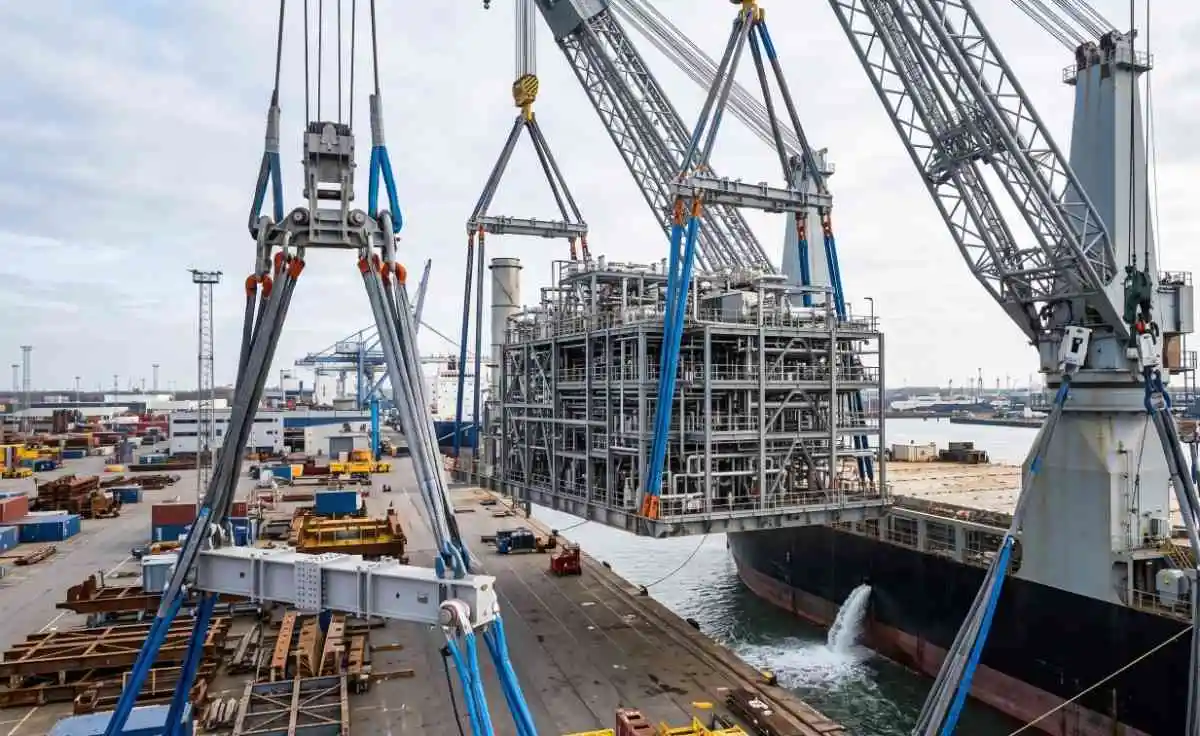
One of the most impactful developments in recent years is the rise of sophisticated automated spreader beams and frames. Traditionally, rigging a heavy load required a large team of personnel to manually attach slings and adjust settings. This process is time consuming and carries significant risks in the dynamic environment of a ship’s deck. Innovative rigging solutions for heavy lift ships now include remotely operated spreaders that can be adjusted in real time using hydraulic or electric actuators to ensure the load remains perfectly balanced.
In 2025, the adoption of four point spreader beams with integrated hydraulic leveling systems accelerated, driven by new safety regulations and advancements in control systems. Enerpac expanded its range of heavy lifting tools in mid 2025 by launching a new series of synchronized hoist systems designed for maritime heavy lift operations. These systems allow for the precise control of multiple lifting points, ensuring that the load remains level even when the center of gravity is offset. By reducing the need for manual intervention, these automated systems significantly lower the risk of accidents and speed up loading cycles by up to 30 percent.
These automated systems are often paired with active heave compensation technology, which uses sophisticated sensors and winch control to counteract the motion of the waves. Huisman announced the successful deployment of a new generation of motion compensated cranes in early 2026, specifically designed for the installation of massive offshore wind foundations. This integration of rigging and winch control is a hallmark of modern maritime engineering, allowing for safer operations in higher sea states and reducing the downtime caused by weather events.
The Transition from Steel to Synthetic Fibers
The materials used in heavy lift rigging are also undergoing a fundamental evolution to meet the demands of super heavy lifts:
- Material Shift: Traditional steel wire rope is increasingly being supplemented by high-performance synthetics like High Modulus Polyethylene (HMPE).
- High Strength-to-Weight Ratio: HMPE rigging is up to 80% lighter than steel while delivering equivalent breaking strength.
- Increased Vessel Efficiency: Lighter rigging deadweight frees up vessel payload capacity, allowing more weight to be allocated directly to cargo.
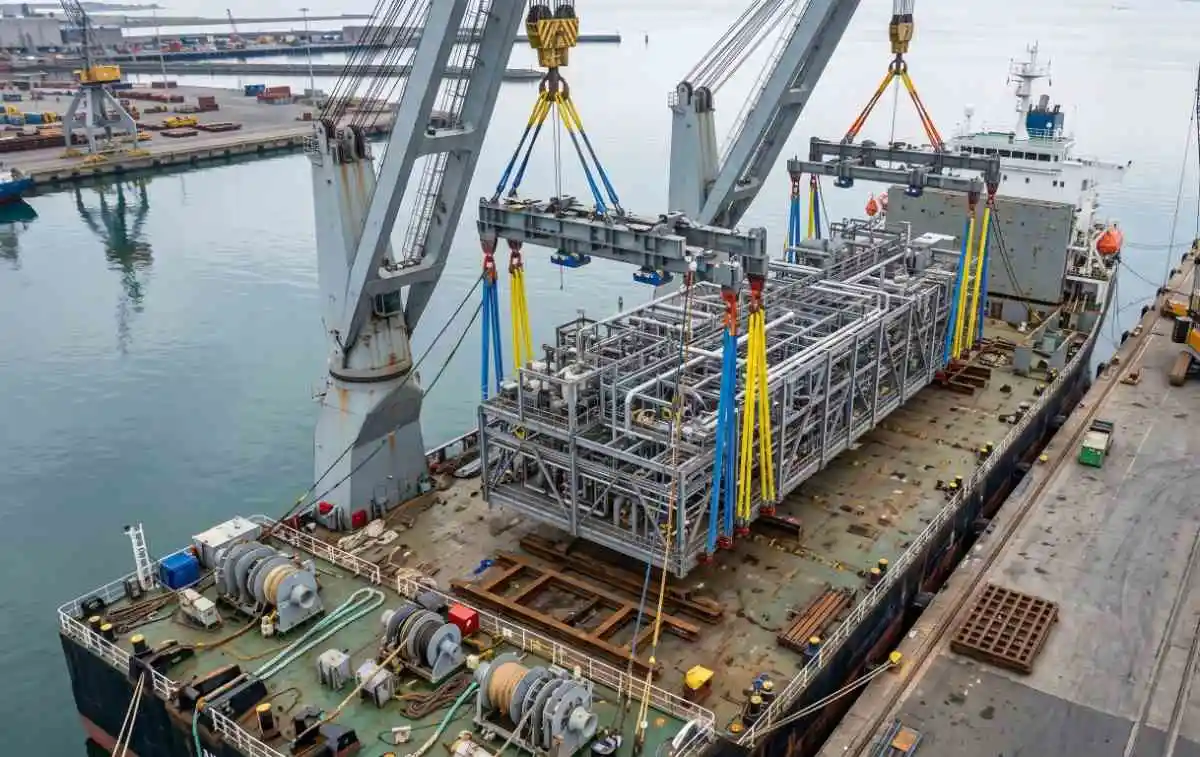
Modular rigging systems are another key component of this technical shift toward efficiency. Modulift expanded its global distribution network in late 2025, launching a new range of high capacity modular spreader beams that can handle loads up to 5,000 tonnes. These beams can be reconfigured for different cargo shapes and weights, reducing the need for custom manufactured rigging for every project. This flexibility is essential for the rapid deployment of specialized equipment in the global energy sector, where project timelines are often extremely tight.
Companies like Mammoet have been at the forefront of this modular trend, utilizing standardized components in their record breaking lifts. In February 2026, Mammoet successfully utilized its super heavy lift cranes in complex configurations for major infrastructure projects, demonstrating the extreme flexibility that modern rigging solutions provide. The use of high strength synthetic slings in combination with modular beams allows for safer and more efficient operations, as ground crews can handle the lighter equipment with less physical strain and lower risk of injury.
Integration with Vessel Stability and Load Monitoring
Modern heavy lift ships are equipped with sophisticated stability systems that work in perfect tandem with the rigging equipment. As a crane begins to lift a 3,000 tonne module, the ship must automatically and instantaneously adjust its internal ballast to prevent a dangerous list. Innovative rigging solutions for heavy lift ships now include high precision sensors, such as load cells and inclinometers, that feed real time data directly into the vessel’s central stability computer. This integration ensures that the ship and the rigging are always working as a single, coordinated system.
Liebherr accelerated the development of its intelligent crane control systems in early 2026, focusing on the seamless integration of load data with vessel automation. These systems provide the operator with a comprehensive view of the entire lift, including the exact tension in every sling and the stability margin of the vessel. The use of load cells integrated directly into the shackles allows engineers to monitor the exact tension in every part of the rigging. If an imbalance is detected, the system can provide an immediate alert to the operator or make autonomous adjustments to the leveling systems.
Precise rigging design is also highly dependent on environmental data, often gathered by optimizing route surveys for super heavy loads before the voyage begins. By understanding the exact forces that a cargo will encounter during a long ocean transit, engineers can design seafastening and rigging systems that are perfectly optimized. This balanced approach is crucial for maintaining vessel stability, reducing fuel consumption, and ensuring the absolute safety of the high value cargo throughout its journey across the world.
The Role of Digital Twins and 3D Simulation in Rigging
The use of digital twins and high fidelity 3D simulation has become standard practice for all complex rigging operations:
-
Virtual Pre-Lift Simulation: Engineers simulate the entire lifting sequence in a digital environment modeling real-world physics, including wind and gravity.
-
Proactive Hazard Detection: Digital testing reveals clash points and structural stress concentrations that traditional 2D drawings often miss.
-
Enhanced Safety & De-Risking: Upfront digital preparation provides an essential layer of risk mitigation for multi-million-dollar heavy-lift vessel operations.
Furthermore, the development of specialized remote rigging tools allows engineers to perform complex connections and disconnections from a safe distance, particularly during hazardous weather. These tools, often equipped with high definition cameras, provide the operator with a level of situational awareness that was previously impossible. This trend toward remote and autonomous operation is driven by a deep commitment to personnel safety and operational resilience. By removing humans from the most dangerous parts of the lifting cycle, the industry is setting new benchmarks for safety in demanding work environments.
The successful integration of these technologies into the daily operations of heavy lift ships will be the ultimate proof of the industry’s ability to innovate and adapt. As the scale of global industrial projects continues to grow, the innovation in rigging technology will remain a central, defining pillar of the maritime logistics sector. Transport Advancement believes that the development of even more advanced materials and automated systems will continue to push the boundaries of what is possible, enabling the construction of the massive infrastructure required for a sustainable future.
References
- “How Four Point Spreader Beam Works — In One Simple Flow 2025” – LinkedIn
- “Project Logistics Market Size, Share | Growth Report [2034]” – Fortune Business Insights
- “Enerpac Launches Synchronized Hoist for Maritime Heavy Lift” – Enerpac News
- “Huisman Deploys Motion Compensated Cranes for Offshore Wind” – Huisman Press Release
- “Modulift Expands Range for Super Heavy Lifts” – Modulift Newsroom
- “Giant Mammoet cranes for national museum construction” – Crane & Transport Briefing
- “Liebherr Advances Intelligent Crane Control for Heavy Lift” – Liebherr
- “DP WORLD REPORTS RECORD $24.4 BN REVENUE AND $6.4BN EBITDA FOR 2025” – DP World
- “XCMG Delivers Hybrid Mobile Crane XCA60_EV to Mammoet” – PA Media
