





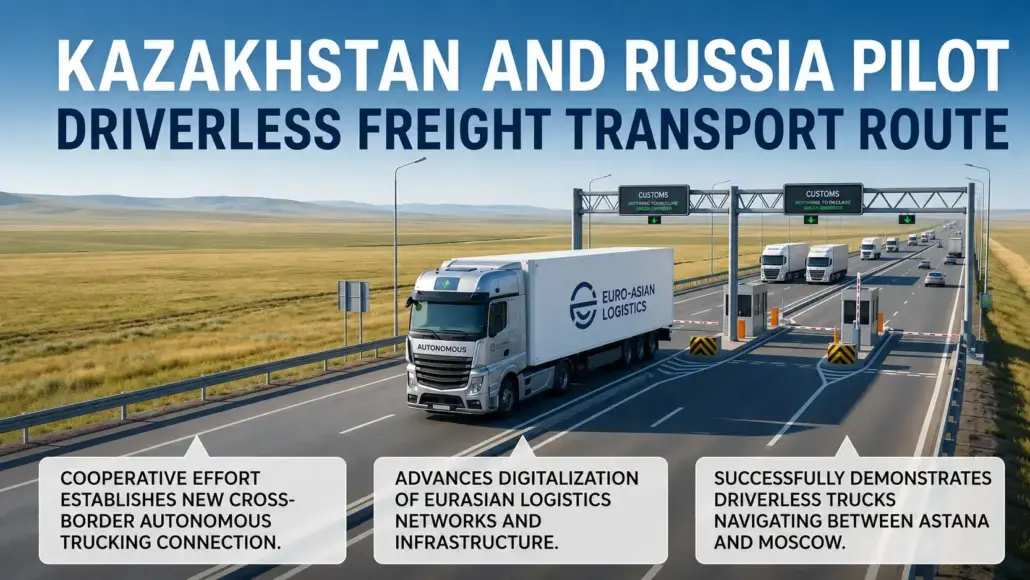
Kazakhstan and Russia have officially launched a pilot project for driverless freight transport route, signaling a new era for the digitalization of Eurasian logistics and cross-border infrastructure. The announcement was made by Kazakhstan’s President Kassym-Jomart Tokayev following discussions with Russian President Vladimir Putin.
President Tokayev emphasized the critical role of transport connectivity for both nations in facilitating the delivery of goods to both domestic and international markets. He highlighted ongoing efforts by Kazakhstan and Russia to enhance transcontinental transport corridors, specifically along the North-South and East-West routes, as part of a broader strategy to strengthen Eurasian connectivity.
“It is encouraging that systematic measures are being taken to optimize tariffs, simplify administrative procedures, and modernize border infrastructure, resulting in steady growth in cargo transportation volumes,” Tokayev said.
Last year, freight volumes between the two countries reached approximately 92 million tons, representing an increase of nearly 3.5%.
“We plan to continue increasing these indicators, including through the introduction of advanced digital solutions and artificial intelligence technologies. A clear example is today’s launch of driverless freight vehicles between our countries,” Tokayev added.
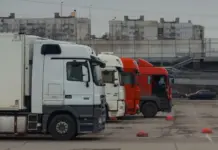
Speaking on the sidelines of the Eurasian Economic Forum, Kazakhstan’s Vice Minister of Transport, Damir Kozhakhmetov stated that driverless freight transport route is operational between Astana and Moscow.
The innovative driverless freight transport route initiative is viewed as a reflection of the robust bilateral relations between Kazakhstan and Russia.
“Relations between Kazakhstan and Russia have stood the test of time and are now successfully responding to the challenges of a new era,” said Toyakev.
Following the discussions in Astana, Kazakhstan and Russia signed a joint declaration outlining seven principles of friendship and good neighborliness. Additionally, an intergovernmental agreement was executed detailing the terms and conditions for cooperation on the construction of the nuclear power plant, along with an agreement for a Russian state export loan to finance the project.
