










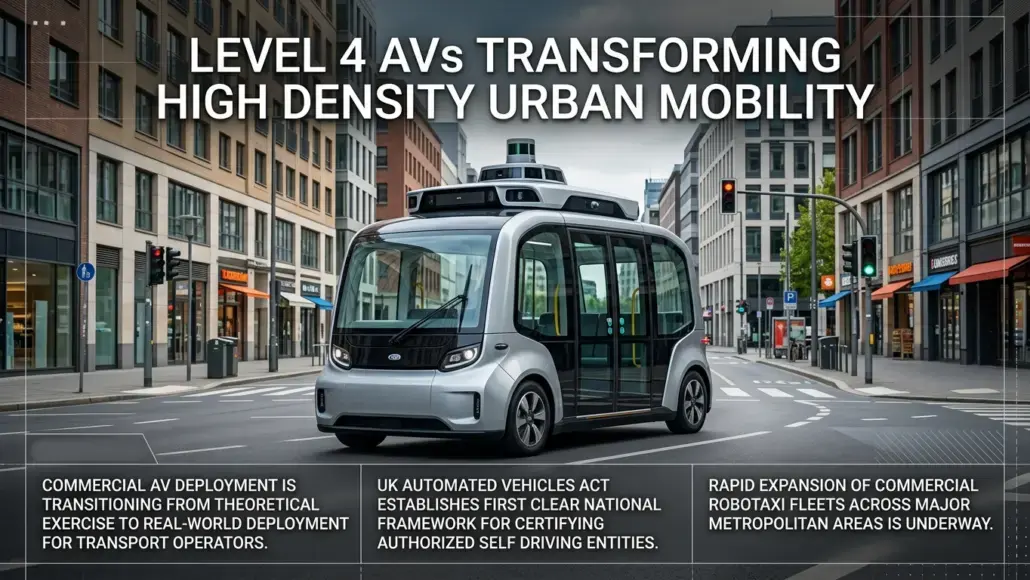
The commercial deployment of highly automated driving systems is no longer a distant theoretical exercise for urban planners and transport operators. In early 2026, the global transport industry witnessed a significant shift as the UK Automated Vehicles Act reached full implementation, establishing the first clear national framework for certifying Authorized Self Driving Entities. This legislative milestone coincides with the rapid expansion of commercial robotaxi fleets across major metropolitan hubs, where vehicles operating at SAE Level 4 are moving beyond restricted pilots into high density environments. The successful integration of these technologies depends on a complex interplay between digital infrastructure, municipal regulation, and the physical constraints of the urban landscape. Business leaders and municipal authorities are now prioritizing the technical and operational foundations required to support thousands of autonomous units within existing transit ecosystems.
Commercial scaling in 2024 and 2025 demonstrated that Level 4 systems can achieve operational break even when deployed at scale in managed urban zones. In Wuhan, the Baidu Apollo Go project expanded its commercial footprint to cover over 3,000 square kilometers, serving a population of more than 7.7 million residents with a fleet of over 1,000 autonomous units. This expansion highlights a critical trend where high density cities are becoming the primary proving grounds for the commercial viability of autonomous mobility as a service. As these fleets grow, the industry is shifting its focus from basic vehicle performance to the systemic challenges of fleet management, infrastructure connectivity, and public transit interoperability.
The Digital Foundation of Urban Autonomy
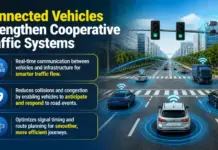
The transition to Level 4 AVs requires a fundamental upgrade to the digital fabric of the city. While early autonomous prototypes relied almost exclusively on onboard sensor suites, the current generation of commercial vehicles utilizes a combination of vehicle to everything communication and high definition mapping to navigate complex urban canyons. The release of the National V2X Deployment Plan by the USDOT in August 2024 set clear targets for the rollout of cellular vehicle to everything infrastructure across the top 75 US metro areas. This plan aims to equip 25 percent of signalized intersections with connected roadside units by 2028, eventually reaching 100 percent coverage by 2036. For transport operators, this connectivity is essential for managing signal phase and timing data, which allows autonomous fleets to anticipate light changes and optimize energy consumption.
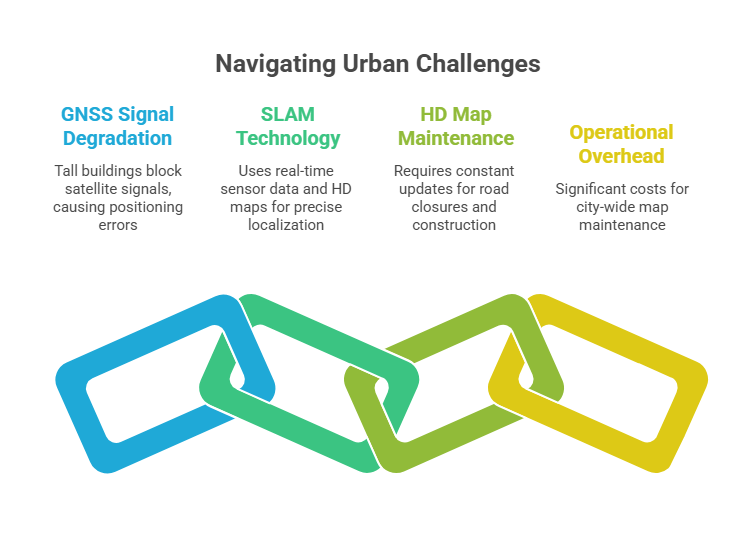
High density environments present unique technical hurdles for autonomous navigation. Urban canyons created by tall buildings can cause significant degradation of global navigation satellite system signals, leading to positioning errors that can disrupt vehicle operations. To counter this, operators are deploying compute heavy simultaneous localization and mapping technologies that cross reference real time sensor data with static high definition maps. This approach ensures that vehicles remain localized within centimeters, even when satellite signals are blocked. However, the maintenance of these digital maps requires constant updates to reflect temporary road closures, construction zones, and changes in lane markings. The operational overhead of maintaining these maps at a city wide scale represents a significant recurring cost for Level 4 AV operators.
Regulatory Frameworks and Liability Management
Clear legal and regulatory frameworks are the primary catalysts for institutional investment in autonomous mobility. The UK Automated Vehicles Act 2024 provides a blueprint for how governments can manage the transition by shifting liability from the human passenger to the entity that authorized the self driving system. This legal clarity allows insurance providers to develop specialized products for autonomous fleets, reducing the financial risk for large scale operators. Furthermore, the certification of Authorized Self Driving Entities ensures that only companies meeting rigorous safety and cybersecurity standards can operate on public roads. These regulatory developments are mirrored in the European Union, where the implementation of the UNECE R155 and R157 regulations has created a standardized approach to cybersecurity and automated lane keeping systems.
Safety validation remains a central concern for both regulators and the public. In 2024, Waymo One surpassed 150,000 commercial trips weekly, providing a massive dataset that demonstrates the safety advantages of autonomous systems in preventing human error related accidents. According to data from the McKinsey Center for Future Mobility, shared autonomous mobility is projected to generate between 300 billion and 400 billion dollars in revenue by 2035. As the cost per mile for robotaxis falls toward a target of 1.00 to 1.50 dollars by 2030, the economic incentive to replace human driven services becomes undeniable. Nevertheless, the regulatory landscape remains fragmented across different jurisdictions, requiring operators to navigate a patchwork of local, state, and national mandates.
Infrastructure Integration and Curbside Management
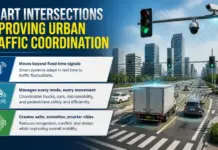
The physical integration of Level 4 AVs into high density cities requires a rethink of how curbside space is allocated. Traditional parking models are often incompatible with the needs of autonomous fleets, which require designated pick up and drop off zones to prevent traffic congestion. Municipalities are increasingly adopting dynamic curbside management systems that use digital twins to monitor and allocate space in real time. These systems allow autonomous vehicles to reserve spots for passenger exchanges, reducing the amount of time spent idling in active traffic lanes. The lack of standardized digital pick up and drop off management remains a bottleneck in many cities, leading to localized congestion during peak travel periods.
Depot infrastructure is also evolving to meet the needs of autonomous fleets. Large scale deployments require specialized facilities equipped with high power electric vehicle charging, automated sensor calibration systems, and teleoperation centers. The auxiliary load from Level 4 AV sensor and compute systems can draw between 0.5 and 2.5 kilowatts of continuous power, resulting in a 12 to 20 percent range penalty for electric autonomous vehicles. This necessitates the installation of 1 to 5 megawatt fast charging infrastructure at centralized depots to support fleets of 50 vehicles or more. The high capital expenditure required for these facilities is driving a new market for depot as a service providers, where infrastructure firms build and manage the necessary charging and maintenance hardware for multiple autonomous operators.
Integrating Autonomous Feeder Services with Mass Transit
One of the most promising applications for Level 4 AV technology is the creation of autonomous feeder services that link suburban neighborhoods to high capacity metro stations. In Hamburg, the Project ALIKE initiative is testing Volkswagen ID. Buzz AD shuttles that are directly integrated into the public transit framework of the Hamburger Hochbahn. This model allows passengers to book a shared autonomous ride through a single mobility as a service platform, providing a seamless transition between light autonomous vehicles and heavy rail. The effectiveness of these autonomous links is often enhanced by a robust ecosystem of light electric transport, which is explored in the companion analysis on scaling micromobility operations for urban operators. By automating the first and last mile of a journey, transit agencies can significantly increase the catchment area of their rail networks without the high cost of expanding fixed bus routes.
Technical Challenges and Operational Resilience
Despite the rapid progress, several technical and operational challenges persist. Teleoperation latency remains a critical issue, particularly during edge case disengagements where a vehicle requires human intervention to navigate a complex situation. While 5G networks provide the necessary bandwidth for video streaming, cellular handoff bottlenecks in dense urban environments can still lead to momentary signal drops. Operators are addressing this by implementing multi carrier connectivity and edge computing nodes that minimize the distance between the vehicle and the teleoperator. The ability to maintain a stable connection is a prerequisite for safety certification in many urban jurisdictions.
Cybersecurity is another primary concern for autonomous fleet operators. The interconnected nature of V2X systems and cloud based fleet management platforms creates a wide attack surface for potential cyber threats. Compliance with the UNECE R155 regulation for cybersecurity management systems is now mandatory for new vehicle types in many markets. This requires operators to implement robust monitoring and response capabilities to detect and mitigate unauthorized access to vehicle control systems. As autonomous vehicles become a core component of municipal infrastructure, the resilience of these digital systems is a matter of national security and public safety.
Real-World Commercialization: Key Deployments in Urban Autonomous Mobility
The commercial integration of Level 4 AV driving into dense metropolitan environments has accelerated through major fleet deployments, cross-industry partnerships, and next-generation vehicle rollouts. Waymo expanded its commercial robotaxi footprint by extending operations to high-density hubs like London and partnering to integrate autonomous rides into transit networks, supported by multi-billion-dollar scale-up rounds. Concurrently, Uber Technologies cemented its position as a central mobility platform for Level 4 AVs by partnering with OEMs and AV specialists like Lucid, Nuro, and WeRide to deploy tens of thousands of commercial robotaxis across major international markets.
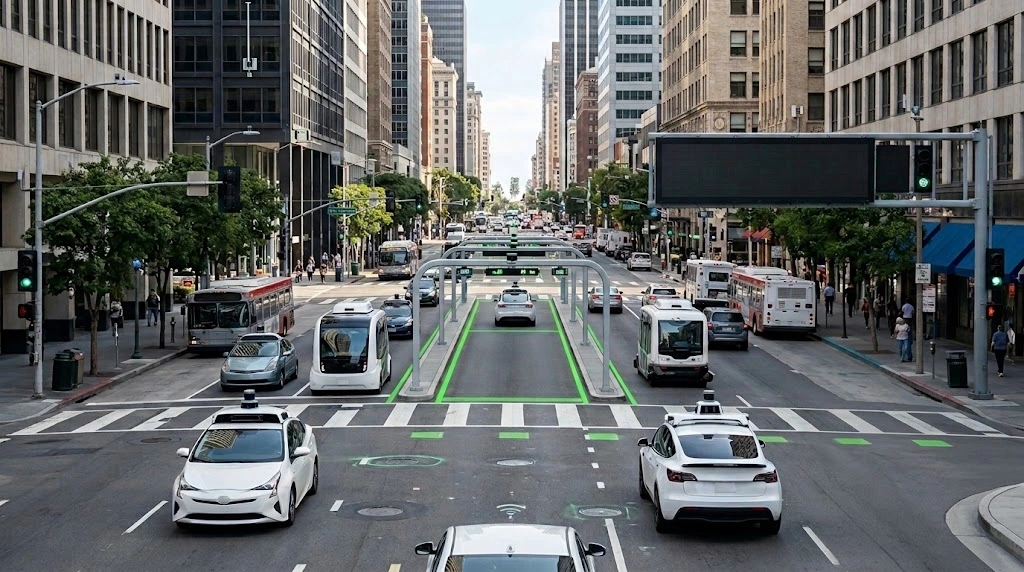
In Asia and the Middle East, WeRide obtained commercial permits to launch driverless operations for its purpose-built GXR robotaxi across Tier 1 hubs like Beijing and Guangzhou while scaling autonomous fleets to international cities including Dubai and Riyadh. Simultaneously, Pony.ai achieved key operational benchmarks toward commercial sustainability by unveiling its Seventh-Generation mass-produced robotaxi lineup and attaining city-wide unit economics breakeven in dense metropolitan environments such as Guangzhou. Finally, Baidu (Apollo Go) continued scaling commercial autonomous services by deploying hundreds of mass-produced, steering-wheel-detachable Apollo RT6 Level 4 AV electric vehicles across dense urban centers like Wuhan and expanding commercial footprints internationally.
The Strategic Path Toward Full Urban Autonomy
The integration of Level 4 AVs into high density cities is a long term strategic transition rather than a sudden technological shift. Success requires a collaborative approach involving vehicle manufacturers, technology providers, infrastructure firms, and municipal governments. The focus is now shifting toward the creation of standardized open data architectures that allow different autonomous systems to communicate with city infrastructure and with each other. This interoperability is vital for preventing vendor lock in and for ensuring that autonomous mobility can be managed as a public good.
Industry leaders are also focusing on the long term sustainability of autonomous operations. While the initial capital expenditure for autonomous hardware remains high, with premiums of 80,000 to 150,000 dollars per vehicle, the falling costs of sensors and the increasing efficiency of compute platforms are improving the ROI. The environmental benefits of optimized driving patterns and the transition to electric autonomous fleets are also key drivers for municipal adoption. As cities move toward their net zero goals, the role of autonomous shared mobility in reducing congestion and emissions will become increasingly important.
The commercial deployment of Level 4 AVs is transforming the landscape of urban transport. The combination of legislative progress, infrastructure investment, and technological refinement is creating a viable path for large scale operations in high density environments. By addressing the technical hurdles of V2X connectivity, curbside management, and system resilience, the transport industry is laying the groundwork for a more efficient and integrated urban mobility ecosystem. The next several years will be defined by the transition from localized trials to the full commercial integration of autonomous fleets into the heart of the world’s major cities.
References
- Baidu
- McKinsey Center for Future Mobility
- UITP
- European Investment Bank
- ABI Research
- MOIA
- IEA
- UK Department for Transport
Waymo
