

















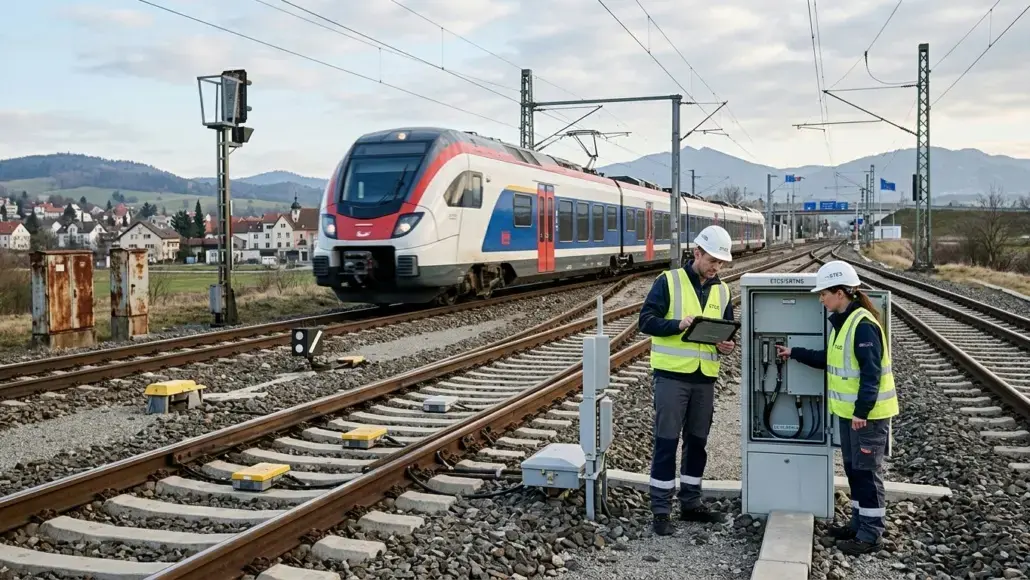
The historical development of the European railway network was largely a national endeavor, with each country designing its own signaling systems, track gauges, and safety protocols. This fragmented landscape resulted in a complicated siyuation of over twenty different signaling systems across the continent, creating a massive barrier to international rail travel and freight. For a train to travel from Paris to Berlin, it often required multiple locomotives or specialized drivers trained in different national rules, leading to significant delays and increased costs. Transport Advancement highlights that the introduction of ETCS Technology has fundamentally changed this dynamic. It is acting as a universal digital language that enables seamless rail interoperability across international corridors, thereby unlocking the full potential of a unified global rail network.
The Challenge of Fragmentation in Cross-Border Rail
Rail interoperability is the ability of a train to operate safely and efficiently across different infrastructure networks without the need for technical or operational changes at the border. Before the advent of ETCS Technology, crossing a border was a complex logistical challenge. Each national system had its own unique hardware—magnets, beacons, and relays—that were incompatible with those of its neighbors. This meant that international rail was often slower and more expensive than road or air transport, despite being more environmentally friendly. The lack of standardized signaling prevented the creation of a truly integrated market for rail services, stifling competition and limiting the choices available to passengers and freight forwarders.
Standardizing the Signaling Language with ETCS
ETCS Technology was developed specifically to solve the problem of fragmentation. By providing a single, standardized signaling protocol, it allows a train equipped with an ETCS on-board unit to communicate with any ETCS-compliant trackside infrastructure, regardless of the country it is in. This plug-and-play capability is essential for the creation of the Trans-European Transport Network (TEN-T) corridors. With ETCS, the movement authority—the digital permission for a train to proceed—is transmitted in a universal format that every train understands. This standardization eliminates the need for expensive multi-system locomotives and ensures that safety standards are consistent across the entire international rail corridor.
Facilitating Single Driver Operations Across Borders
One of the most immediate benefits of ETCS Technology for rail interoperability is the simplification of driver requirements. In the legacy era, a driver often had to be certified in the specific signaling rules of every country they entered. With ETCS, the human-machine interface (HMI) is standardized. The information displayed on the driver’s screen looks the same in Poland as it does in Spain. This reduces the training burden on rail operators and allows for more flexible staff scheduling. By making the signaling system transparent to the operator, ETCS supports the creation of a truly international workforce of rail professionals who can operate across borders as easily as a truck driver or an airline pilot.
Enhancing Freight Competitiveness in Global Supply Chains
For the global logistics industry, time and predictability are the most valuable commodities. International rail freight has traditionally struggled to compete with shipping and trucking due to the friction of border crossings. ETCS Technology significantly reduces this friction. By allowing freight trains to bypass the traditional locomotive changes at the border, ETCS can shave hours or even days off a long-distance journey. This improved reliability makes rail a much more attractive option for high-value goods and just-in-time supply chains. Furthermore, because ETCS allows for longer and heavier trains to run safely, it improves the economies of scale for rail freight, lowering the cost per ton-mile and helping to shift cargo from road to rail.
The Role of GSM-R and FRMCS in Global Connectivity
Rail interoperability is not just about the data on the screen. It is also about the communication infrastructure that carries it. ETCS Technology relies on a standardized radio network—originally GSM-R and now transitioning to the Future Railway Mobile Communication System (FRMCS) based on 5G. This common communication backbone ensures that trains can always stay in contact with the regional control centers, even when moving between different telecommunications providers at national boundaries. FRMCS provides the high-bandwidth, low-latency connectivity required for advanced features like real-time video surveillance and predictive maintenance, further enhancing the attractiveness of international rail corridors for modern logistics and passenger travel.
Promoting Competition and Innovation in the Rail Market
A standardized system like ETCS Technology also fosters a more competitive and innovative rail market. In the past, rail operators were often locked in to a single manufacturer who supplied both the infrastructure and the rolling stock for a national network. Rail interoperability breaks this monopoly. Because ETCS is an open standard, any certified manufacturer can build compliant equipment. This interchangeability allows rail operators to source their locomotives and signaling units from a wider range of suppliers, driving down costs and encouraging the development of new technologies. This competitive environment is vital for keeping the rail industry at the cutting edge of the broader transportation market.
Integrating with Global Logistics Corridors Beyond Europe
While ETCS originated in Europe, its success has made it the global benchmark for rail interoperability. Major rail projects in the Middle East, Asia, and North Africa are now adopting ETCS Technology as the foundation for their new international corridors. For example, the massive rail networks being built as part of the Belt and Road Initiative or the GCC Railway in the Persian Gulf utilize ETCS to ensure that trains from different national operators can share the same tracks seamlessly. This global adoption is creating a worldwide standard of excellence, where a locomotive built for a network in Riyadh could, in theory, operate on a line in Rotterdam or Shanghai, provided the technical interfaces are aligned.
The vision of a borderless railway is becoming a reality thanks to the steady deployment of ETCS Technology. As the digital backbone of the world’s most important rail corridors, ETCS is doing more than just controlling trains; it is stitching together the economies of different nations and providing a sustainable, high-speed alternative for global transport. In an increasingly connected world, Transport Advancement believes that the ability to move people and goods effortlessly across borders is the hallmark of a modern civilization, and ETCS is the technology making that possible.
