












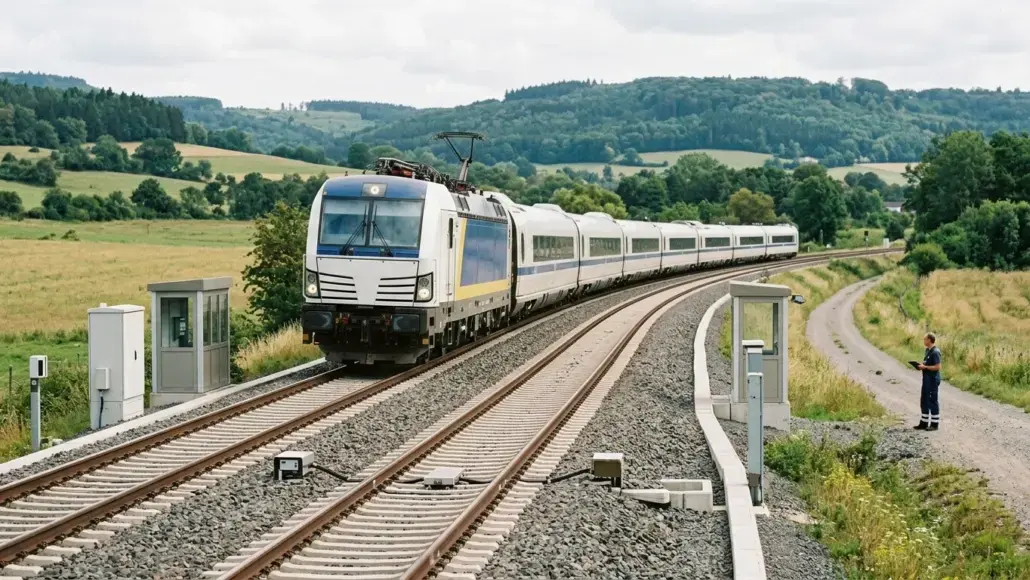
The transition from traditional, hardware-heavy railway management to a software-defined Digital Railway is the most significant leap the industry has taken since the replacement of steam with electricity. In this new era, the railway is no longer just a collection of steel and concrete; it is a sophisticated, data-driven ecosystem where every train, track sensor, and control center is connected in real-time. At the heart of this transformation lies the combination of ETCS and Digital Railways. Transport Advancemenet highlights that by providing a high-fidelity, standardized digital signaling backbone, ETCS serves as the essential operating system upon which the entire suite of smart train operations is built, enabling a level of precision, safety, and efficiency that was previously unimaginable.
From Mechanical Interlockings to the Software-Defined Grid
The concept of a Digital Railway refers to the integration of advanced telecommunications, computing power, and automation into the rail network. Historically, railways were controlled by mechanical or electrical interlockings that were physically hard-wired to signals and points. These systems were reliable but incredibly rigid. Any change in the timetable or a minor disruption would ripple through the network, causing significant delays because the system lacked the flexibility to adapt. ETCS and Digital Railways break this rigidity. By moving the logic of train control from trackside relays to centralized servers and onboard computers, the network becomes a dynamic grid that can be reconfigured in software to respond to real-time conditions.
The Role of ETCS in Providing High-Fidelity Data
Smart train operations require high-quality data. To optimize a train’s journey, the control system needs to know its exact position, speed, and braking capability with centimeter-level accuracy. Traditional track circuits only provide a binary signal—whether a block is occupied or not. ETCS and Digital Railways provide much more. Via the continuous radio link (Level 2 or 3), the train reports its state back to the control center several times per second. This closed-loop communication provides the granular data needed for advanced traffic management systems (TMS). With this information, the TMS can calculate the conflict-free path for every train on the network, minimizing wait times at junctions and ensuring that the entire grid operates like a finely tuned clock.
Enabling Automatic Train Operation (ATO) over ETCS
One of the most visible results of combining ETCS and Digital Railways is Automatic Train Operation (ATO). While the idea of driverless trains is common in closed metro systems, implementing it on the complex open networks of high-speed and freight rail is a different challenge. ETCS provides the safety-critical layer (the ATP) that prevents collisions, while the ATO layer focuses on the driving strategy. Together, they allow the train to follow a mathematically optimized speed profile. This results in smart train operations where the computer can account for variables like track gradient, wind resistance, and the exact position of the train ahead to ensure the most efficient journey possible. This not only improves punctuality but also reduces mechanical wear on the train’s traction and braking systems.
Predictive Maintenance and the Internet of Trains (IoT)
A digital railway is also an Internet of Trains. When every train is equipped with an ETCS onboard unit and a high-speed data link (FRMCS/5G), the train becomes a mobile sensor platform. As the train travels, it can monitor the health of the track, the overhead lines, and its own internal components. This data is transmitted back to a central digital twin of the railway. Through AI and machine learning, operators can predict when a component is likely to fail before it actually does. This shift from reactive to predictive maintenance is a cornerstone of smart train operations, significantly reducing the downtime caused by unexpected equipment failure and extending the life of multi-million dollar assets.
Real-Time Passenger Information and Experience
The benefits of ETCS and Digital Railways extend directly to the passenger. In a legacy system, information about delays is often lagged and inaccurate because it is based on manual reports or infrequent track sensors. In a digital railway, the where and when of every train is known exactly. This allows for hyper-accurate real-time updates on mobile apps and station displays. Furthermore, because the digital backbone (FRMCS) can support high-bandwidth passenger Wi-Fi alongside safety-critical data, the journey itself becomes more productive and enjoyable. Smart operations mean that the train is not just a mode of transport, but a connected workspace or entertainment hub that seamlessly integrates with the passenger’s digital life.
Optimizing Network Resilience through Digital Traffic Management
Perhaps the most critical function of ETCS and Digital Railways is managing the recovery from disruptions. In a traditional rail network, a single broken-down train can paralyze an entire region because the analog controllers cannot easily visualize alternative routes or adjust the speeds of dozens of other trains simultaneously. A digital railway uses Automated Traffic Management to simulate thousands of scenarios in seconds. When a problem occurs, the system presents the controller with the optimal solution, such as rerouting a freight train to a loop or adjusting the arrival times of connecting passenger services. This digital resilience ensures that small incidents do not escalate into network-wide collapses.
The Foundation for a Sustainable Moving Block Future
The ultimate evolution of the digital railway is the implementation of Moving Block signaling, made possible by ETCS Level 3. In this setup, the safety distance between trains is not fixed but dynamic, based on the real-time speed and braking performance of each train. This allows trains to follow each other much more closely—sometimes only a few hundred meters apart at high speed. This massive increase in capacity is achieved through software rather than concrete, making it the most sustainable and cost-effective way to grow the rail network. ETCS and Digital Railways are the only path to achieving this Moving Block future, which is essential for making rail the dominant mode of transport in high-density corridors.
The Future of ETCS in Smart Train Opeartions
The marriage of ETCS and Digital Railways is not just a technical upgrade; it is a fundamental reimagining of what a railway can be. By building this foundation today, we are creating a smart rail ecosystem that is safer, greener, and more responsive to the needs of a rapidly changing world. As the digital transformation continues to accelerate smart train operations, Transport Advancement believes that the railway will reclaim its position as the most advanced and efficient transport network on the planet.
