







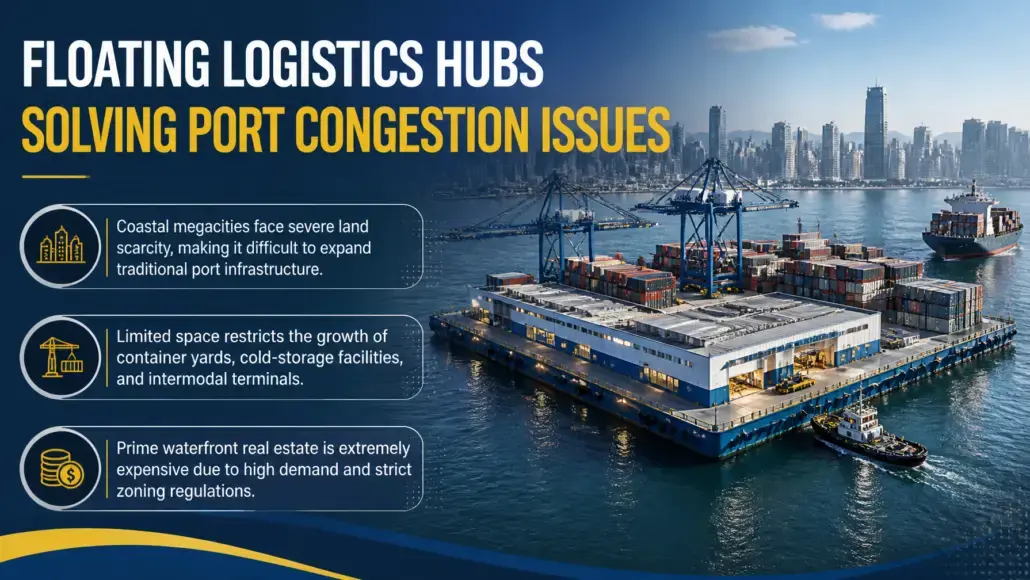
Rapid urbanization across international coastal corridors has precipitated a severe spatial crisis for traditional seaport infrastructure. Densely populated coastal megacities, including Singapore, Tokyo, Hong Kong, New York, and Rotterdam, face acute land scarcity that prevents the physical expansion of terrestrial container yards, cold-storage warehouses, and intermodal freight terminals. At the same time, commercial waterfront real estate commands prohibitive valuations as municipal zoning authorities prioritize residential towers, recreational public esplanades, and commercial developments over industrial port logistics.
Faced with geographic and political barriers to landward expansion, forward-thinking maritime authorities and industrial developers are looking seaward. Rather than embarking on environmentally destructive and contentious sand-fill reclamation projects, commercial operators are deploying large-scale modular floating logistics platforms. These engineered waterborne facilities function as self-contained offshore transshipment terminals, automated consolidation yards, and temperature-controlled distribution centers. Transport Advancement observes that by decoupling port capacity from terrestrial acreage, floating logistics hub operations provide coastal megacities with flexible, climate-resilient logistics space that adapts dynamically to evolving global trade flows.
Structural Engineering and Hydrodynamic Stability of Waterborne Hubs
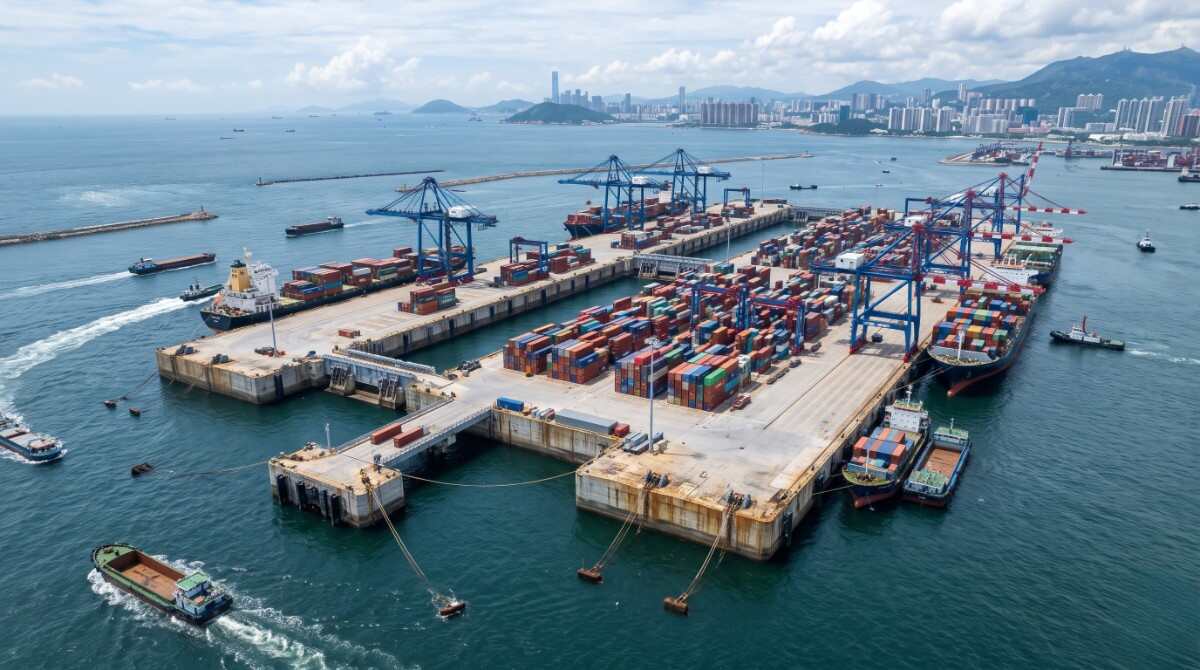
Modern floating logistics hubs utilize very large floating structure technology engineered to remain stable in exposed coastal waters over multi-decade operational lifecycles. Constructed from heavy-duty prestressed marine concrete or specialized corrosion-resistant steel pontoon modules, these modular structures measure hundreds of meters in length and provide tens of thousands of square meters of unobstructed deck space. Multiple pontoon units connect through flexible, fatigue-resistant mechanical hinges that dissipate wave energy while maintaining structural alignment across changing tides.
To ensure uninterrupted container and cargo handling, naval architects engineer specialized hydrodynamic damping systems:
- Submerged porous breakwaters and internal oscillating water columns attenuate incoming swell energy, maintaining deck accelerations within strict tolerances required for automated gantry cranes.
- High-capacity tension-leg mooring tendons and suction-embedded pile anchors secure floating platforms firmly in position without disturbing sensitive subsea marine ecosystems.
- Advanced ballast water management systems automatically shift fluid between interior hull compartments in real time, counterbalancing uneven weight distributions as heavy container-stacking vehicles move across the deck.
- Wave-compensating cargo transfer ramps bridge the dynamic interface between floating logistics platforms, conventional quaysides, and arriving ocean-going feeder vessels.
These hydro-structural innovations allow floating terminals to operate safely alongside deep-draft container vessels and coastal barges in high-traffic anchorages, achieving cargo transfer rates comparable to traditional shore-based container terminals. In addition, internal void spaces within the submerged concrete pontoons serve as automated subterranean storage vaults, housing high-capacity battery banks, automated material handling conveyors, and freshwater desalination plants that support zero-emission terminal operations.
Environmental, Climate, and Urban Planning Advantages
Shifting industrial logistics onto waterborne platforms resolves intense urban friction between commercial port operations and coastal municipal populations. Traditional container terminals generate intense diesel exhaust emissions, heavy highway congestion, and severe acoustic noise as thousands of heavy drayage trucks navigate city streets adjacent to residential neighborhoods. Floating logistics hubs relocate sorting, container consolidation, and bulk freight staging to offshore anchorages, diverting intermodal traffic away from congested urban highway corridors onto zero-emission electric water taxis and battery-powered short-sea container barges.
Climate resilience provides another powerful justification for floating maritime infrastructure. Fixed concrete quaysides, port rail heads, and coastal warehouses face escalating risks of catastrophic storm surge flooding and permanent inundation as global sea levels rise. Floating logistics hubs rise and fall naturally with astronomical tides and storm surges, remaining fully operational through extreme coastal weather events that would submerge conventional terrestrial port yards.
From an environmental sustainability standpoint, modular floating structures avoid the immense ecological disruption associated with traditional marine land reclamation. Dredging and filling near-shore seabeds destroys productive mangrove forests, smothers benthic coral communities, and permanently alters coastal sediment transport regimes. Conversely, floating platforms leave the underlying seabed largely undisturbed, allowing tidal currents to circulate freely beneath pontoon hulls while minimizing local environmental disruption.
Operational Complexities and Marine Legal Governance
Operating high-throughput commercial cargo hubs on waterborne platforms introduces unique logistical and administrative friction that terminal operators must resolve. Power delivery and utility connectivity require specialized infrastructure. Floating logistics hubs demand megawatts of continuous electrical power to operate automated stacking cranes, cold-storage refrigeration units, and shore-power connections for berthed vessels. Operators achieve this through high-voltage underwater power umbilical cables connected to the municipal grid, supplemented by onboard microgrids combining industrial battery storage, rooftop solar arrays, and auxiliary green hydrogen fuel cells.
Marine legal jurisdiction and regulatory classification present complex administrative hurdles. Traditional terrestrial warehouses fall under municipal zoning, building codes, and municipal property taxation frameworks. In contrast, floating logistics platforms occupy an ambiguous legal zone between maritime vessel regulations and civil infrastructure. Marine classification societies, including DNV and the American Bureau of Shipping, have established specialized structural class rules governing stationary very large floating structures, requiring rigorous non-destructive hull testing and corrosion monitoring protocols.
Supply chain velocity also requires meticulous scheduling of waterborne feeder movements. Because floating hubs lack direct highway connection, all cargo intake and distribution depends on marine barges, ro-ro lighters, or automated water taxis. Maintaining just-in-time delivery schedules for coastal megacities demands tight integration between automated terminal operating software and coastal vessel traffic management services.
To maximize carbon efficiency across near-shore waters and feeder routes, floating hub planners are designing transshipment berths to service vessels utilizing Wind-Assisted Propulsion Modernizing Merchant Shipping.
Economic Viability and the Future of Coastal Megacity Logistics
The economic lifecycle analysis for floating logistics hubs is fundamentally altering the mathematics of port expansion. Traditional land reclamation projects in coastal megacities require astronomical capital expenditures, often exceeding billions of dollars per square kilometer of new ground, and entail decade-long environmental impact reviews and political approvals. Conversely, modular floating platforms can be prefabricated efficiently in commercial shipyards under controlled industrial conditions, towed to coastal anchorages, and commissioned within eighteen to twenty-four months.
Furthermore, modular floating infrastructure provides unprecedented capital flexibility. If international trade lanes shift or municipal economic priorities change, a modular floating logistics hub can be disassembled, reconfigured, or towed to another deep-water port, preserving asset value and eliminating the risk of stranded terrestrial real estate investments. Transport Advancement notes that as coastal megacities continue to expand and waterfront land values climb, floating logistics hub operations will serve as vital commercial lifelines, unlocking scalable maritime capacity while preserving fragile coastal environments.
