




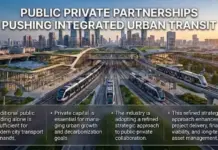
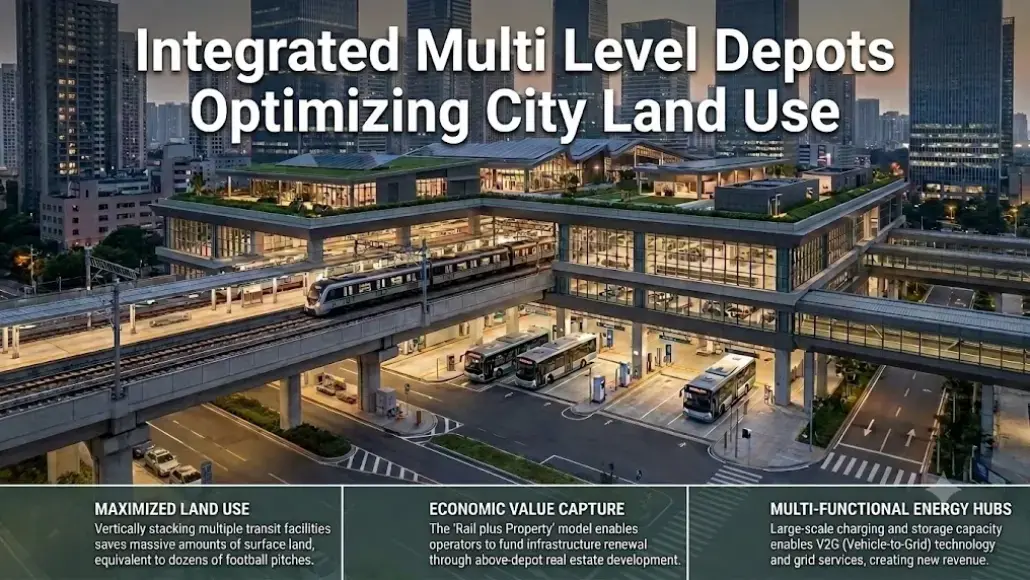
The chronic scarcity of land in the world’s most densely populated cities is forcing a radical reimagining of how essential transport infrastructure is designed and integrated into the urban fabric. Traditionally, rail and bus depots were treated as industrial cost centers, occupying vast surface level footprints on the city periphery. However, in early 2026, the global transport industry is embracing a new paradigm where these facilities are transformed into high yield, multi functional assets. By building integrated multi level depots optimizing city land use, transit agencies and urban developers are unlocking billions in real estate value while significantly reducing the capital expenditure required for separate infrastructure projects.
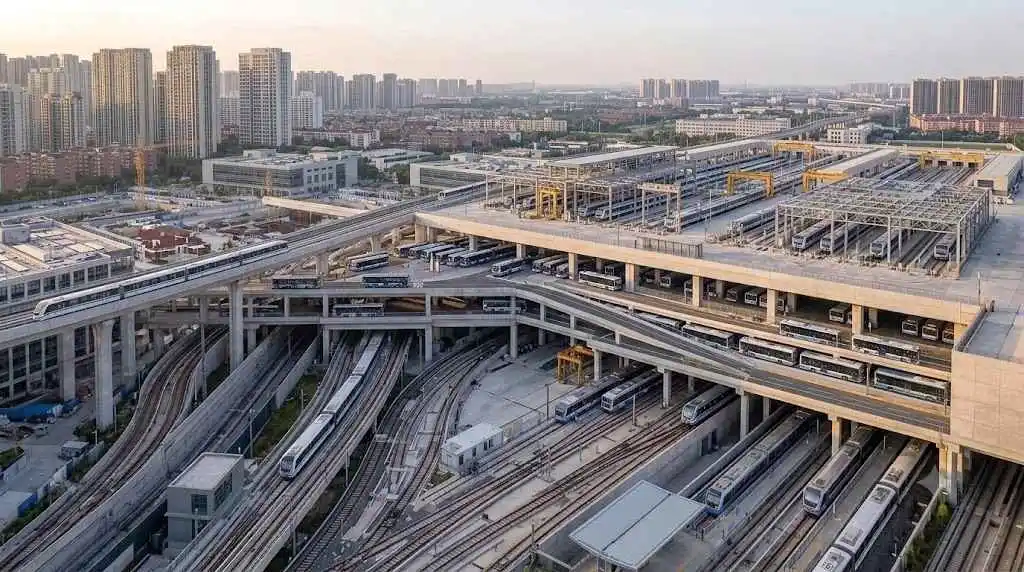
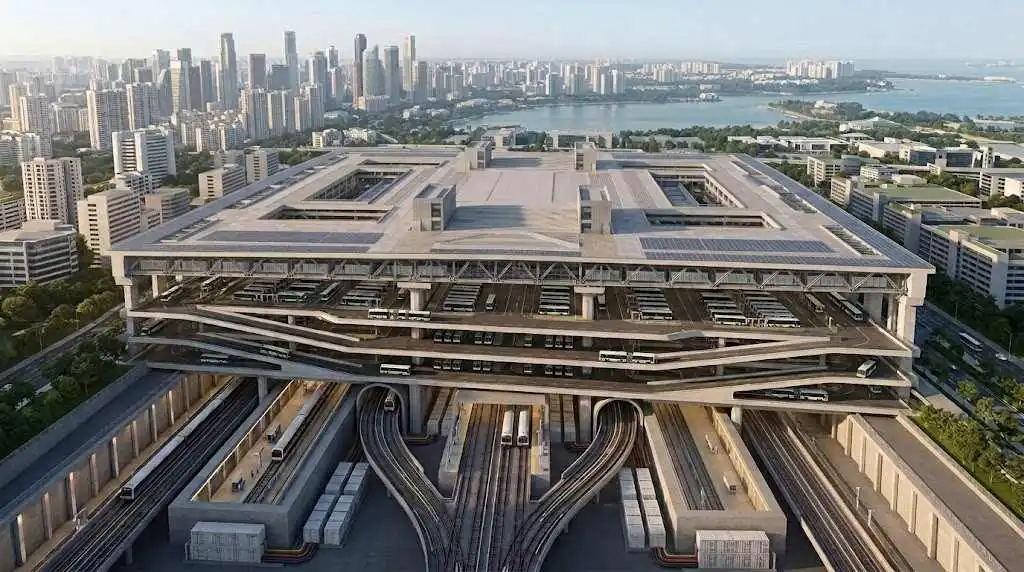
The economic and spatial benefits of integrated multi level depots are demonstrably substantial. In Singapore, the East Coast Integrated Depot, which became fully operational across its multiple tiers in 2025 and 2026, serves as a global benchmark. By stacking three MRT train lines and a multi storey bus depot within a single 36 hectare site, the Land Transport Authority saved 44 hectares of land, equivalent to 60 international football pitches. This consolidation also resulted in an estimated capital saving of 2 billion Singapore dollars compared to the cost of constructing four separate facilities. Such efficiencies are critical for cities that must expand their transit capacity without encroaching on greenfield reserves or precious housing land.
The Rail plus Property Model and Land Value Capture
The integration of commercial and residential real estate with transit maintenance facilities is a core component of the most successful urban development strategies. Hong Kong’s MTR Corporation has pioneered the Rail plus Property mechanism, which enables the transit operator to fund its entire capital construction and renewal program through the development of land above its stations and depots. A primary example is the Siu Ho Wan Depot redevelopment, where an engineered transfer podium slab is being constructed over 30 hectares of active rail tracks. This project will eventually support a new community of 20,000 apartments, schools, and 300,000 square feet of retail space, all financed via land value capture.
Integrated multi level depots transform what was once a single use industrial liability into a vibrant urban ecosystem. By capturing the increased value of the land generated by the presence of high capacity transit, operators can achieve an internal rate of return uplift of 250 to 400 basis points over standalone infrastructure projects. For B2B stakeholders, this creates significant opportunities for consortium partnerships between transit agencies, institutional infrastructure funds, and private real estate developers. The ability to link the long term asset lifecycle of a railway to the shorter term returns of property development is a powerful driver of modern urban investment.
Vertical Engineering for Electric Bus Fleets
As cities transition to zero emission transport, the space requirements for bus maintenance are increasing significantly. Electric bus fleets typically require 15 to 30 percent more ground surface area than conventional diesel fleets when operating from single level depots, due to the need for DC fast charging cabinets, pantograph gantries, and fire separation corridors. To address this, many transit agencies are moving toward multi storey vertical bus depots. These facilities can reduce the required ground land footprint by 60 to 75 percent per stabled vehicle.
Singapore’s Gali Batu and Sengkang West bus depots exemplify this trend. The Gali Batu facility is a five storey structure capable of parking 715 buses, equipped with high power charging infrastructure and advanced smart load management systems. However, building vertically for electric buses introduces unique engineering challenges, particularly regarding the concentrated weight of heavy battery packs and the immense power demands of simultaneous charging. A multi hundred vehicle bus depot can require grid connection capacities ranging between 15 and 40 megawatts, necessitating the integration of heavy industrial substations directly within the building structure.
Overcoming Structural and Acoustic Challenges
The physical engineering of integrated multi level depots is a highly complex undertaking. Rail depots and bus maintenance floors require long, unobstructed spans to accommodate vehicle movements, whereas the residential or commercial towers built above them require tight, regular column grids. The solution is the construction of massive reinforced or post tensioned concrete transfer podium decks, which can be between 2.0 and 3.5 meters thick. These decks must support the immense weight of the buildings above while providing a stable foundation for the transit operations below. The structural cost of these decks can account for 25 to 40 percent of the total civil construction budget for the podium.
Acoustic and vibration isolation is another critical concern. Heavy rolling stock movements and rail switches generate pervasive structure borne vibrations that can transmit directly into upper residential floors, causing human discomfort and acoustic fatigue. Preventing this requires sophisticated engineering solutions, such as high performance floating slab tracks mounted on elastomeric bearings and sub ballast polyurethane mats. These measures can add 10 to 18 percent to the cost of the railway permanent way but are essential for maintaining the commercial value and livability of the topside real estate.
Fire Safety and Thermal Runaway in Enclosed Spaces
The transition to battery electric vehicles has introduced new safety risks that are particularly acute in enclosed, multi level environments. A battery thermal runaway event in a bus or train can generate intense heat exceeding 1,000 degrees Celsius and release toxic, explosive gases. In 2024, the Singapore Land Transport Authority publicly solicited new engineering solutions for the rapid extraction of burning electric buses from multi storey depots, as standard recovery trucks cannot operate within the low clearance indoor parking decks.
Ensuring safety in these facilities requires the installation of high capacity deluge sprinkler grids, thermal imaging surveillance, and dedicated explosion venting shafts. Modern vertical depots are also being designed with automated fire suppression systems and purpose built water immersion pits for battery containment. Compliance with these stringent safety standards is a mandatory requirement for securing insurance and regulatory approval for multi level transit projects. For B2B decision makers, the cost of these safety systems must be balanced against the significant land savings and real estate revenues generated by the vertical design.
Strategic Multi Party Governance and 3D Land Rights
The successful delivery of integrated depots requires navigating complex legal and governance frameworks. Unlike traditional projects, these developments involve multi tier property stratifications where different entities may own the subterranean rail tunnels, the ground level transit operations, and the above deck commercial air rights. Harmonizing the expectations of private developers, who focus on short term project returns, with the multi decade priorities of public transit agencies requires clear contractual risk allocation and structured ground leases.
Furthermore, many jurisdictions are modernizing their municipal zoning and cadastral regulations to support 3D volumetric property boundaries. Clear statutory frameworks defining shared structural maintenance liabilities and property taxation across 3D strata parcels are essential for unlocking institutional private capital. In cities like Vancouver and Paris, transit agencies are actively monetizing their former single level depot properties to generate reserves for fleet electrification, while simultaneously planning for more densified, multi level transit centers that integrate social housing and community infrastructure. Future proofing these multi level facilities also requires consideration of automated fleet requirements, particularly the technical hurdles of integrating Level 4 AVs into high density cities.
Energy Hubs and V2G Integration
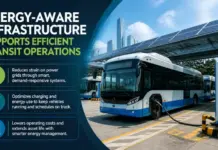
Integrated multi level depots offer a unique opportunity to create multi tenant energy hubs. The concentration of high capacity grid connections and large surface areas for solar PV arrays allows these facilities to act as central nodes in the local energy network. By co locating multi megawatt battery energy storage systems, operators can perform bi directional energy arbitrage and peak shaving, reducing their own energy costs while providing valuable grid balancing services.
The potential for Vehicle to Grid technology is particularly promising in the context of large bus depots. During periods of peak grid demand, the combined battery capacity of hundreds of electric buses can be used to feed power back into the network, providing an additional revenue stream for the transit operator. As cities move toward their net zero goals, the role of these energy hubs in supporting local grid stability and integrating renewable energy will become increasingly important. For infrastructure investors, the energy revenue potential adds another layer of financial attractiveness to the integrated depot model.
Strategic Operations and Engineering in Multi-Level Transit Depots
The transition toward space-saving, multi-level transit infrastructure is being heavily driven by major operators and construction firms maximizing urban land use. MTR Corporation Limited has advanced its Rail plus Property model by executing agreements for the Siu Ho Wan Depot, which integrates a massive engineered transfer podium to support high-density topside development directly above active rail maintenance yards.
In Singapore, SBS Transit Ltd recently commenced operations at the Sengkang West facility, a pioneering five-storey multi-level bus depot structurally designed to accommodate large-scale electric bus charging and on-site staff housing. Supporting this infrastructure, BYD Company Limited deployed its latest fleet of electric buses specifically to utilize the heavy high-capacity charging networks embedded within this multi-level footprint. Furthermore, SMRT Corporation Ltd is actively preparing operational integration for the East Coast Integrated Depot, finalizing systems for the world’s first four-in-one stacked train and bus facility as it nears completion.
The Long Term Value of Urban Consolidation
Building integrated multi level depots is a strategic investment in the future of the city. By colocating high density residential and commercial spaces with electrified mass transit interchanges, these projects directly curb municipal sprawl and reduce automobile dependency. This alignment with ESG principles is helping transit agencies to secure green bond financing and sustainability linked debt at favorable margins. Institutional investors are increasingly recognizing that these consolidated, multi functional assets are better positioned to maintain their value in a low carbon economy.
As we look toward the end of the decade, the trend toward vertical and integrated transport infrastructure will continue to accelerate. The lessons learned from pioneering projects in Hong Kong, Singapore, and Paris are being applied to new developments across North America and Europe. By treating depot modernization as a real estate value creation exercise rather than a simple operational upgrade, the transport industry is playing a vital role in creating more sustainable, connected, and resilient cities. The integration of land, transport, and energy is the key to unlocking the full potential of the modern urban landscape.
References
- World Bank
- EIB
- IEA
- Singapore LTA
- MTR Corporation
- UITP
- BYD
- SBS Transit Ltd
- SMRT Corporation Ltd
