

















For decades, the image of a ship in port has been synonymous with a steady plume of dark smoke rising from its funnel. Even when a vessel is stationary and docked at a pier, its massive auxiliary engines continue to run to provide electricity for lighting, refrigeration, communication systems, and other vital onboard operations. This process, known as hotelling, is a significant source of localized air pollution and greenhouse gas emissions in port cities around the world. However, a proven and increasingly popular technology is changing this dynamic. Shore power for ships, also known as cold ironing or shore-to-ship power, allows vessels to turn off their diesel engines and plug into the local electrical grid while at berth. Transport Advancement notes that this transition not only cleans the air in our coastal communities but also represents a critical step in the broader decarbonization of the global maritime industry.
The Mechanics of Shore-to-Ship Power
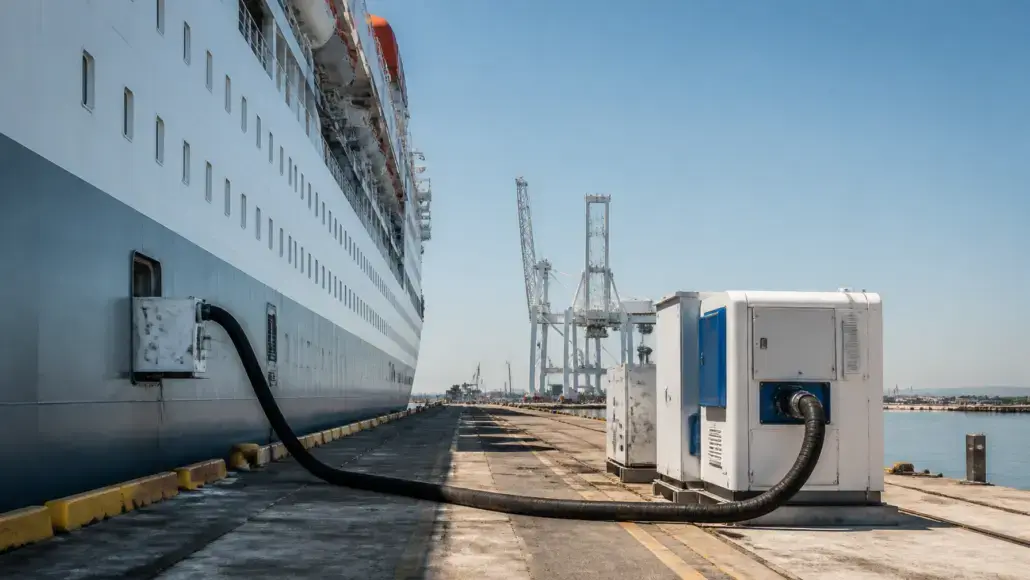
The concept of shore power for ships cutting vessel emissions is deceptively simple: instead of generating power onboard using fossil fuels, the ship draws power from the land-based grid. However, the technical implementation involves sophisticated engineering. Ships operate on a wide variety of electrical systems, often with different voltages and frequencies (such as 50Hz vs. 60Hz) than the local land-based grid. A shore power installation must, therefore, include high-capacity transformers and frequency converters to ensure compatibility. Furthermore, the physical connection requires heavy-duty cables and specialized connectors that can handle the massive electrical loads of a container ship or a cruise liner, often exceeding several megawatts.
Modern shore power systems are designed for ease of use and safety. Automated cable management systems, often mounted on the pier or a mobile barge, help bridge the gap between the shore and the ship’s connection point. Once the connection is established and synchronized, the ship can safely shut down its auxiliary engines. This transition is seamless, ensuring that critical systems like refrigerated containers (reefers) or passenger amenities on cruise ships remain operational without interruption. By utilizing shore power for ships cutting vessel emissions, a port can effectively eliminate the funnel emissions of every vessel that plugs in, transforming the air quality of the surrounding waterfront.
The Environmental Mandate: Cleaning Port Air
The primary driver for the adoption of shore power for ships cutting vessel emissions is the urgent need to improve public health in port communities. Ships burning heavy fuel oil or marine diesel at berth release a cocktail of pollutants, including nitrogen oxides (NOx), sulfur oxides (SOx), and particulate matter (PM2.5). These pollutants are linked to respiratory diseases, heart conditions, and premature mortality in populations living near major maritime hubs. In many cities, port operations are the single largest source of localized air pollution.
By switching to electricity, shore power for ships cutting vessel emissions provides an immediate and dramatic reduction in these harmful pollutants. If the electricity provided by the port is sourced from renewable energy—such as wind, solar, or hydro—the greenhouse gas emissions of the docked vessel are virtually eliminated. Even if the grid relies on a mix of fossil fuels, the centralized power generation at a utility-scale plant is generally far more efficient and cleaner than the small, individual auxiliary engines on a ship. This makes shore power one of the most effective low-hanging fruits for ports looking to meet their environmental commitments and improve their relationship with local stakeholders.
Economic and Strategic Benefits for Ports and Shipowners
While the environmental benefits are clear, the economic case for shore power for ships cutting vessel emissions is also becoming more robust. For shipowners, using shore power can reduce the wear and tear on auxiliary engines, extending their lifespan and reducing maintenance costs. It also eliminates the consumption of expensive marine fuels while in port. As carbon taxes and emissions regulations become more stringent, the financial penalty for burning fossil fuels at berth will only increase, making the transition to electricity a strategic necessity for future-proofing fleets.
For ports, investing in shore power for ships cutting vessel emissions is a way to maintain their license to operate and attract the next generation of green vessels. Many major shipping lines are now prioritizing ports that offer shore power as part of their own sustainability goals. Furthermore, ports can act as energy hubs, selling electricity to docked vessels and potentially utilizing onsite renewable generation and battery storage to manage the load. This new revenue stream, combined with government grants and subsidies aimed at port electrification, helps offset the significant capital expenditure required for the transformers, switchgear, and cabling involved in a shore power installation.
Regulatory Pressure and Global Standardization
The adoption of shore power for ships cutting vessel emissions is being accelerated by a tightening regulatory landscape. In California, the At-Berth regulation has been a pioneer, mandating that container, refrigerated, and cruise vessels utilize shore power (or an equivalent emission reduction technology) at major ports. In Europe, the Fit for 55 package includes the FuelEU Maritime initiative, which will require passenger and container ships to use shore power in major EU ports by 2030. These clear regulatory signals are providing the impetus for both ports and shipowners to invest in the necessary hardware.
Global standardization is another critical factor in the success of shore power for ships cutting vessel emissions. Organizations like the IEC (International Electrotechnical Commission), ISO (International Organization for Standardization), and IEEE (Institute of Electrical and Electronics Engineers) have worked together to create the IEC/ISO/IEEE 80005 standard. This universal standard ensures that a ship built in Asia can plug into a port in Europe or North America without compatibility issues. This interoperability is essential for the global shipping industry, where vessels move across different jurisdictions daily. As more vessels are built shore-power ready at the shipyard, the friction of adopting this technology continues to decrease.
Overcoming Infrastructure and Grid Challenges
Despite its advantages, the rollout of shore power for ships cutting vessel emissions faces significant infrastructure hurdles. The electrical demand of a single cruise ship can be equivalent to that of a small city. Providing this level of power at multiple berths simultaneously requires a massive upgrade of the port’s electrical grid and the surrounding utility infrastructure. This often involves building new substations and laying high-voltage lines through densely populated urban areas, a process that is both costly and time-consuming.
Furthermore, the last mile of the connection—the cabling on the pier—must be robust enough to withstand the harsh marine environment and flexible enough to accommodate different ship sizes and tide levels. To address these challenges, some ports are exploring mobile shore power solutions, such as LNG-powered barges or massive battery containers that can be moved to the ship. Others are integrating shore power into their broader smart grid strategies, using the massive storage capacity of docked vessels (if they have batteries) to help balance the local grid. This Vehicle-to-Grid (V2G) concept for ships is an exciting frontier in the development of shore power for ships cutting vessel emissions.
The Role of Renewables and Energy Management
The ultimate goal for shore power for ships cutting vessel emissions is to ensure that the power being used is as green as possible. Many ports are now entering into Power Purchase Agreements (PPAs) for renewable energy or installing their own solar and wind capacity. By synchronizing the refuelling of ships with periods of high renewable production, ports can maximize the environmental benefit and potentially lower costs. Advanced energy management systems (EMS) are used to monitor the load in real-time, ensuring that the demand from ships doesn’t compromise the stability of the local grid or lead to excessive peak demand charges.
Digital integration also plays a role in the user experience. Ship captains can use digital platforms to book shore power slots in advance, and automated billing systems ensure that the transaction is smooth and transparent. This digital layer makes shore power for ships cutting vessel emissions as easy to use as traditional bunkering, removing the operational barriers to adoption. As the data from these sessions is collected, it provides valuable insights into the energy needs of different vessel types, helping ports plan their future infrastructure investments more effectively.
Imagining A Silent, Cleaner Future for Ports
The establishment of shore power for ships cutting vessel emissions is a transformative development for the maritime industry and the communities that support it. Transport Advancement believes that by breaking the link between port activities and air pollution, it offers a pathway to a healthier, more sustainable waterfront. The transition is supported by proven technology, a maturing global standard, and a clear regulatory mandate. While the infrastructure challenges are significant, the environmental and public health rewards are even greater.
As more ports around the world activate their shore power systems, the sight of a ship at berth will no longer be accompanied by a cloud of diesel smoke. Instead, it will be a silent participant in a modern, electrified energy system. Shore power for ships cutting vessel emissions is not just an environmental upgrade. It is a fundamental shift in how we power our global supply chains. It ensures that the vital work of maritime trade can continue in harmony with the local environment, marking a new chapter in the long history of human interaction with the sea.
