












The global supply chain has undergone unprecedented shifts in recent years, testing the resilience and adaptability of every logistical node. Amidst this flux, the air cargo sector has demonstrated a remarkable rebound, emerging stronger and more central to global trade than ever before. This resurgence, fueled by the relentless pace of e-commerce, the need for expedited delivery of high-value goods, and the rebalancing of global manufacturing, is not merely a return to previous volumes but a profound evolution. It demands more than just capacity. It calls for intelligence, agility, and foresight. This is where AI smart logistics air cargo operations step in, fundamentally transforming how airports manage the complex ballet of freight, from touchdown to onward journey.
The traditional approach to air cargo, often characterized by manual processes, fragmented data, and reactive problem-solving, is increasingly ill-equipped to handle the demands of today’s hyper-connected and fast-moving world. Delays, inefficiencies, and security vulnerabilities are no longer tolerable in an environment where speed and precision are paramount. Transport Advancement notes that the answer lies in leveraging artificial intelligence and advanced analytics to create genuinely smart logistics ecosystems within airport environments. These digital logistics platforms are not just tools. They are the architects of a more streamlined, predictable, and resilient future for air freight.
Redefining Airport Cargo Handling Through Automation and Intelligence
At the very heart of air cargo operations, the airport serves as a critical nexus, a temporary home for millions of tons of goods annually. The sheer volume and diversity of cargo, from perishables and pharmaceuticals to oversized machinery and essential components, present immense logistical challenges. Here, AI is proving to be a game-changer, moving beyond mere mechanization to intelligent automation that learns, adapts, and optimizes.
Revolutionizing Ground Support and Robotic Integration
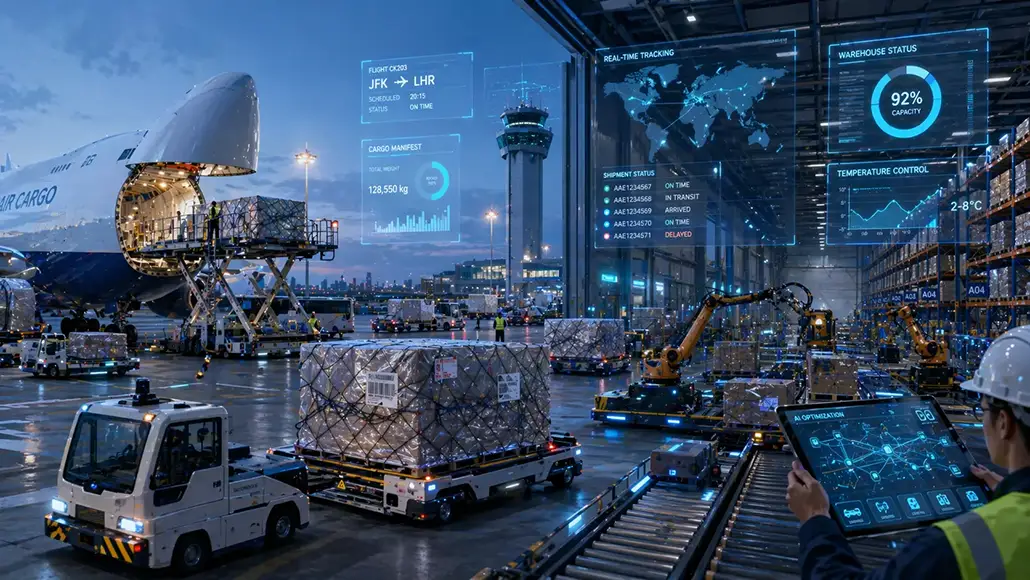
The manual handling of cargo, while still present, is increasingly being augmented and replaced by advanced robotic systems. These robots can handle repetitive, heavy, or hazardous tasks with unparalleled precision and speed, significantly reducing human error and workplace injuries. Automated Guided Vehicles (AGVs) and Autonomous Mobile Robots (AMRs) navigate warehouses and aprons, moving cargo containers and pallets with efficiency that traditional forklifts cannot match. Furthermore, AI-powered vision systems analyze cargo dimensions and types, enabling faster sorting and precise placement, optimizing every inch of available space. This sophisticated cargo automation dramatically accelerates turnaround times for aircraft, a critical metric in air freight profitability.
Optimizing Warehousing and Storage
Beyond the tarmac, AI smart logistics platforms are revolutionizing warehouse management within airports. AI algorithms analyze incoming and outgoing shipment schedules, storage requirements (e.g., temperature control), and historical data to dynamically allocate storage space. This intelligent space management minimizes wasted capacity and ensures that cargo is stored in optimal locations for quick retrieval, reducing dwell times. Predictive maintenance for warehousing equipment, also an AI application, anticipates potential failures before they occur, ensuring uninterrupted operation. This comprehensive approach to airport cargo handling ensures that freight moves seamlessly from airside to landside, avoiding bottlenecks that can cascade into significant delays.
Enhancing Efficiency with Predictive Planning and Analytics
One of the most profound impacts of AI smart logistics air cargo operations is its ability to shift from reactive problem-solving to proactive, predictive planning. By analyzing vast datasets, including weather patterns, historical traffic, global trade trends, flight schedules, and customs clearance times, AI algorithms can forecast demand, anticipate disruptions, and optimize resource allocation with remarkable accuracy.
Precision in Demand Forecasting
AI-driven systems can predict surges or dips in cargo volume with high fidelity, allowing airlines and ground handlers to adjust staffing, equipment, and even flight schedules in advance. This foresight minimizes instances of understaffing during peak periods or over-allocation during troughs, leading to significant cost savings and improved operational fluidity. For instance, understanding the likely demand for medical supplies during a regional health crisis or e-commerce volumes during holiday seasons empowers stakeholders to prepare proactively.
Streamlining Resource Allocation
Predictive logistics extends to optimizing the deployment of critical resources like ground handling equipment, staff, and even aircraft maintenance schedules. AI models can simulate various scenarios, identifying the most efficient deployment strategies to mitigate potential delays stemming from unexpected events or routine operations. This means fewer instances of equipment shortages, better managed workforce availability, and ultimately, a smoother flow of cargo through the airport. The ability to anticipate and pre-empt issues before they escalate is a cornerstone of resilient AI in airport operations.
Unprecedented Visibility with Real-Time Tracking
In an industry where the value of goods can be astronomical, and delivery deadlines are often non-negotiable, transparency and visibility are paramount. Real-time tracking powered by AI smart logistics platforms offers unprecedented insight into the location, condition, and estimated time of arrival for every shipment, from origin to destination.
Comprehensive Shipment Monitoring
Using a combination of IoT sensors, GPS, RFID tags, and advanced data analytics, these platforms provide a live digital twin of the physical cargo. Stakeholders, including shippers, freight forwarders, airlines, and customs officials, can monitor a shipment’s journey at every stage. This not only provides peace of mind but also allows for immediate intervention if a deviation occurs. For high-value or temperature-sensitive cargo, constant monitoring ensures integrity and compliance, addressing critical aspects of supply chain security.
Enhancing Security and Compliance
The enhanced visibility offered by real-time shipment tracking plays a crucial role in improving security. Any unauthorized movement or deviation from the planned route can be immediately flagged, allowing for rapid response. Furthermore, AI can analyze tracking data alongside customs regulations to flag potential compliance issues proactively, accelerating clearance processes and reducing the risk of costly penalties. This integrated approach elevates the overall security posture of air cargo operations.
The Rise of Digital Logistics Platforms: Integration and Data-Driven Insights
The true power of AI smart logistics air cargo operations lies in the integration of these disparate capabilities into cohesive digital logistics platforms. These platforms act as central nervous systems, connecting all stakeholders and data points across the air freight ecosystem.
Fostering Integration and Collaboration
These platforms break down traditional silos between airlines, ground handlers, customs, freight forwarders, and trucking companies. By providing a single source of truth and shared operational visibility, they facilitate seamless communication and collaboration. This interconnectedness allows for faster decision-making and more coordinated responses to dynamic situations, enhancing the overall efficiency of the freight transportation networks.
Driving Insights and Continuous Improvement
Beyond operational efficiency, digital logistics platforms leverage AI to generate deep insights from the accumulated data. This includes identifying bottlenecks, evaluating performance metrics, predicting future trends, and even recommending optimal routing or packaging strategies. This continuous feedback loop drives ongoing optimization and innovation, ensuring that airport logistics platforms remain at the cutting edge of technological advancement. The data collected from every stage of air cargo tracking becomes a valuable asset for strategic planning and process refinement.
Navigating Challenges and Charting the Future
While the transformative potential of AI smart logistics air cargo operations is immense, its widespread adoption is not without challenges. Integrating legacy systems with new AI-driven platforms can be complex and costly. Ensuring data quality and cybersecurity are paramount, as these systems rely heavily on accurate and secure information. Furthermore, the shift towards automation necessitates upskilling and reskilling the workforce to manage and interact with these advanced technologies, rather than being displaced by them.
Despite these hurdles, the trajectory is clear. The future of air cargo operations will be increasingly intelligent, autonomous, and interconnected. As AI continues to evolve, we can anticipate even more sophisticated predictive capabilities, fully autonomous ground handling, and advanced decision-making support that anticipates human needs. The synergy between a rebounding air cargo market and the transformative power of AI is not just enhancing efficiency. It’s creating a new paradigm for speed, reliability, and sustainability in global logistics. Transport Advancement highlights that the ongoing evolution of AI smart logistics air cargo operations will be central to how global commerce adapts and thrives in the decades to come.
