









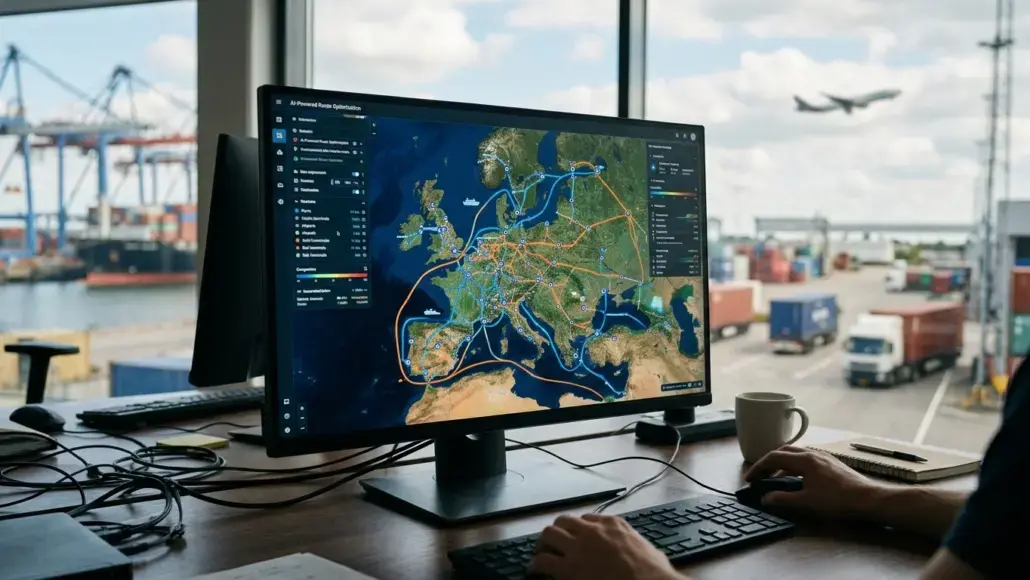
In the complex world of global logistics, the shortest distance between two points is rarely a straight line. The movement of goods across continents involves a dizzying array of variables, from port congestion and weather patterns to fluctuating fuel prices and carbon tax regulations. Traditional route planning, which often relied on static maps and historical averages, is no longer sufficient for the demands of the modern economy. AI-powered route optimization has emerged as the definitive tool for navigating this complexity, providing the computational power needed to orchestrate movement across road, rail, sea, and air with unprecedented precision. Transport Advancement notes that by analyzing millions of data points in real-time, AI is transforming logistics from a reactive best effort process into a predictive, self-optimizing science that maximizes efficiency while minimizing costs and environmental impact.
The Algorithmic Shift in Global Freight Planning
The heart of AI-powered route optimization lies in the shift from simple pathfinding to multi-objective optimization. While older systems focused primarily on finding the cheapest or fastest route, modern AI algorithms consider a much broader set of constraints. These include soft constraints like customer delivery windows and driver rest periods, and hard constraints like bridge height limits, port depth, and aircraft weight capacities. Machine learning models are trained on years of historical transport data, allowing them to identify patterns that human planners might miss. For instance, an AI system might recognize that a specific rail corridor consistently experiences delays on Tuesday afternoons due to maintenance, and will automatically route high-priority freight via an alternative sea-road path. This algorithmic foresight ensures that the global supply chain is not just moving, but moving intelligently.
Balancing Cost, Speed, and Carbon Emissions
One of the most significant challenges at present is the triple bottom line of logistics: balancing financial cost, delivery speed, and carbon emissions. AI-powered route optimization is the key to solving this multi-dimensional puzzle. As governments implement more stringent carbon pricing, the ‘greenest’ route is often becoming the most economical one. AI can simulate thousands of different modal combinations to find the sweet spot for each shipment. For example, a system might decide that while air freight is the fastest, a combination of high-speed rail and electric trucking offers a 90% reduction in CO2 with only a 12-hour delay in delivery. By providing shippers with a transparent view of these trade-offs, AI is enabling the transition to a more sustainable global economy without sacrificing the responsiveness that modern consumers expect.
Dynamic Re-Routing in Response to Real-Time Variables
The true power of AI-powered route optimization is seen when things go wrong. In a static world, a blocked canal or a closed mountain pass would lead to days of chaos. In an AI-driven world, the system responds instantaneously. By integrating real-time data from IoT sensors, satellite imagery, and weather services, the optimization engine can detect disruptions the moment they occur. If a major storm is predicted to impact the Atlantic crossing, the AI can proactively re-route ships to alternative ports or switch the cargo to a trans-continental rail link. This dynamic re-routing capability minimizes the ripple effect of disruptions, ensuring that a delay in one part of the world does not lead to a total shutdown of a manufacturing line elsewhere. The ability to pivot the entire transport strategy in seconds is a hallmark of the new era of logistics resilience.
Solving the Complexity of Intermodal Handoffs
The most significant bottlenecks in multimodal transport often occur at the handoff points—the ports, rail yards, and airports where cargo is transferred from one mode to another. AI-powered route optimization excels at synchronizing these transitions. By predicting the exact arrival time of a container ship, the AI can coordinate the scheduling of freight trains and trucks to minimize dwell time on the dock. This level of synchronization is essential for maximizing the utilization of infrastructure and reducing congestion. Furthermore, AI can optimize the loading sequence of ships and planes to ensure that the most time-sensitive cargo is accessible first at the destination. By treating the entire multimodal journey as a single, integrated flow rather than a series of disconnected steps, AI is eliminating the friction that has traditionally slowed down international trade.
The Role of Machine Learning in Lane Performance Analysis
Beyond immediate routing, AI is providing logistics companies with deep insights into the long-term performance of their transport lanes. Machine learning models can analyze the reliability, cost-volatility, and carbon-intensity of every possible route over time. This lane performance analysis allows companies to build more resilient procurement strategies, identifying the most dependable carriers and corridors for their critical shipments. If the AI detects that a particular sea lane is becoming increasingly prone to delays or that a rail operator’s performance is declining, it can recommend a strategic shift in the transport mix. This data-driven approach to procurement ensures that logistics managers are not just making the best decision for today, but are building a more robust and adaptable network for the future.
Future Frontiers: Quantum Computing and Autonomous Swarms
As we look toward the next decade, the capabilities of AI-powered route optimization will be further enhanced by the arrival of quantum computing. Quantum algorithms are uniquely suited for the traveling salesperson problems that lie at the heart of logistics, potentially finding optimal solutions in seconds that would take current computers hours to calculate. Simultaneously, the rise of autonomous trucks, ships, and drones will create a world of autonomous swarms, where vehicles communicate with each other and the central AI to self-organize for maximum efficiency. In this future, the AI will not just plan the route; it will actively manage the entire fleet in a fluid, real-time dance of movement. The integration of these advanced technologies will lead to a world where the movement of physical goods is as effortless and optimized as the flow of data on the internet.
AI-powered route optimization is the engine of the modern global supply chain. It has transformed the complex, often chaotic world of international freight into a high-precision digital discipline. By empowering organizations to navigate the variables of road, rail, sea, and air with ease, AI is ensuring that the world’s resources are moved in the most efficient, cost-effective, and sustainable way possible. Transport Advancement believes that as the technology continues to evolve, its impact on global trade and economic development will only grow. For companies that embrace AI-driven planning, the benefits in terms of resilience and competitive advantage are clear. The future of logistics is not just about moving faster. It is also about moving smarter, and AI-powered optimization is the compass that is leading the way.
