
























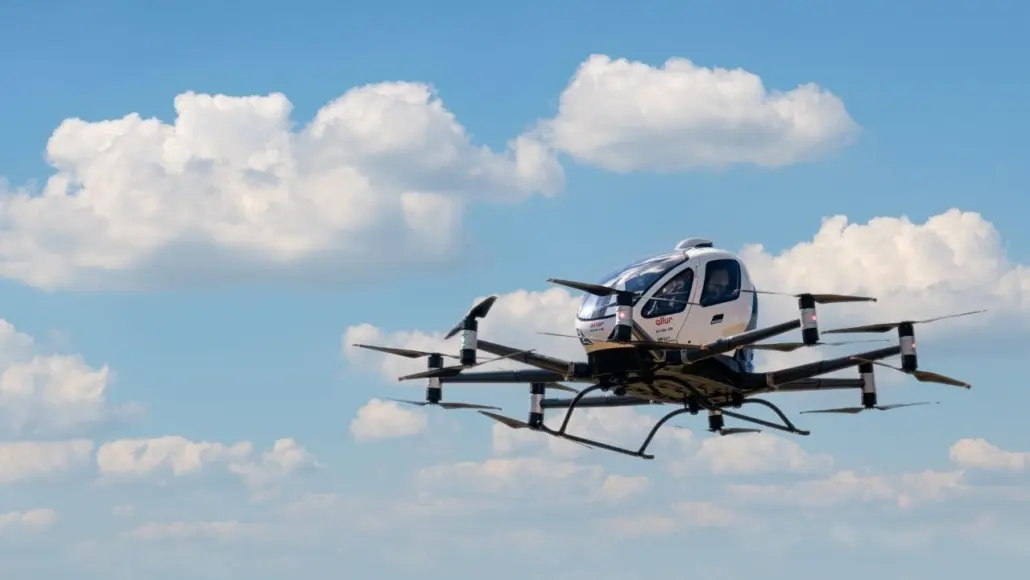
Kazakhstan has successfully completed its first passenger flight using an unmanned eVTOL aircraft, marking a significant step in the country’s adoption of next-generation aviation technologies. The demonstration featured the EH216-S in Astana, where the autonomous aircraft carried a passenger during a specially authorized flight operation. According to the statement of the Ministry of Transport of Kazakhstan, the serial-produced autonomous aircraft performed the demonstration over a designated area of the capital as part of the international “Games of the Future 2026” tournament. The event represented the first occasion in Kazakhstan’s history in which a passenger was transported aboard an unmanned eVTOL aircraft.
Designed to accommodate two passengers, the EH216-S is capable of reaching a maximum speed of up to 130 kilometers per hour while covering distances of up to 35 kilometers. Through the demonstration, participants were able to witness the practical application of unmanned aviation technologies under real operating conditions. The successful flight showcased the operational potential of the unmanned eVTOL aircraft, offering an early indication of how autonomous passenger aviation could be incorporated into future mobility solutions within the country.
Tourism, Infrastructure and Future Applications Drive Development
Kazakhstan is evaluating the introduction of demonstration and tourism routes during the initial phase of deployment, with proposed flights lasting between five and 30 minutes over the country’s natural, cultural and historical attractions. Looking ahead, unmanned passenger aircraft systems are expected to become part of Kazakhstan’s modern transport infrastructure, complementing existing mobility options and expanding the country’s urban air mobility ecosystem through the use of unmanned eVTOL aircraft technologies.
“The project also envisages the development of a wide range of applications for unmanned aerial systems, including emergency medical services, medicine delivery, firefighting operations and logistics, where speed and operational efficiency are critical,” the statement of the ministry says.
Alongside operational deployment, Kazakhstan is also prioritizing domestic manufacturing capabilities. Through international cooperation, the country plans to localize the production of passenger unmanned aerial systems, creating new competencies in high-tech manufacturing while supporting additional employment opportunities and industrial cooperation.
At the same time, the Ministry of Transport, together with relevant government bodies, continues to develop the regulatory and infrastructure framework required for the introduction of urban air mobility. Kazakhstan has already adopted legislative amendments governing the operation of eVTOL aircraft, vertiports and unmanned air traffic management systems, establishing the conditions needed for the safe integration of these technologies into the national transport system.
