








The global pursuit of decarbonization has historically focused on the ground beneath our feet, targeting the electrification of passenger vehicles and the expansion of high-speed rail. However, as metropolitan areas continue to swell, the limitations of two-dimensional infrastructure have become increasingly apparent. Traditional urban transport systems, while evolving, remain tethered to massive concrete investments and the persistent friction of congestion. In this context, the emergence of sustainable air taxis represents more than just a futuristic novelty; it is a fundamental reconfiguration of how we perceive movement within the built environment. By leveraging the vertical dimension through electric aviation, Transport Advancement notes that Advanced Air Mobility (AAM) offers a pathway to reduce the environmental toll of daily commuting while bypassing the structural bottlenecks that have long hindered the progress of sustainable cities.
Decarbonizing the Commute Through Electric Aviation
The primary sustainability benefit of sustainable air taxis lies in their propulsion systems. Unlike traditional helicopters that rely on loud, carbon-intensive turbine engines, or conventional cars that often remain idling in traffic, eVTOL aircraft utilize electric aviation technologies. This shift to distributed electric propulsion (DEP) allows for zero-operational emissions. When these vehicles are powered by a grid increasingly dominated by renewable energy sources, the lifecycle carbon emissions per passenger kilometer can be significantly lower than those of a private internal combustion vehicle.
The efficiency of air travel in a direct line cannot be overstated. Conventional urban transport must navigate a maze of streets, stoplights, and geographical obstacles, which results in a high ratio of energy expended per mile traveled. Sustainable air taxis, by contrast, move point-to-point. This eliminates the ‘stop-and-go’ energy waste characteristic of city driving. By flying at optimal altitudes and speeds, these aircraft minimize the total energy required to transport a person from a suburban hub to a city center, making green mobility a functional reality rather than a distant aspiration.
Reducing the Environmental Footprint of Infrastructure
One of the most overlooked aspects of clean transportation is the embodied carbon found in the infrastructure itself. To support the growing demands of urban transport, cities must constantly expand roads, build parking garages, and maintain massive stretches of asphalt. The production of concrete and steel is a major driver of global carbon emissions. Sustainable air taxis offer a unique advantage in this regard because they require significantly less physical infrastructure on the ground.
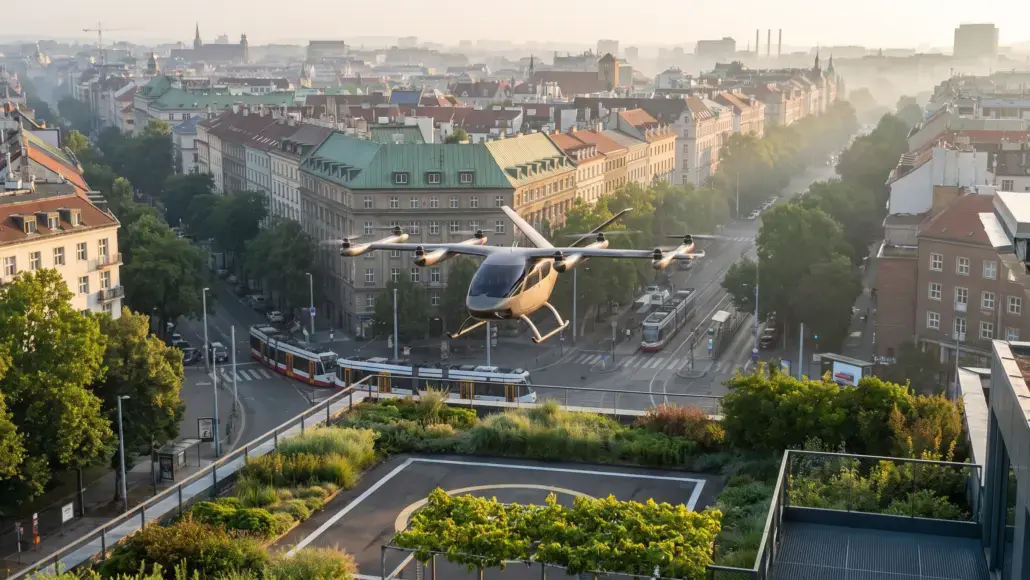
Rather than miles of new highway, Advanced Air Mobility relies on vertiports—compact landing pads that can often be integrated into existing structures, such as the rooftops of parking garages or transit hubs. This minimal land use preserves green spaces within sustainable cities and reduces the need for disruptive, carbon-heavy construction projects. By utilizing the invisible infrastructure of the sky, we can decrease our reliance on the heavy engineering that defines 20th-century urbanism, allowing for a more natural and less invasive approach to connectivity.
Mitigation of Noise and Localized Pollution
Sustainability is a multifaceted concept that encompasses not just carbon, but also the overall health and livability of the urban environment. Conventional urban transport is a primary source of noise pollution and particulate matter from tire wear and brake dust—pollutants that persist even as road vehicles become electric. Sustainable air taxis address these issues through sophisticated engineering. The distributed electric propulsion systems used in eVTOL aircraft are designed to be significantly quieter than traditional rotorcraft. By using multiple small rotors spinning at lower tip speeds, these vehicles can blend into the ambient noise of a city, reducing the psychological and physiological stress associated with urban living.
Furthermore, because these aircraft operate at an altitude, the localized air quality at the street level is preserved. In many dense urban corridors, canyon effects trap vehicle exhaust and particulates, leading to respiratory issues for residents. By moving a portion of the commuter load to the air, we reduce the concentration of pollutants in the immediate vicinity of pedestrians and cyclists. This supports a broader vision of clean transportation where the air we breathe at ground level is unburdened by the machines we use to move through the world.
Energy Efficiency and the Dynamics of Flight
Critics of electric aviation often point to the high energy requirements of takeoff as a sustainability hurdle. However, when viewed through the lens of total trip efficiency, the narrative changes. Modern eVTOL aircraft are designed with high-lift wings that allow them to transition from vertical takeoff to efficient forward flight. Once in the cruise phase, these vehicles operate with remarkable aerodynamic efficiency.
When compared to the energy wasted by a two-ton SUV sitting in a traffic jam for an hour to cover ten miles, the energy profile of a flight that covers the same distance in six minutes is highly competitive. Advanced Air Mobility systems are also being integrated with smart grid technologies. This means that sustainable air taxis can be charged during off-peak hours when renewable energy is most abundant, acting as a flexible load that helps stabilize the energy grid. This synergy between the transport sector and the energy sector is essential for the long-term viability of green mobility.
Easing Surface Congestion and Enhancing Multimodal Networks
The sustainability benefits of air taxis extend beyond the aircraft themselves; they also improve the efficiency of the systems they complement. When a segment of high-value, time-sensitive travel is moved to the air, the pressure on ground-based urban transport is relieved. This reduction in surface congestion allows buses, emergency vehicles, and essential freight to move more freely, reducing their own idle times and fuel consumption.
Sustainable air taxis are not intended to replace public transit but to augment it. By acting as a premium, fast-transit layer within a multimodal network, they can help solve the last mile problem in a way that encourages the use of other low-carbon modes. For example, a traveler might take a high-speed train to a regional hub and then use an air taxi to reach a final destination that would otherwise require a long, congested car ride. This integrated approach ensures that the entire journey remains within the framework of clean transportation, optimizing the strengths of each mode.
The Lifecycle Perspective: Manufacturing and Recyclability
To truly claim the title of sustainable, the industry must look at the lifecycle of the eVTOL aircraft. Manufacturers in the AAM space are increasingly prioritizing the use of advanced composites and recyclable materials. Because weight is such a critical factor in flight, there is a natural incentive to use materials that are both high-strength and lightweight, many of which are being developed with circular economy principles in mind.
The batteries used in electric aviation are also subject to rigorous sustainability standards. As battery technology matures, the second life applications for these power cells—such as stationary energy storage for vertiports—ensure that the environmental cost of battery production is amortized over a much longer period. This cradle-to-grave approach to sustainability distinguishes the burgeoning air taxi industry from the legacy automotive industry, which has only recently begun to grapple with the complexities of material circularity.
A Catalyst for Rethinking Urban Design
The integration of sustainable air taxis provides an opportunity for urban planners to rethink the layout of sustainable cities. For decades, cities have been designed around the car, resulting in sprawling suburbs and fragmented communities. The flexibility of aerial transit allows for a more nodal approach to development. Vertiports can serve as anchors for new, high-density, mixed-use developments that are less dependent on sprawling road networks.
This shift encourages a more efficient use of land and can lead to the 15-minute city concept, where essential services are within a short walk or a quick aerial hop. By reducing the dominance of the car in the urban core, we can reclaim space for parks, pedestrian zones, and cycling infrastructure. In this sense, the air taxi is a tool for liberation—freeing the ground level for human-centric activities while moving the mechanical necessities of transit to the sky.
Economic and Social Dimensions of Sustainability
True sustainability also requires an economic and social component. While early adoption of air taxis may be limited to specific segments, the long-term goal of the industry is to scale until the cost of a flight is comparable to a premium ground rideshare. As the technology matures and operational costs drop due to automation and increased energy efficiency, sustainable air taxis will become accessible to a broader demographic.
This democratization of speed has profound implications for social equity. It allows people to live in more affordable areas while still having access to high-quality urban jobs without the soul-crushing commute that traditionally accompanies such a choice. By reducing the time-tax of travel, we improve the quality of life and allow for a more balanced distribution of economic opportunity across a region. A sustainable city is not just one that is green, but one that is functional and inclusive.
Navigating the Challenges of Transition
The transition to a future defined by Advanced Air Mobility is not without its hurdles. Regulatory frameworks must be established to ensure safety and equitable access to airspace. However, the momentum behind electric aviation is driven by a global recognition that the status quo of urban transport is unsustainable. The collaboration between aerospace engineers, urban planners, and environmental scientists is creating a robust ecosystem dedicated to solving these challenges.
As we look toward the next decade, Transport Advancement believes that the presence of sustainable air taxis in our skies will serve as a visible reminder of our commitment to innovation. They represent a departure from the more of the same mentality that has characterized urban planning for too long. By embracing the complexity of flight and the efficiency of electricity, we are building a transportation system that respects the limits of our planet while meeting the boundless needs of human connectivity.
The comparison between air taxis and conventional transport reveals a clear path forward. While road vehicles will always have a place, the addition of a sustainable aerial layer is the missing piece in the puzzle of green mobility. It is an investment in a future where speed does not come at the expense of the environment, and where our cities can finally breathe again. The evolution of the air taxi is not just about moving people. It is about moving the world toward a cleaner, quieter, and more efficient way of life.
