









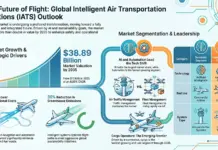
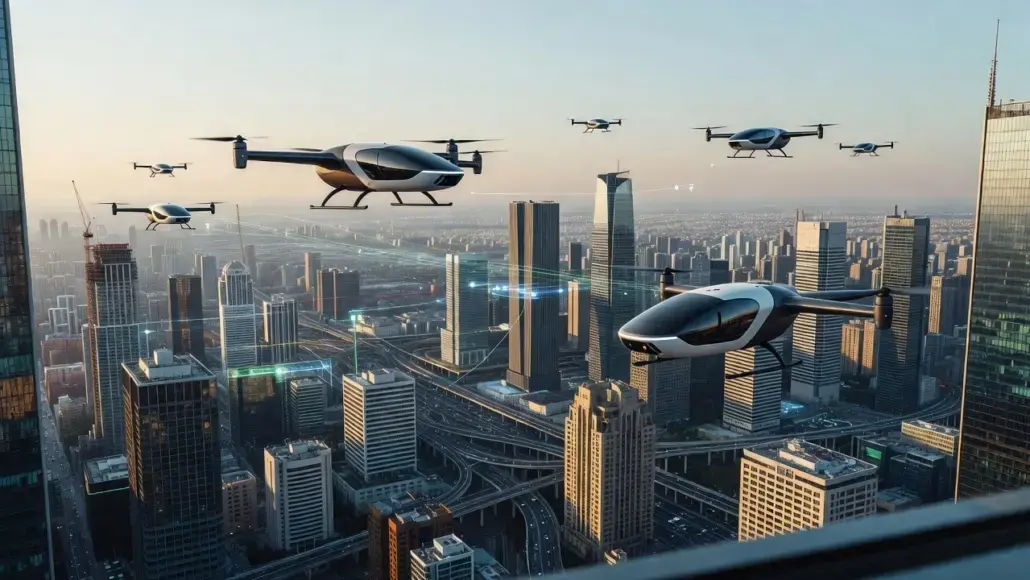
The dream of soaring above congested city streets in a quiet, electric aircraft is rapidly approaching reality. As manufacturers move from experimental prototypes to certified commercial vehicles, the focus of the aviation industry is shifting from the aircraft themselves to the infrastructure required to support them. Urban Air Mobility (UAM) promises to revolutionize transportation, but it introduces a level of complexity that traditional aviation systems were never designed to handle. Transport Advancement notes that central to this challenge is the development of AI air traffic management, a sophisticated digital framework capable of coordinating thousands of low-altitude flights simultaneously.
Unlike commercial airliners that fly along well-defined corridors and communicate with human controllers, air taxis will operate in a dynamic, high-density environment. Vertiports will be located on rooftops and in crowded urban centers, requiring aircraft to navigate through narrow airspaces while avoiding buildings, birds, and other drones. Human air traffic controllers, already strained by existing flight volumes, cannot possibly manage the sheer scale of the proposed air taxi networks. Therefore, the transition to autonomous aviation and the implementation of AI-driven flight management are not just technological upgrades; they are fundamental requirements for the survival and safety of the sector.
The Architectural Foundation of Urban Air Mobility
To understand the necessity of AI air traffic management, one must first appreciate the architectural shift occurring in the skies. Traditional Air Traffic Management (ATM) relies on radar, voice communication, and a first-come, first-served approach to sequencing. This model is linear and centralized. UAM, however, requires a decentralized and highly automated ecosystem often referred to as Unmanned Traffic Management (UTM) or Advanced Air Mobility (AAM) traffic control. In this new paradigm, the controller is a cloud-based AI platform that interacts directly with the flight management systems of each individual eVTOL (electric Vertical Take-Off and Landing) vehicle.
The scalability of air taxis depends on the ability of these AI systems to perform high-frequency calculations. During peak hours, an urban center might see hundreds of take-offs and landings every minute. The AI must manage these movements with microsecond precision, ensuring that safety buffers are maintained while maximizing the throughput of the limited airspace. This requires a profound level of aviation AI integration, where the traffic management system can predict potential conflicts miles in advance and issue silent, automated course corrections to the involved aircraft. This management by exception model allows for a vast increase in flight density without a corresponding increase in human workload or risk.
Dynamic Routing and Real-Time Conflict Resolution
One of the most impressive features of AI air traffic management is its ability to handle dynamic routing. In a traditional flight plan, an aircraft follows a pre-determined path. In the UAM environment, weather conditions can change in an instant, and unexpected obstacles—such as a building fire requiring emergency helicopter access—can disrupt the entire network. An AI-managed system can reroute dozens of air taxis in real time, calculating the most efficient alternative paths that avoid the restricted zone without creating new bottlenecks elsewhere.
Conflict resolution in this context happens at multiple levels. Strategic deconfliction occurs before a flight even takes off, as the AI assigns a 4D trajectory (latitude, longitude, altitude, and time) that is guaranteed to be clear of other planned flights. Tactical deconfliction occurs in-flight, as on-board sensors and the ground-based AI communicate to resolve immediate hazards. By using machine learning algorithms trained on millions of simulated flight hours, these systems can identify patterns and risks that a human observer might miss. This layered approach ensures that the safety standards for air taxis remain as high, if not higher, than those of commercial aviation.
The Role of Autonomous Aviation in Modern Cities
As the technology matures, the goal is for air taxis to operate with a high degree of autonomy. While initial commercial flights will likely have a pilot on board to satisfy regulatory requirements and public trust, the ultimate economic viability of the industry rests on pilotless operations. Autonomous aviation reduces weight, increases passenger capacity, and eliminates the risk of human error, which is a factor in the majority of aviation accidents. However, autonomy is only possible if the AI air traffic management can provide the necessary situational awareness to the vehicle.
In an autonomous network, the aircraft and the traffic management system are in a constant state of digital negotiation. If one aircraft needs to land early due to a low battery, the AI system orchestrates a synchronized movement where other aircraft adjust their speeds and altitudes to create a landing slot. This level of cooperation is only achievable through high-speed, low-latency communication networks like 5G and satellite links. The sky becomes a living grid, where each node is aware of every other node, creating a level of efficiency that makes urban air mobility a practical solution rather than a futuristic novelty.
Addressing Regulatory and Public Perception Challenges
Despite the technological readiness, the widespread adoption of AI air traffic management faces significant non-technical hurdles. Regulators like the FAA and EASA are understandably cautious about delegating life-and-death decisions to algorithms. The process of certifying an AI is fundamentally different from certifying a mechanical part. How do you prove that an AI will make the correct decision in a situation it has never encountered before? This has led to the development of explainable AI and rigorous digital twins where the traffic management system is tested against billions of edge-case scenarios before being deployed in the real world.
Public perception also plays a critical role. For people on the ground, the sound of hundreds of air taxis buzzing overhead could be a source of stress rather than a symbol of progress. AI systems must therefore optimize for noise pollution as well as speed and safety. By analyzing the acoustic footprint of different flight paths, the AI can choose routes that minimize the impact on residential neighborhoods. Transparency and safety must be the twin pillars of the industry; without public trust and regulatory approval, even the most advanced AI air traffic management will remain grounded.
The Future of Global Flight Management
The impact of AI in the skies will eventually extend far beyond the city limits. The lessons learned from managing air taxis will inevitably influence the way we manage commercial airliners and long-haul cargo flights. We are moving toward a unified sky, where the distinctions between manned and unmanned, or low-altitude and high-altitude flight, begin to blur. A global, AI-driven flight management system could save billions of dollars in fuel costs by optimizing routes across continents and reducing the time aircraft spend in holding patterns.
In conclusion, Transport Advancement believes that the development of AI air traffic management is the silent engine of the urban air mobility revolution. While the sleek designs of eVTOL aircraft capture the headlines, it is the digital infrastructure beneath them that will determine the success of the industry. By enabling safer, more scalable, and more efficient operations, AI is turning the vertical dimension of our cities into a new frontier for human mobility. As we look toward the 2030s, the integration of AI into our airspace will be remembered as the moment when aviation finally caught up with the digital age, creating a world where the sky is no longer an obstacle, but a highway.
