


























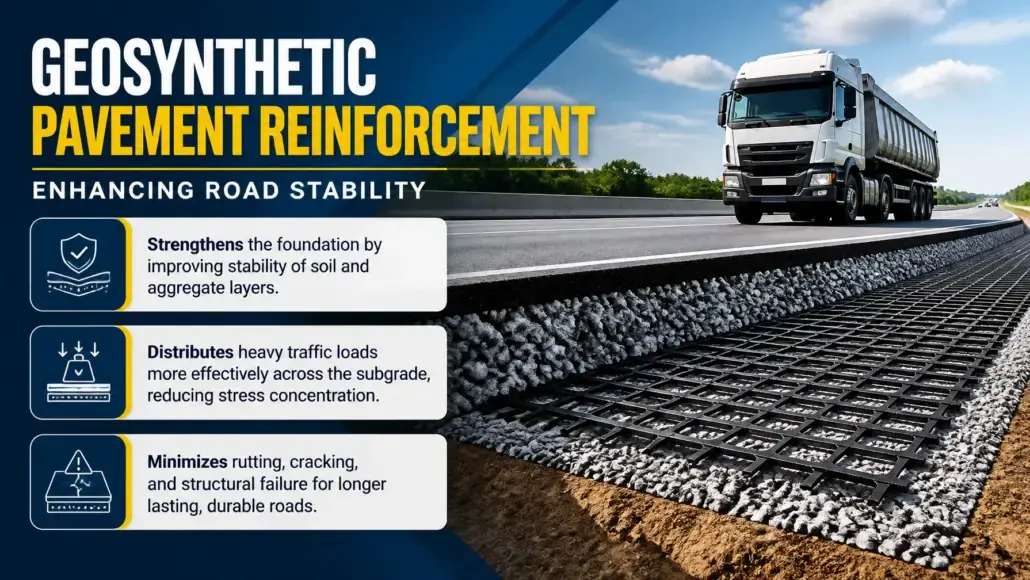
The structural integrity of modern highway systems depends heavily on the stability of the underlying soil and aggregate layers. As traffic volumes and axle loads continue to increase, traditional pavement designs often struggle to distribute stresses effectively across the subgrade. This limitation can lead to rutting, surface cracking, and eventual structural failure. To address these challenges, Transport Advancement observes that the industry is increasingly turning to geosynthetic pavement reinforcement as a standard component of highway construction and rehabilitation.
Market Projections and Core Functions of Geosynthetics
Geosynthetics encompass a wide range of polymeric materials designed to enhance soil performance. The global geosynthetics market is projected to reach approximately 19.42 billion dollars in 2026. This growth reflects a broader industry shift toward materials that can mitigate the impact of poor-quality soils and extreme environmental conditions.
By integrating these products into the roadbed, developers can achieve greater structural capacity through several key functions:
- Separation: Preventing the intermixing of dissimilar soil and aggregate layers, which preserves the structural integrity of the base.
- Filtration: Allowing water to pass through the material while retaining soil particles to prevent erosion and clogging.
- Drainage: Providing a pathway for water to escape the pavement structure, reducing pore water pressure.
- Reinforcement: Increasing the shear strength of the soil through mechanical interlocking and tensile stress distribution.
Mechanical Stabilization via Geogrids
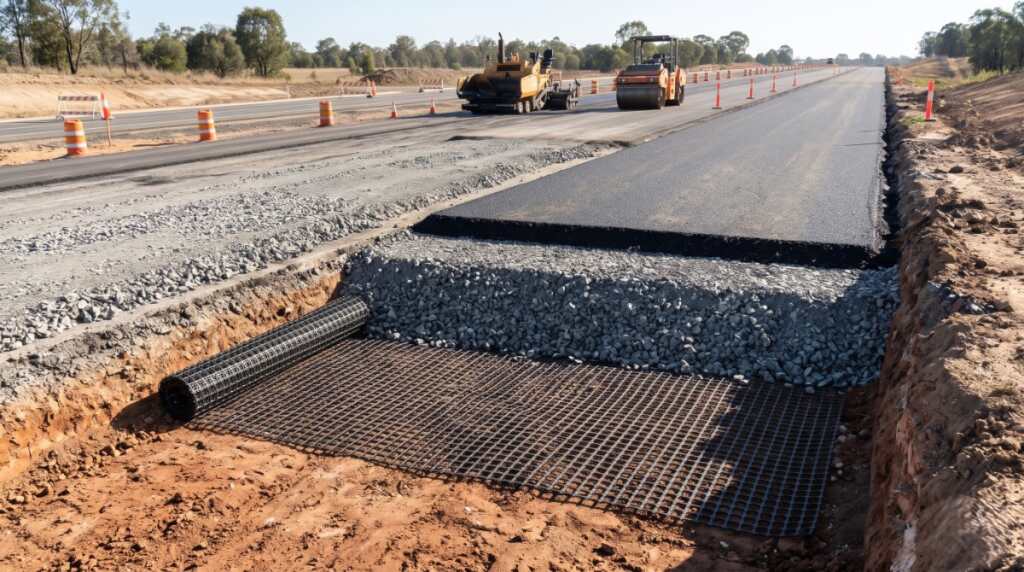
The application of geogrids is a primary method for providing mechanical stabilization to the base and subbase layers. These grid-like structures interlock with the aggregate particles to create a stiffened composite layer that resists lateral movement. This confinement effect significantly improves the load-bearing capacity of the pavement and reduces the required thickness of the aggregate layers. For projects in areas with soft or saturated soils, this reduction in material usage can lead to substantial savings in both procurement and transportation costs.
Key Global Manufacturers and Industry Innovation
The business implications of adopting geosynthetic solutions extend beyond immediate cost savings during construction. The primary value lies in the extension of the pavement service life and the reduction of long-term maintenance needs. Major global companies are driving innovation in this sector through high-profile developments:
- Solmax: Following the integration of the TenCate Geosynthetics brand, Solmax has expanded its portfolio to provide comprehensive reinforcement solutions for massive infrastructure projects worldwide, focusing on environmental resistance.
- Huesker Group: Huesker has introduced advanced geogrid systems designed for high-load applications, handling extreme stresses in challenging terrains.
- Tensar (CMC): As a division of Commercial Metals Company, Tensar leads in the development of multi-axial geogrids and sophisticated design software that quantifies performance benefits for road authorities.
- Berry Global: Through its Typar brand, Berry Global provides high-performance geotextiles that are essential for long-term subgrade stabilization and filtration.
- Low & Bonar (Freudenberg Group): Part of the Freudenberg Group, this company specializes in high-quality geosynthetics that support the global expansion of durable highway corridors.
Resource Conservation and Environmental Sustainability
The adoption of geosynthetic pavement reinforcement also supports modern sustainability initiatives. By reducing the volume of natural aggregates required for a project, these materials help preserve finite natural resources. Furthermore, the ability to use locally available, lower-quality soils that would otherwise be unsuitable for construction reduces the carbon footprint associated with hauling materials from distant quarries. Many major contractors are now including geosynthetic reinforcement in their standard sustainability reports as a key strategy for reducing environmental impact.
The durability of a highway is a function of how well all its components work together. While soil stabilization is fundamental, the performance of the road surface also depends on the integrity of structural connections and joints. For instance, bridge expansion joints reduce maintenance downtime by managing the thermal movement and structural shifts that occur at bridge abutments and piers. When these joints are combined with a stable approach pavement reinforced with geosynthetics, the overall reliability of the transport corridor is significantly enhanced.
Environmental and Regulatory Landscape
Environmental factors such as moisture and temperature cycles are among the most significant threats to pavement stability. Poor drainage can lead to soil saturation, which drastically reduces the strength of the subgrade. Geocomposites, which combine the functions of filtration and drainage, provide a way to quickly remove water from the pavement structure. By keeping the base and subbase dry, these materials prevent the formation of ice lenses in cold climates and the loss of shear strength in tropical regions.
The regulatory landscape for geosynthetics is maturing, with more standardized testing and certification processes becoming available. Organizations such as the International Geosynthetics Society and various national standards bodies have established rigorous protocols for evaluating material properties. This standardization gives road authorities the confidence to specify these products in high-profile projects. As the track record of successful applications continues to grow, the perceived risk of using innovative synthetic materials is steadily decreasing.
Financial models for highway projects are also being updated to reflect the benefits of geosynthetic reinforcement. Institutional investors and lenders often view the inclusion of these materials as a form of risk mitigation. By ensuring a more predictable performance over the life of the asset, geosynthetics help protect the value of the infrastructure investment. This is particularly relevant for projects funded through long-term concessions where the operator is responsible for all maintenance costs over several decades.
The Future of Smart Geosynthetics
Future advancements in this field are likely to focus on smart geosynthetics. Research is underway to integrate sensing capabilities directly into the polymeric fibers. These sensors could monitor strain, temperature, and moisture levels within the roadbed, providing real-time data on the structural health of the pavement. Such information would allow maintenance teams to intervene at the first sign of trouble, potentially preventing major failures and further reducing lifetime costs.
Transport Advancement observes that the adoption of geosynthetic pavement reinforcement is no longer an optional luxury for high-budget projects. It has become a fundamental engineering practice for building resilient and sustainable highway networks. As the industry continues to evolve, the combination of advanced materials, rigorous design standards, and real-time monitoring will define the next generation of transportation infrastructure. Companies that master the application of these solutions will be at the forefront of the global effort to modernize aging roads and build new, high-performance corridors.
References
- “Geosynthetics Market Companies, Size & Trends 2026-2035” – Precedence Research
- “Geosynthetics Market Size, Share, Trends 2036” – Future Market Insights
- “Pavement Geosynthetics Market: US, Japan, Korea, Europe” – LinkedIn
- “Tensar International and CMC News” – CMC
- “Solmax and TenCate Geosynthetics Integration” – Solmax
