
























Highway infrastructure maintenance represents one of the most significant recurring expenses for national transportation departments and private road operators. Traditional asphalt pavements are prone to oxidative aging and micro-cracking caused by heavy traffic loads and environmental fluctuations.
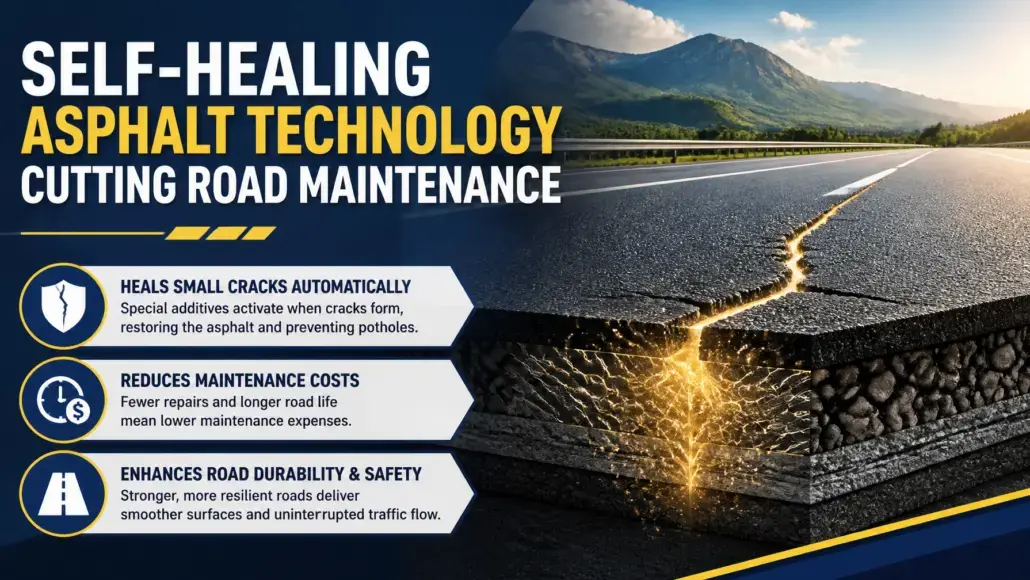
These small cracks eventually expand into potholes and structural failures that require expensive repairs and cause significant traffic disruptions. Transport Advancement observes that the emergence of self-healing asphalt technology offers a proactive solution to this cycle of deterioration by enabling materials to repair themselves without human intervention.
Market Growth and Commercial Adoption
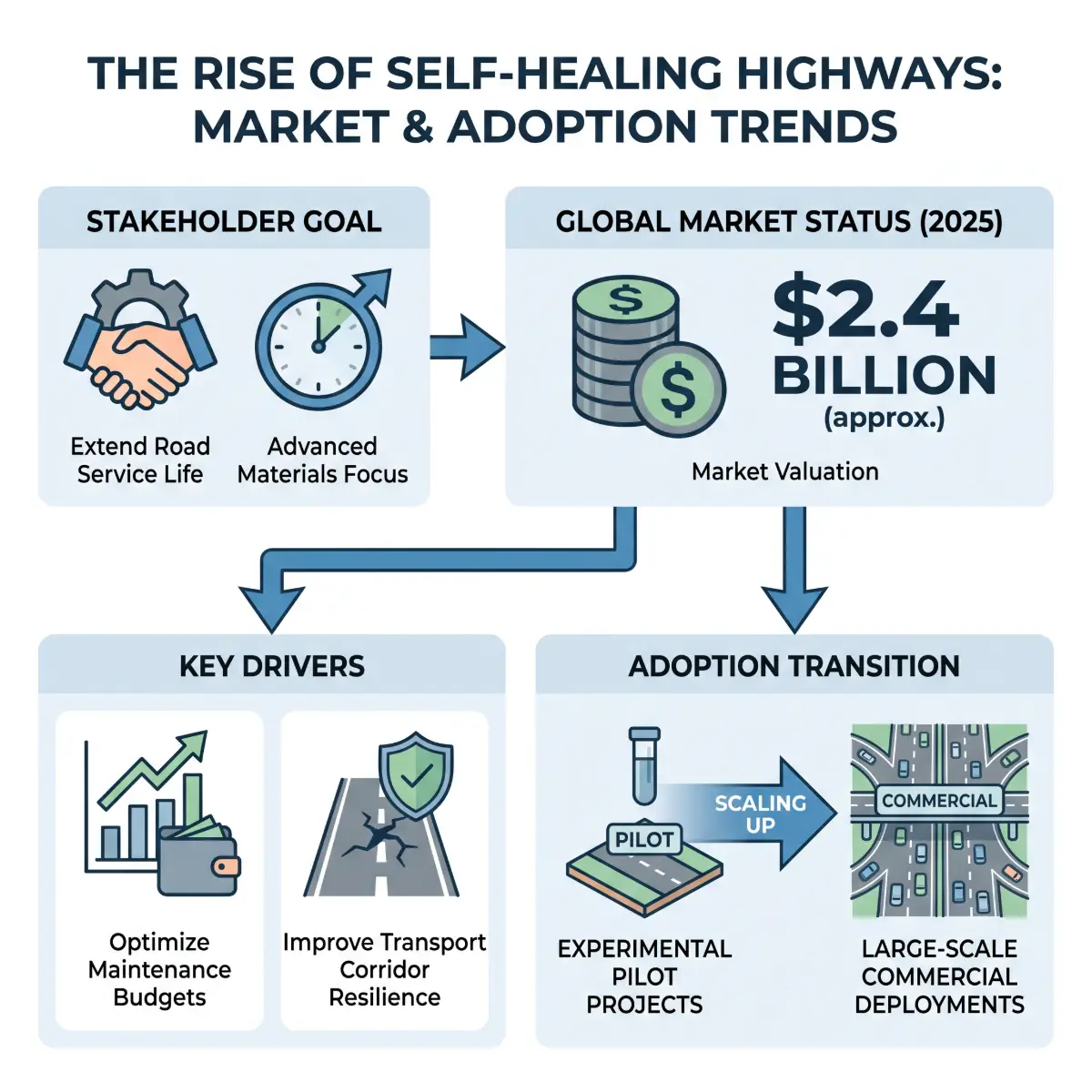
Industry stakeholders are increasingly looking at advanced materials to extend the service life of road networks. The global self-healing highways market reached a valuation of approximately 2.4 billion dollars in 2025. This growth is driven by the urgent need to optimize maintenance budgets and improve the resilience of critical transport corridors. As the demand for durable infrastructure increases, the adoption of self-healing solutions is transitioning from experimental pilot projects to large-scale commercial deployments.
Technical Mechanisms Powering Autonomous Repair
The technical foundation of self-healing asphalt involves the integration of encapsulated healing agents or conductive fibers within the bitumen matrix. The primary mechanisms include:
- Micro-encapsulation: Integration of small capsules containing rejuvenating oils that rupture under stress, sealing cracks as they form.
- Induction Heating: Inclusion of steel wool or conductive fibers that, when heated by a specialized vehicle, soften the bitumen to flow back into fissures.
- Vascular Networks: A series of integrated channels that can deliver healing agents to damaged areas, similar to a biological circulatory system.
- Polymer Modified Bitumen: Enhancing the natural elastic recovery of the binder to close micro-fissures before they expand.
The business case for these materials is centered on the total cost of ownership rather than initial capital expenditure. While self-healing mixes may have higher upfront costs compared to standard hot-mix asphalt, the reduction in maintenance frequency and the extension of pavement life provide a compelling return on investment. Road operators can significantly decrease the need for frequent resurfacing and patch repairs, which accounts for a substantial portion of annual operating budgets. This efficiency is particularly valuable for high-traffic expressways where the cost of lane closures and traffic management can exceed the actual repair costs.
Industry Leadership and Real-World Deployments
Major global companies are actively advancing the deployment of these innovative solutions in real-world environments. Recent developments include:
- VINCI Construction / Eurovia: In July 2026, the company completed the largest-ever upgrade of the R1 Via Pribina highway in Slovakia. This 52-kilometer project demonstrated the capacity for large-scale operators to implement high-performance paving programs under compressed timelines.
- Kraton Corporation: A leader in specialty chemicals, Kraton has developed high-performance polymers and additives that improve the elasticity and durability of bitumen, supporting the integration of healing agents.
- Shell Infrastructure: Continued investment in bitumen technology that integrates recycling and self-healing properties to reduce the carbon footprint of road construction.
- Nynas AB: Developing naphthenic bitumen products that offer superior aging resistance and compatibility with induction-heating additives.
- Arup Group: Engineering consultants actively designing highway specifications that prioritize performance-based materials like self-healing asphalt for long-term resilience.
Beyond simple repair, self-healing materials contribute to broader sustainability goals within the construction sector. By extending the interval between resurfacing projects, these technologies reduce the consumption of virgin aggregates and bitumen. The carbon footprint associated with manufacturing, transporting, and laying new asphalt is significantly lowered when road surfaces remain functional for longer periods. This alignment with environmental regulations and corporate sustainability targets is making self-healing asphalt an attractive option for institutional investors and green infrastructure funds.
Data Integration and Chemical Advancement
The deployment of these materials is often paired with advanced pavement management systems. By using sensors and data analytics, engineers can identify the optimal timing for induction heating treatments to maximize the effectiveness of the healing process. This data-driven approach ensures that maintenance activities are performed precisely when the material is most receptive to restoration. Such precision helps in maintaining geosynthetics across the entire network by ensuring that the underlying layers are not compromised by surface cracks.
The structural integrity of a road depends on more than just the surface layer. While self-healing technology addresses surface-level fissures, long-term durability also requires a stable foundation. Integrating surface innovations with sub-surface reinforcements can create a truly resilient highway system. This holistic view of pavement design is becoming the standard for modern infrastructure projects that aim to minimize downtime over a thirty-year horizon.
Research institutions are continuing to refine the chemical composition of healing capsules to ensure they can survive the high temperatures of the asphalt mixing process. Early iterations of the technology faced challenges with premature capsule rupture during the production phase. However, recent developments in shell materials have led to more robust designs that only break under the specific mechanical stresses of crack formation. These refinements are essential for maintaining the predictability and reliability of the material in diverse climatic conditions.
Policy Changes and Financial Infrastructure
The regulatory environment is also evolving to accommodate innovative paving materials. Many national transport agencies are updating their specifications to include performance-based criteria rather than strictly prescriptive material lists. This shift allows contractors to propose self-healing solutions if they can demonstrate long-term durability benefits through standardized testing. Such flexibility is crucial for fostering a competitive market where technology providers can prove the value of their solutions in varied geographic regions.
Financial institutions are increasingly recognizing the value of resilient infrastructure as a low-risk asset class. The predictability of maintenance costs associated with self-healing roads makes them more attractive for public-private partnerships. When the risk of unexpected structural failure is reduced, the financial model for toll roads and long-term concessions becomes more stable. This financial stability can unlock new sources of funding for highway modernization projects globally.
Transition Toward Smart Infrastructure
The transition toward self-healing asphalt is a key component of the move toward smart infrastructure. As vehicles become more autonomous and connected, the demand for high-quality, predictable road surfaces will only grow. Maintaining the physical condition of the road network is a fundamental requirement for the safe operation of advanced mobility systems. Self-healing technology provides a way to meet this requirement while simultaneously reducing the economic and environmental burden of traditional maintenance.
Transport Advancement notes that future developments in this field are likely to involve the integration of biological agents. Some researchers are exploring the use of bacteria that can precipitate calcium carbonate to seal cracks in asphalt, similar to techniques used in self-healing concrete. While these bio-based solutions are still largely in the laboratory phase, they represent the next frontier in material science. The ongoing investment from major global construction firms suggests that the industry is committed to a future where roads are no longer passive assets but active, self-maintaining systems.
References
- “Self-Healing Highways – The Next Revolution in Road Infrastructure” – Spherical Insights
- “Self-Healing Construction Materials Market Trends 2026” – Polaris Market Research
- “Largest-ever upgrade of the R1 Via Pribina highway completed in record time” – Via Pribina
- “AI Takes the Wheel in Highway Repairs” – Bentley Systems
- “Advanced Drainage Systems Hosts 2026 Investor Day” – Advanced Drainage Systems
