

















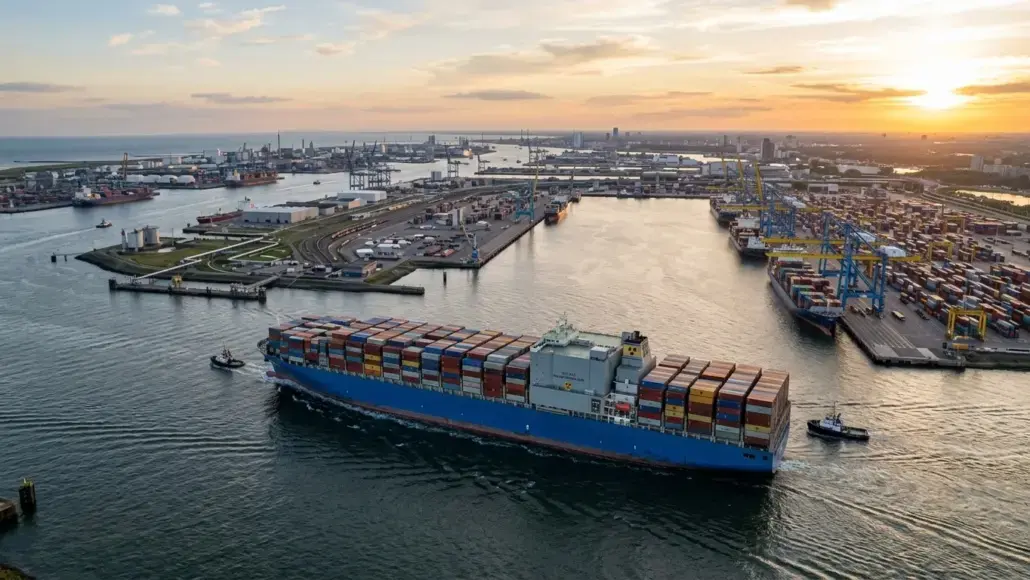
A comprehensive joint development project has explored the potential for nuclear-powered commercial ships to berth at major European ports, with the Port of Rotterdam serving as a focal point for the evaluation. The study, conducted by A.P. Moller – Maersk, the Port of Rotterdam Authority, Lloyd’s Register, and CORE POWER, suggests that current port safety and risk-management protocols could offer a viable basis for assessing the viability of nuclear-powered vessel arrivals.
The report, titled ‘Enabling Nuclear-Powered Feeder Ships: A Joint Development Project on Port Call Feasibility and Regulatory Pathways’, advocates for the inclusion of maritime nuclear propulsion in broader discussions concerning shipping decarbonization, energy resilience, and long-term industrial competitiveness. By using the Port of Rotterdam as a case study, the project aimed to understand how novel energy and shipping technologies might integrate with established port safety frameworks, operational procedures, and regulatory processes.
“Ports need to understand how emerging energy and shipping technologies may interact with future port operations and industrial systems,” said René de Vries, Harbour Master of the Port of Rotterdam.
“This study represents an initial case-study assessment intended to better understand the regulatory, operational and safety considerations associated with nuclear-powered commercial shipping within a European port context,” he added.
The findings indicate that the established risk-based safety frameworks, already familiar to European ports, could serve as a credible structure. This is contingent upon the systematic incorporation of nuclear-specific safety, security, and operational aspects, supported by relevant national and international guidelines. The study highlights that the primary hurdles for future maritime nuclear propulsion are likely to revolve around aligning regulations, establishing governance, integrating nuclear and maritime safety regimes, and ensuring public and institutional readiness. For instance, existing International Maritime Organization (IMO) regulations for nuclear-powered ships, originating from an earlier period, would require updating to support any future pathway for civilian commercial nuclear propulsion.
Ole Graa Jakobsen, Head of Fleet Technology at A.P. Moller – Maersk, said, “Shipping’s long-term energy transition will require the consideration of multiple fuel and technology pathways. Civil commercial nuclear propulsion presents a number of significant challenges, including safety, waste management, regulatory alignment and public acceptance across regions.”
“This study does not represent a decision to pursue nuclear propulsion, but contributes to further understanding of what would be required for ports and authorities to assess such vessels in a structured and responsible way. We continue to monitor and assess this technology alongside other low-emission solutions,” he added.
