

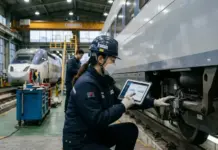

















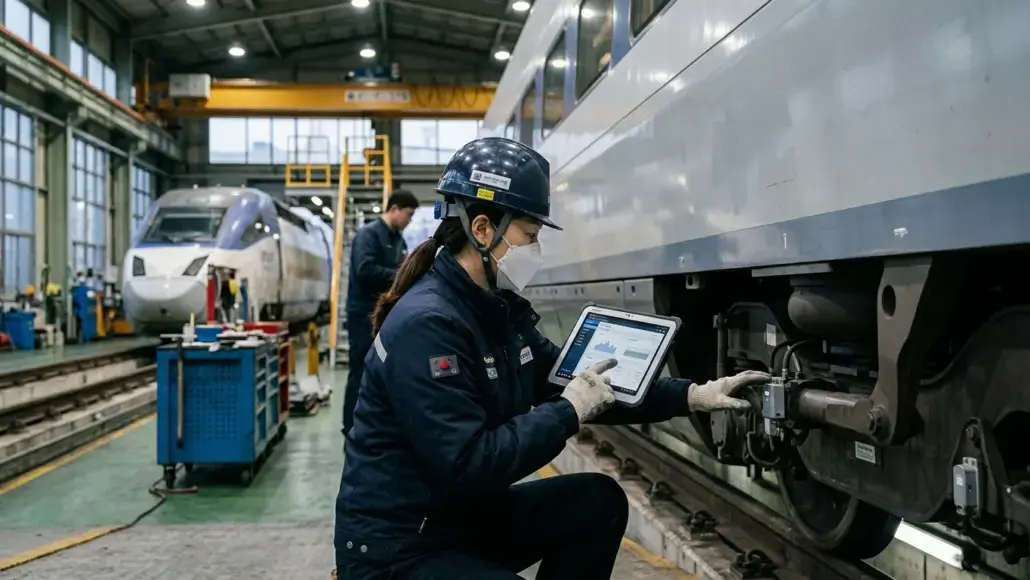
South Korea’s Ministry of Land, Infrastructure and Transport announced on 27th July 2026 that it will begin equipping new rail cars, including KTX-Eum and Cheongryong, with sensors across critical systems to monitor vehicle conditions in real time. Through artificial intelligence (AI) analysis, the ministry plans to forecast potential failures before they occur and determine the most effective timing for replacing components. The initiative marks a major shift in railway maintenance, replacing the long-standing practice of conducting light maintenance at fixed operating intervals of every 3 days, 15 days, 4 months, 7 months, and 14 months with a more efficient maintenance model.
As part of its broader “full life-cycle reinforcement plan for rail car maintenance,” the Ministry of Land, Infrastructure and Transport (MOLIT) confirmed the introduction of condition-based maintenance (CBM), a system designed to identify potential problems before they develop into operational failures. The ministry is pursuing the initiative as derailments, fires, train failures, delays, and other service disruptions have continued to rise compared with the same period last year.
According to the Ministry of Land, Infrastructure and Transport (MOLIT), train failures resulting in service disruptions of 20 minutes or longer reached 40 through June this year, an increase from 31 during the corresponding period last year. The ministry also highlighted that 53% of high-speed trains and 62% of conventional trains have been operating for 20 years or more. Combined with higher train utilization rates than those seen overseas and increasingly challenging climate conditions, including heat waves and cold snaps, these factors have heightened the need for more advanced railway maintenance practices.
AI Platform and Predictive Analytics to Strengthen Railway Maintenance
Once the condition-based maintenance (CBM) framework is fully established, sensors will monitor 16 essential systems, including the power unit, running gear, signaling equipment, doors, and heating and cooling units, enabling operators to identify failures immediately and respond without delay. The collected operational data—including vibration, temperature, noise, and current readings—will be processed using AI algorithms. By 2028, the system is expected to detect signs of anomalies before failures occur, while by 2030 it will be capable of predicting the remaining service life of individual parts.
In parallel, an AI vehicle maintenance platform will be developed to integrate technical information, maintenance records, accident reports, and failure histories into a unified system that supports data-driven maintenance. By 2030, the government also plans to invest 200 billion won to replace 30 categories of aging electrical systems on high-speed trains.
Passenger safety requirements will become more stringent as well. If failures or abnormal signs are detected in any of 14 critical systems—including power, running, and braking systems—that could contribute to derailment risks, commercial operation will, in principle, be prohibited. Authorities also confirmed that trains found operating without mandatory maintenance will face a zero-tolerance policy, including criminal penalties under the Railroad Safety Act.
To further improve railway maintenance, a dedicated “cause investigation task force” involving the Ministry of Land, Infrastructure and Transport, the Korea Railroad Research Institute, the Korea Transportation Safety Authority, manufacturers, and other related organizations will strengthen root-cause investigations beyond simple parts replacement. Additionally, spare trains will be permanently stationed at Seoul, Busan, Gwangju Songjeong, Suseo, Osong, and Gyeongju, allowing replacement trains to be dispatched anywhere on high-speed lines within 30 minutes during emergencies.
