










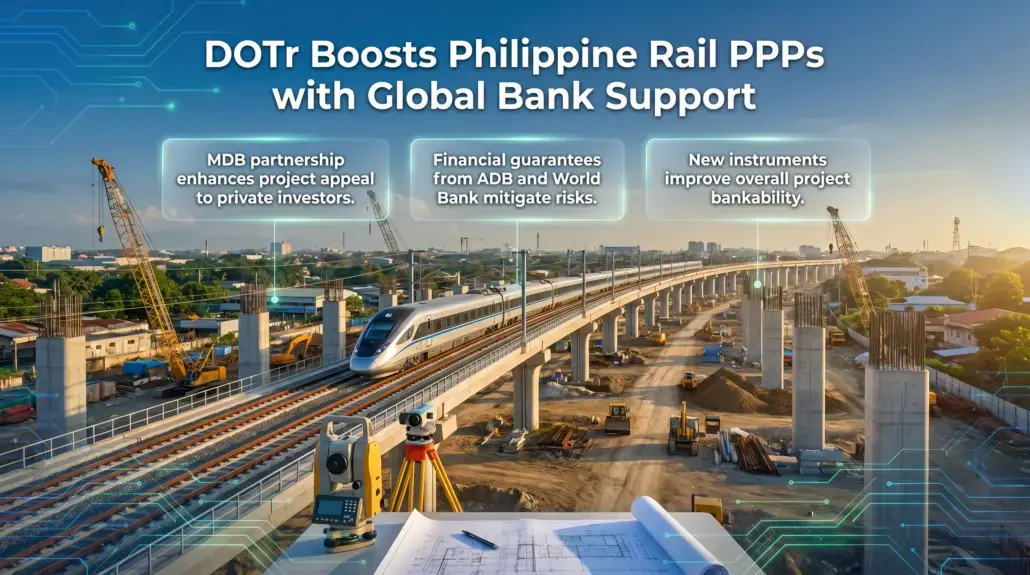
The Philippines’ Department of Transportation (DOTr) is strategically increasing its engagement with multilateral development banks (MDBs) to bolster investor confidence and participation in the Philippines’ forthcoming railway public-private partnership (PPP) initiatives. This approach aims to enhance the bankability of these significant rail PPP projects by integrating robust financing support and risk-mitigation mechanisms.
Speaking at the Asia Infrastructure Forum (AIF) 2026, DOTr Undersecretary for railways Timothy John R. Batan highlighted how MDB-backed guarantees and concessional financing facilities from the Asian Development Bank (ADB) and the World Bank are anticipated to make substantial Philippine railway projects more appealing to the private sector.
Currently, the government is actively marketing three key railway PPP projects:
- The Metro Rail Transit Line 3 (MRT-3) capacity expansion and its operations and maintenance (O&M)
- The Light Rail Transit Line 2 (LRT-2) rehabilitation and O&M
- The Metro Manila Subway Project (MMSP) O&M concession
These projects are scheduled to commence their solicited tender process in the third quarter of 2026, with evaluations and awards expected the following year before their eventual handover to private concessionaires. The utilization of MDB-backed financial instruments is a direct response to feedback gathered during market-sounding activities with potential investors.
Batan elaborated that the government has been collaborating closely with both multilateral and bilateral development partners. This collaboration focuses on aligning capital-intensive railway projects with international standards for project preparation, risk sharing, and financing, recognizing the critical importance of proper structuring for multi-billion peso infrastructure investments. These MDB-backed guarantees and financing facilities represent a novel inclusion in Philippines’ rail PPP projects, designed to better attract private sector capital.
The strong interest observed in the North-South Commuter Railway (NSCR) O&M PPP serves as a positive indicator. This project has already drawn participation from major international railway operators and infrastructure firms, including Japan’s JR East and JR West, Paris Metro operator RATP Dev, French transport operators Keolis and Transdev, as well as local firms San Miguel Corp. (SMC), Ayala Corp., and First Balfour.
The NSCR is a substantial 147-kilometer railway designed to connect Clark International Airport and New Clark City with Metro Manila and Calamba City. To further support such endeavors, the Philippines is seeking significant ADB-backed partial credit guarantees for the NSCR O&M concession. This proposed facility is intended to act as a liquidity backstop for availability payments due to the future operator, thereby addressing market concerns regarding potential payment delays and encouraging wider participation from leading global railway operators.
A particularly innovative tool being explored in rail PPPs is the Step-Up Loan (SUL) facility from the International Bank for Reconstruction and Development (IBRD), a lending arm of the World Bank Group. For the LRT-2 rehabilitation and O&M PPP, potential concessionaires could access up to $300 million in optional concessional financing through this IBRD SUL.
In parallel, the Metro Rail Transit Line 4 (MRT-4) is undergoing recalibration amidst interagency discussions. Both the ADB and the Asian Infrastructure Investment Bank (AIIB) have shown interest in co-financing MRT-4, which is planned to link eastern Metro Manila with the expanding communities in Rizal province. The DOTr is also pursuing a transit-oriented development (TOD) framework for MRT-4, integrating mixed-use developments and commuter-oriented facilities around key stations. This TOD model aims to enhance the project’s investment appeal by creating opportunities for commercial and residential developments and allowing affected landowners and businesses to benefit from the generated economic activity.
