










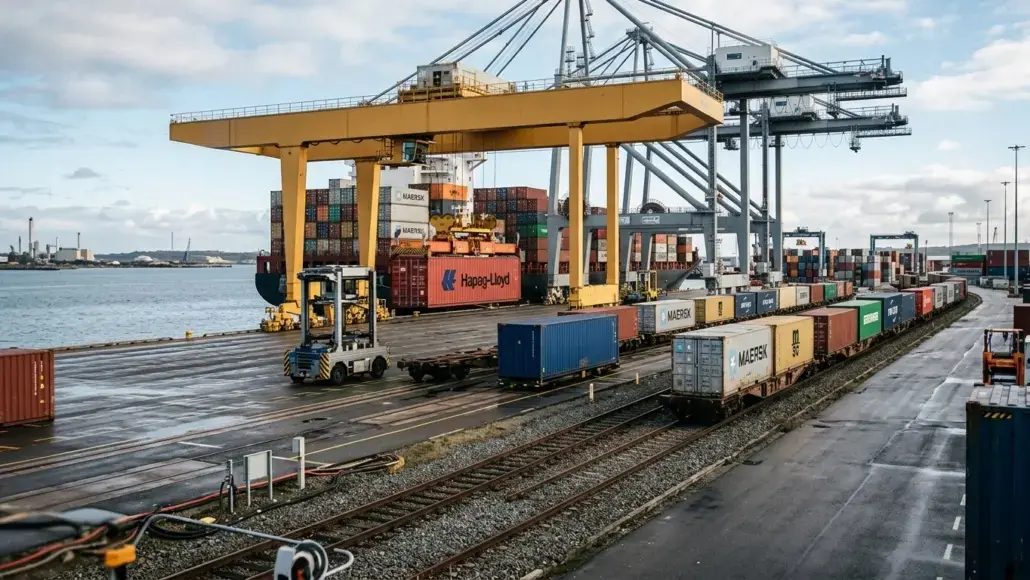
The efficiency of global supply chains increasingly depends on the speed and reliability of the transition points where goods move between different modes of transport. Among these, the connection between maritime ports and rail networks is perhaps the most critical. As container ships grow in size and the volume of international trade continues to rise, the traditional, manual processes of unloading ships and loading trains are becoming significant bottlenecks. Port-to-rail automation has emerged as the definitive solution to this challenge, introducing a suite of advanced technologies that synchronize the movement of cargo with unprecedented precision. Transport Advancement believes that by automating the transfer systems that link the quay to the rail yard, the industry is building a more fluid, cost-effective, and sustainable multimodal network. This digital and mechanical transformation is not just improving terminal operations. It is redefining the very architecture of global trade.
The Convergence of Maritime and Rail Logistics
In the past, port and rail operations often functioned as separate silos, with limited data sharing and manual coordination at the handover points. This fragmentation led to long ‘dwell times’—the period a container spends sitting in a yard waiting for its next transport leg. Port-to-rail automation breaks down these barriers by creating a unified digital and physical flow. Modern smart ports utilize integrated Terminal Operating Systems (TOS) that communicate directly with rail management software. This allows for the real-time scheduling of trains based on the exact progress of the unloading cranes. By treating the port and the rail head as a single, integrated system, operators can eliminate unnecessary delays and ensure that cargo keeps moving toward its final destination. The goal is a ‘seamless’ transition, where the arrival of a vessel and the departure of a freight train are perfectly synchronized.
Automated Stacking Cranes (ASC) and Yard Orchestration
The cornerstone of the modern automated terminal is the Automated Stacking Crane (ASC). These massive, rail-mounted machines are capable of organizing thousands of containers in the terminal yard with surgical accuracy. Unlike traditional cranes operated by a driver in a cabin, ASCs are controlled by sophisticated software that optimizes the placement of each container based on its priority and intended transport mode. For port-to-rail automation, ASCs are the engine of yard orchestration. They can pre-stage containers destined for rail transport in specific blocks near the tracks, ensuring that when the train arrives, the loading process is as fast as possible. This level of organization reduces the number of ‘re-handles’—moving a container just to get to another one—which is a primary source of inefficiency in manual yards.
Intelligent Gate Systems and OCR for Rapid Intake
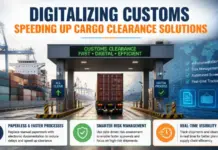
Efficiency begins the moment a shipment enters the terminal. Automated rail gates, equipped with Optical Character Recognition (OCR) and Radio Frequency Identification (RFID) technology, are transforming the intake process. As a freight train rolls into the port, high-speed cameras sweep the wagons, instantly identifying container numbers, seal integrity, and wagon IDs. This data is automatically cross-referenced with the terminal’s database, allowing the train to enter without stopping for manual inspection. This ‘gate automation’ significantly reduces the time required for train arrival and departure, allowing for more frequent rail services and a higher throughput. In a multimodal system, where speed is paramount, the ability to process a 100-car train in minutes rather than hours is a major competitive advantage, ensuring that the rail link remains the most efficient choice for long-distance transport.
Automated Guided Vehicles (AGV) in Intermodal Transfers
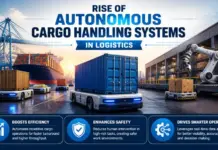
Connecting the ship’s side to the rail yard requires a robust and agile internal transport system. In automated terminals, this role is increasingly filled by Automated Guided Vehicles (AGVs). These driverless, battery-powered vehicles transport containers across the terminal following pre-defined paths. In the context of port-to-rail automation, AGVs act as the physical link between the ship-to-shore (STS) cranes and the rail stacking area. Because they are controlled by a central AI, AGVs can be dispatched with perfect timing, ensuring that cranes never have to wait for a vehicle. The latest generation of AGVs is even more flexible, capable of navigating complex layouts and interacting with both cranes and automated rail loaders. This robotic workforce operates 24/7 in all weather conditions, providing a level of consistency and safety that manual trucking cannot match.
Reducing Dwell Time and Improving Port Throughput
The primary metric of success for any port is throughput—the amount of cargo it can process in a given time. Dwell time is the enemy of throughput. By automating the port-to-rail link, terminals can significantly reduce the time a container spends on the ground. When a container is moved directly from the ship to a rail-bound AGV, and then immediately loaded onto a waiting train by an automated crane, the dwell time can be reduced from days to hours. This high-velocity movement allows the port to handle more cargo without expanding its physical footprint—a vital consideration for land-constrained urban ports. Improving port-to-rail efficiency also has a positive ripple effect throughout the entire supply chain, reducing inventory carrying costs for shippers and ensuring that manufacturing lines remain supplied with raw materials on a just-in-time basis.
The Role of AI in Synchronizing Ship-to-Shore-to-Rail Flows
The ‘brains’ behind port-to-rail automation is Artificial Intelligence. AI algorithms are responsible for the complex task of ‘synchromodality’—deciding the best way to move each container through the terminal in real-time. This involves balancing the speeds of different machines, predicting potential bottlenecks, and adjusting schedules in response to unplanned events, such as a delayed vessel or a mechanical issue. The AI considers millions of permutations to find the most efficient path for every shipment. By constantly learning from terminal data, the AI can identify systemic inefficiencies and recommend improvements to the terminal layout or process flow. This continuous optimization ensures that the automated systems are always operating at their peak technical limit, providing a level of performance that is far beyond the reach of traditional human-led planning.
Future Outlook: Fully Autonomous Intermodal Terminals
As we look toward the future, the integration of automation will move toward the concept of the ‘dark terminal’—a facility that operates entirely without human presence on the ground. In this future, port-to-rail automation will be fully integrated with autonomous ships and autonomous freight trains. The entire multimodal journey, from the deep ocean to the inland distribution center, will be managed by a decentralized network of AI systems. This will eliminate the final sources of human error and friction in the supply chain, leading to a world where the movement of goods is as fast and reliable as the movement of information. The transition to fully autonomous intermodal terminals is a massive undertaking, requiring billions in investment and a complete overhaul of global logistics standards. However, the benefits in terms of efficiency, safety, and sustainability make this an inevitable destination for the industry.
Port-to-rail automation is the key to a more efficient and resilient global supply chain. By bridging the gap between maritime and rail logistics through advanced technology, the industry is creating a high-performance network that can meet the demands of the 21st century. The benefits of this transformation—faster transfers, reduced costs, and lower environmental impact—are already being felt in the world’s most advanced ports. Transport Advancement highlights that as the technology continues to mature and find application in terminals around the world, its impact on global trade and economic growth will only increase. For the logistics sector, the move toward automation is not just a technological upgrade. It is a fundamental shift in how we connect the world. The future of multimodal transport is automated, and the port-to-rail link is the vital connection that is making it possible.
