










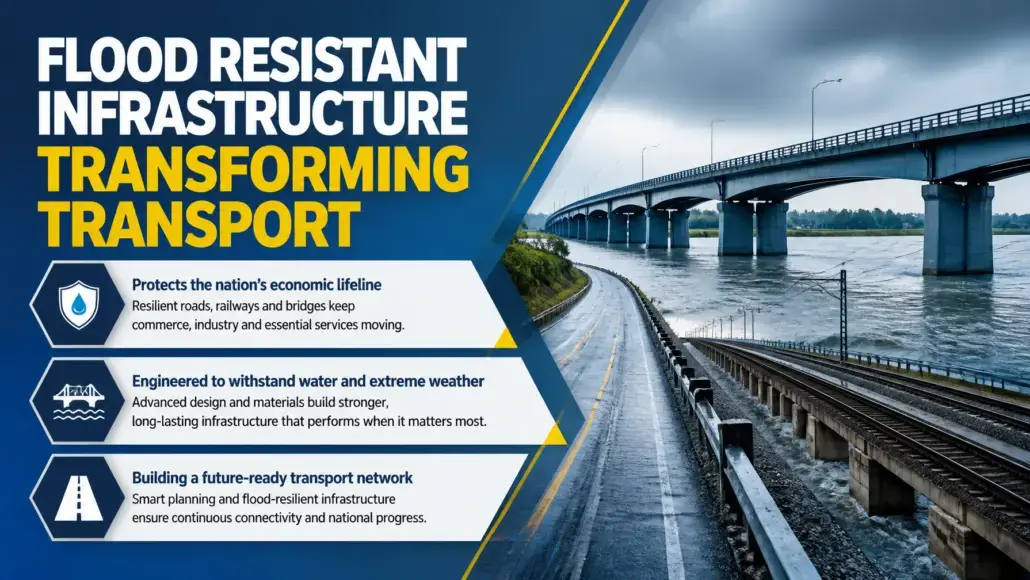
The stability of a nations transportation network is the invisible foundation upon which its economy is built. When this foundation is threatened by natural disasters, the consequences are felt in every sector, from retail and manufacturing to healthcare and emergency services. In recent years, the devastating impact of water on roads, railways, and bridges has brought the flood resistant infrastructure to the forefront of public policy and engineering innovation. We are no longer in an era where infrastructure can be built to withstand historical averages, instead, it must be designed to survive the unprecedented extremes of a changing climate.
Engineering for an Era of Extreme Rainfall
Transport Advancement notes that the physical design of our transport networks is undergoing a fundamental transformation to better manage the impact of heavy rain and rising waters. One of the most significant changes is the adoption of permeable pavements and green infrastructure. These materials allow water to seep through the surface and into the ground below, rather than accumulating on the road and creating hazardous driving conditions. By mimicking the natural water cycle, these systems reduce the load on traditional drainage networks and help to prevent the flash flooding that can paralyze a city in a matter of minutes.
Bridges and tunnels are also being redesigned with flood resilience in mind. Modern bridge foundations are built to withstand the immense pressure of fast moving water and the debris it carries, a phenomenon known as scour. Engineers are using more robust materials and deeper pilings to ensure that these critical links remain stable even during extreme flooding. In tunnels, the focus is on advanced pumping systems and waterproof seals that can prevent inundation and protect the sensitive electrical and mechanical systems housed within. The flood resistant infrastructure is driving a new era of engineering excellence that prioritizes durability and adaptability above all else.
The Rise of the Sponge City Concept
In many urban areas, the traditional approach to flood management, which relies on pipes and concrete channels, is no longer sufficient. This has led to the rise of the sponge city concept, where the entire urban landscape is designed to absorb, store, and purify rainwater. In the context of transportation, this means integrating parks, wetlands, and bio swales alongside roads and railways. These natural features act as buffers, capturing excess water and releasing it slowly back into the environment. This not only reduces the risk of flooding but also improves the quality of the water and enhances the biodiversity of the urban environment.
The integration of green infrastructure into transport corridors also offers significant aesthetic and social benefits. A road that is lined with trees and vegetation is not only more resilient to flooding but also more pleasant for the people who use it. It helps to reduce the urban heat island effect and provides valuable public space in crowded cities. The flood resistant infrastructure is thus contributing to a more holistic and sustainable approach to urban development, where infrastructure serves multiple purposes and enhances the quality of life for all residents.
Data Driven Resilience and Predictive Analytics
While physical engineering is critical, the modern approach to flood resilience is increasingly defined by the use of data and technology. Real time sensors placed throughout the transport network can monitor water levels, soil moisture, and structural integrity, providing a continuous stream of information to central control centers. This data allows authorities to detect the early signs of flooding and to take proactive measures, such as closing vulnerable roads or activating mobile flood barriers. The ability to respond quickly and effectively is a key factor in minimizing the impact of a disaster and in ensuring a rapid recovery.
Predictive analytics and climate modeling are also playing a vital role in the planning and design of new infrastructure. By simulating the impact of future flood events, engineers can identify the most vulnerable points in the network and prioritize investments where they are needed most. These models take into account a wide range of factors, including land use changes, sea level rise, and the increasing intensity of rainfall. The flood resistant infrastructure is driving the development of more sophisticated and accurate tools that allow us to see the future of our climate and to build accordingly.
Enhancing Supply Chain Continuity and Economic Stability
The economic impact of transport disruptions caused by flooding is immense. When a major highway or rail line is closed, the flow of goods and people is interrupted, leading to significant financial losses for businesses and a decrease in productivity. By investing in flood resistant infrastructure, governments can ensure the continuity of supply chains and protect the economic stability of their regions. A resilient network is a competitive advantage in a global market, as it provides the reliability that businesses need to thrive and grow.
The importance of resilient infrastructure is also being recognized by the insurance and finance sectors. Projects that are designed to be flood resistant are increasingly seen as lower risk investments, making them easier and cheaper to finance. Insurance companies are also beginning to factor resilience into their premiums, providing a direct financial incentive for authorities to invest in more robust designs. The move toward a more resilient transportation network is thus being supported by a broad range of economic and political forces, all working together to ensure a more stable and prosperous future.
Social Equity and the Protection of Vulnerable Communities
Flooding often has a disproportionate impact on the most vulnerable members of society, who may live in areas with poor infrastructure or who have limited resources to recover from a disaster. A key goal of flood resistant infrastructure is to ensure that all communities are protected, regardless of their economic status. This means prioritizing investments in areas that are at the highest risk and ensuring that the transport network provides reliable access to essential services for everyone.
Resilient transportation is also a matter of public safety. During a major flood event, the ability of emergency services to reach those in need is often determined by the stability of the transport network. A bridge that remains open or a road that is not submerged can be the difference between life and death. By building more resilient infrastructure, we are not only protecting our economy but also our people. The commitment to flood resistance is a reflection of our values as a society and our responsibility to protect one another in the face of natural disasters.
Challenges in Funding and Political Will
Despite the clear benefits, the transition to flood resistant infrastructure faces significant challenges. The primary hurdle is often the high cost of upgrading existing networks and building new, resilient designs. In an era of competing priorities and limited budgets, finding the necessary funding can be difficult. There is also a need for greater political will to prioritize long term resilience over short term gains. Building for the climate of the future requires a vision that extends beyond the next election cycle.
However, the cost of inaction is far higher than the cost of investment. The repairs and economic losses caused by a single major flood event can easily exceed the cost of building more resilient infrastructure. As the public becomes more aware of the risks and as the impacts of climate change become more visible, the pressure on governments to act is growing. Transport Advancement believes that by working together, we can build a transportation network that is as resilient as it is efficient, providing a solid foundation for the future.
