












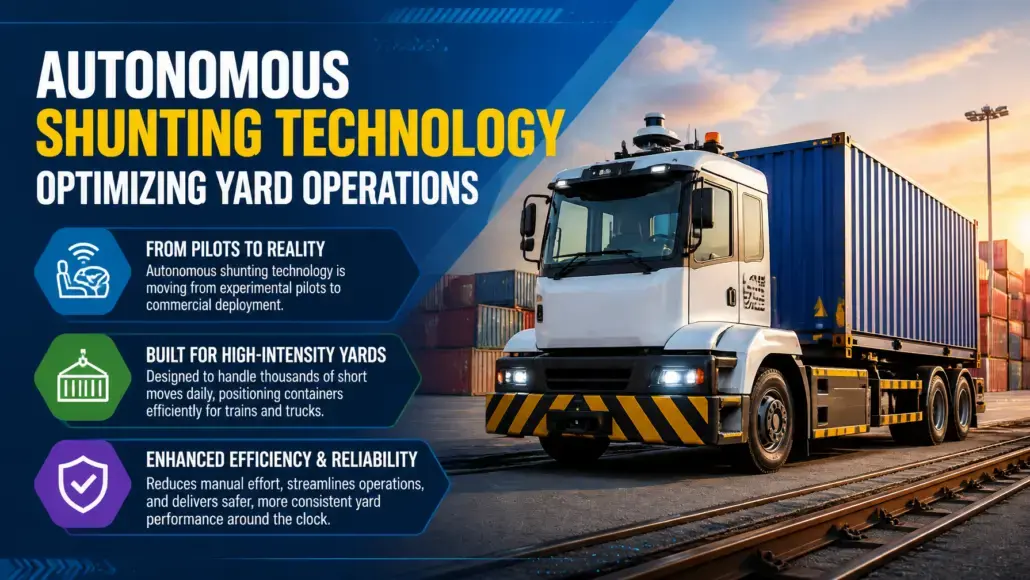
Rail yards and intermodal terminals have long been the manual workhorses of the global supply chain. In these high-intensity environments, terminal tractors, often called hostlers or shunters, perform thousands of short-distance moves every day to position containers for loading onto trains or trucks. This repetitive and labor-intensive process is now undergoing a fundamental transformation. Transport Advancement notes that autonomous shunting technology is moving from experimental pilots to commercial deployment, driven by a combination of labor shortages and the need for higher operational precision.
The global autonomous terminal tractor market reached a valuation of approximately 4.8 billion dollars in 2025. Market research from DataIntelo suggests this sector is on track to reach 13.2 billion dollars by 2034, representing a compound annual growth rate of nearly 12 percent. This surge in investment is underpinned by the significant productivity gains that automation offers. In an era where every minute of equipment idle time translates to lost revenue, the ability to operate a fleet of yard tractors 24/7 without human intervention is a powerful value proposition for terminal operators.
Improving Safety and Operational Reliability
Safety remains the most compelling argument for the adoption of autonomous shunting technology. Rail yards are inherently dangerous places, with heavy machinery moving in close proximity to ground personnel. A 2025 report from the U.S. Congressional Research Service highlighted that roughly 25 percent of rail-yard accidents involved remote-control locomotives, whereas these incidents accounted for less than 1 percent on main lines. This disparity underscores the risks associated with manual or semi-manual yard operations.
By removing the driver from the cab, autonomous systems eliminate the risks associated with fatigue and human error in confined spaces. Leading engineering firms are now focusing on creating fully automated environments where machines communicate with each other to prevent collisions. Siemens Mobility, for instance, completed the full automation of the largest rail freight yard in the Netherlands, the Kijfhoek facility, in June 2025. This yard serves as a vital link for the Port of Rotterdam, and its automation ensures that shunting operations can continue with high reliability regardless of weather conditions or labor availability.
Leading Global Developments in Autonomous Hostlers
Several major global companies are at the forefront of this technological shift. Kalmar, a subsidiary of Cargotec, has been a dominant force in terminal equipment for decades. In April 2025, Kalmar unveiled the Ottawa AutoTT, an autonomous terminal tractor developed in partnership with Forterra. This vehicle is designed to operate in complex yard environments with minimal infrastructure changes. The Ottawa AutoTT is currently undergoing its second round of field testing in Kansas, focusing on real-world reliability in varying temperatures and lighting conditions.
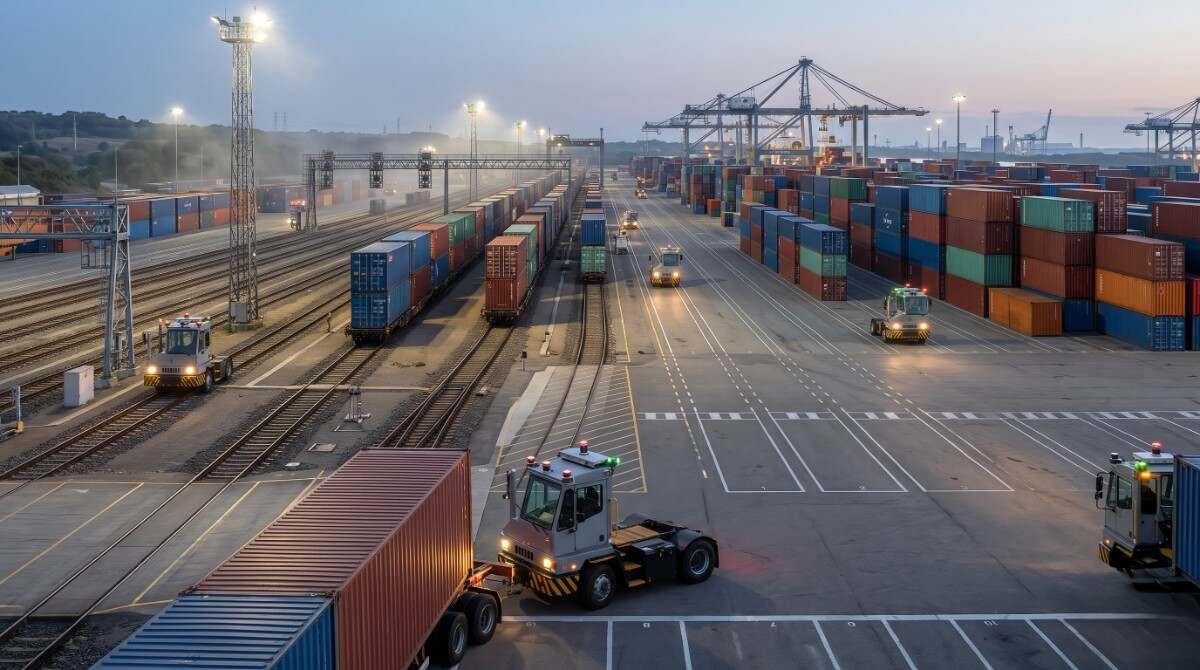
Other significant developments include:
- DB Cargo and Bosch subsidiary ITK Engineering announced a partnership in March 2025 to develop a fully automated shunting locomotive for series production.
- HHLA TK Estonia transitioned to fully driverless terminal tractor operations at its Tallinn terminal in July 2025, marking a European first for the organization.
- EUROGATE successfully completed a Level 4 autonomous proof-of-concept using MAFI terminal tractors at the Wilhelmshaven container terminal in January 2025.
- China Energy’s Shuohuang Railway launched an intelligent remote shunting system at Huanghua Port Station in early 2025 to improve heavy-haul freight efficiency.
These projects demonstrate that the industry is moving toward a standard where autonomous equipment is integrated directly into the Terminal Operating System. This integration allows for dynamic task assignment, where the central system can dispatch an autonomous hostler to the exact location of a container as soon as it is needed.
Technological Foundations of Yard Autonomy
The success of autonomous shunting technology depends on a sophisticated stack of sensors and software. Most modern autonomous hostlers use a combination of LiDAR, radar, and high-definition cameras to build a 360-degree map of their surroundings. This sensor fusion allows the vehicle to detect obstacles, read container numbers, and navigate to docking stations with centimeter-level precision.
Furthermore, the shift toward electric and hydrogen propulsion is coinciding with the move toward autonomy. Hyster-Yale has been active in trialing hydrogen fuel-cell terminal tractors in Hamburg throughout 2024 and 2025. The combination of zero-emission power and autonomous control addresses two of the biggest challenges facing modern terminals: environmental impact and labor costs. When a tractor is both electric and autonomous, the total cost of ownership over its lifecycle can be significantly lower than traditional diesel-powered, human-operated alternatives.
The Role of Predictive Maintenance in Autonomous Fleets
Maintaining a fleet of autonomous vehicles requires a different approach than traditional mechanical maintenance. Because these tractors are packed with sensitive electronics and sensors, any failure in a single component can take the entire vehicle out of service. This makes the implementation of predictive maintenance safeguards rolling stock and yard assets even more critical, as it allows operators to identify sensor degradation or battery issues before they cause an operational stoppage.
Predictive maintenance systems use the data generated by the autonomous hostler to monitor health in real time. If a LiDAR sensor begins to show signs of misalignment or a motor shows abnormal heat patterns, the system can automatically schedule the vehicle for a service check during a scheduled lull in operations. This proactive approach ensures that the autonomous fleet maintains the high availability required for modern just-in-time logistics.
Future Outlook for Intermodal Yard Automation
As we move through 2026, Transport Advancement observes that the focus is shifting from proving that the technology works to scaling it across entire networks. McKinsey estimates that intermodal terminals will see a significant increase in the use of autonomous hostlers as part of a broader logistics automation trend worth hundreds of billions in productivity potential. The goal is to create a dark yard where the movement of containers is entirely orchestrated by AI, from the moment they arrive at the gate to the moment they are loaded onto a train.
Strategic investments in infrastructure will be necessary to support this vision. While some autonomous tractors are designed to work in existing yards, the highest levels of efficiency are achieved when the yard itself is designed for automation. This includes dedicated lanes for autonomous vehicles, standardized charging infrastructure, and high-speed 5G networks for real-time machine-to-machine communication. The next few years will likely see a wave of terminal retrofits as operators seek to capitalize on the benefits of autonomous shunting technology.
References
- “Autonomous Terminal Tractor Market Analysis 2025-2034” – DataIntelo
- “Rail Yard Safety and Technology Report 2025” – U.S. Congressional Research Service
- “Kijfhoek Rail Yard Automation Announcement” – Siemens Mobility
- “Ottawa AutoTT Product Launch” – Kalmar
- “Automated Shunting Locomotive Series Production Plan” – DB Cargo
- “European Driverless Terminal Tractor Operations” – HHLA
