










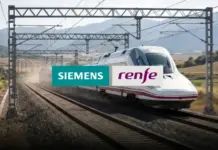




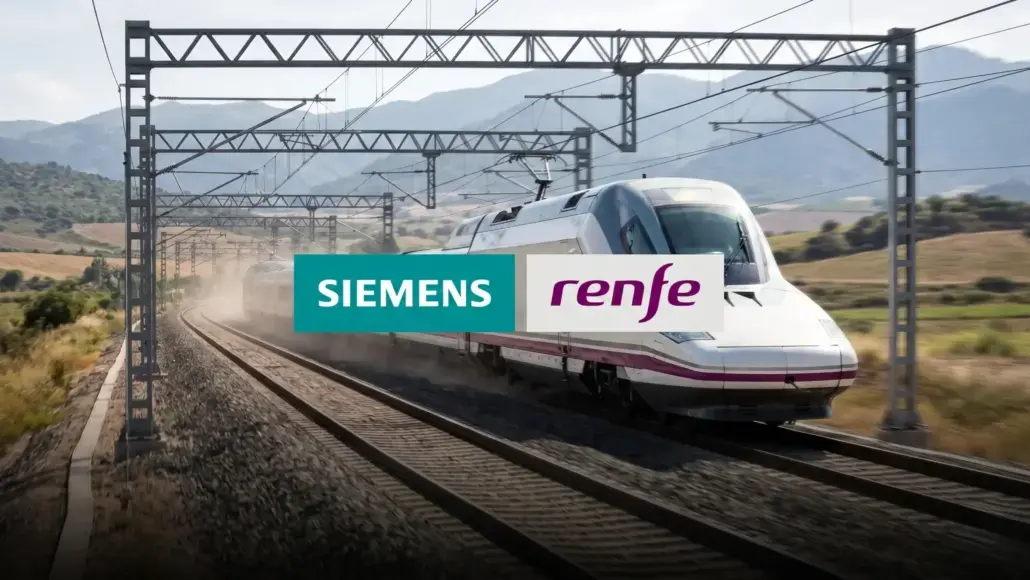
Spain’s national passenger rail operator Renfe has awarded Siemens Mobility a contract worth around EUR 1.22 billion for the supply of 30 Velaro Novo high-speed trains. The agreement, announced on 27th October 2026, includes equipment for maintaining the new fleet and an option to acquire ten additional trainsets, potentially increasing the total order to 40 trains.
The EUR 1.22B high-speed train deal represents one of Renfe’s most significant investments in high-speed rolling stock as the operator looks to replace older trains and expand transport capacity in Spain’s liberalised rail market, where it competes with Iryo and Ouigo. Developed from the Velaro platform, which Renfe already operates through its 103 series, the Velaro Novo belongs to a new generation of Siemens trains. However, the model has not yet entered commercial service. Spanish Minister for Transport Óscar Puente acknowledged that the selection of Siemens came as a surprise, adding that Spain could become the first country to operate the new trains for passenger services.
Velaro Novo Trains Designed for 350 km/h Operations
The new trainsets will be designed for speeds of 350 km/h, although their actual operating speeds will depend on the characteristics and authorisation of the railway lines on which they run. Each train will comprise seven single-level railcars with a total capacity of 520 seats. The seating arrangement will include 404 seats in Turista class, with pairs of seats on either side of the aisle, and 116 seats in Preferente class, arranged in a two-plus-one configuration. Passengers will be able to adjust their seats to face the direction of travel, while every seat will include a power socket and a USB port.
Siemens aims to increase passenger capacity without extending train length by reducing the weight of the vehicles and the space occupied by technical equipment. The design will also incorporate larger multi-purpose areas for luggage, bicycles and passengers with reduced mobility. New bogies and aerodynamic improvements are intended to minimise noise, vibrations and pressure fluctuations when trains pass through tunnels or cross paths with other trains travelling at high speeds. In addition, a digital architecture will support higher-capacity Wi-Fi connections and allow information and entertainment systems to be updated throughout the trains’ operational lives.
Battery-Powered Last Mile System and Predictive Maintenance
A key feature of the Velaro Novo fleet will be the Last Mile system, which uses high-capacity batteries to power the traction equipment in certain breakdown situations. This capability is intended to let trains cover limited distances when their normal power supply is unavailable, reducing the immediate need for a rescue locomotive.
Reliability measures will include fewer components, continuous system monitoring, remote diagnostics and predictive maintenance. These technologies are designed to detect faults earlier and help limit downtime, delays and cancellations. The lighter construction, improved aerodynamics and modern traction systems are also expected to lower energy consumption and operating costs. As part of the EUR 1.22B high-speed train deal, these technical features will accompany the fleet expansion, supporting Renfe’s efforts to improve operational performance while increasing passenger capacity.
Renfe Sets Delivery Deadlines for the New Fleet
The contract establishes specific delivery milestones for the new trains. Siemens Mobility must deliver the first five trainsets within 40 months at the latest, while the complete batch of 30 trains must arrive within a maximum of 62 months, with deliveries scheduled in stages. Meeting these deadlines was a key consideration in the procurement process, which began in April 2026. Renfe stated in its press release that it could no longer afford delays similar to those encountered in some recent rolling stock procurements.
Consequently, the agreement places importance on both the technical performance of the trains and Siemens Mobility’s ability to meet the agreed schedule. Siemens secured the contract ahead of Hitachi Rail, which submitted a bid featuring a model from the ETR1000 family. The acquisition will provide Renfe with up to 15,600 seats across the 30 trainsets, reinforcing the operator’s efforts to strengthen its position in Spain’s high-speed rail market. The EUR 1.22B high-speed train deal therefore combines fleet renewal, additional passenger capacity and defined delivery commitments.
