























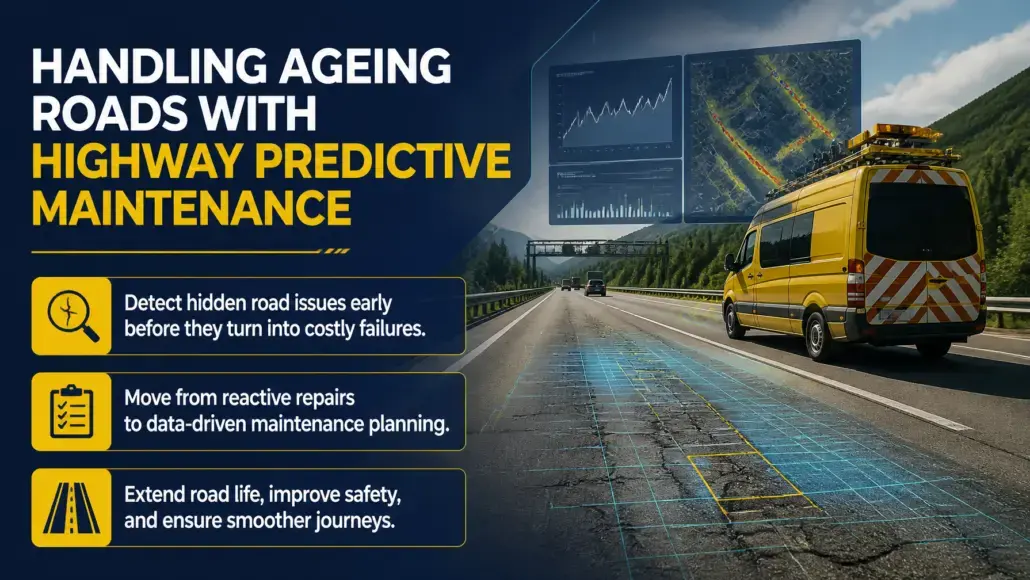
Global transportation departments are currently facing the dual challenge of managing ageing highway assets while accommodating unprecedented levels of traffic. Traditional maintenance strategies have historically relied on reactive repairs or scheduled inspections that often fail to identify underlying structural issues until they become critical failures. The integration of highway predictive maintenance analytics represents a paradigm shift in how infrastructure is managed, allowing operators to transition from manual oversight to data-driven precision. Transport Advancement notes that by leveraging artificial intelligence and the Internet of Things, road authorities can now anticipate maintenance needs and optimize resource allocation across entire networks.
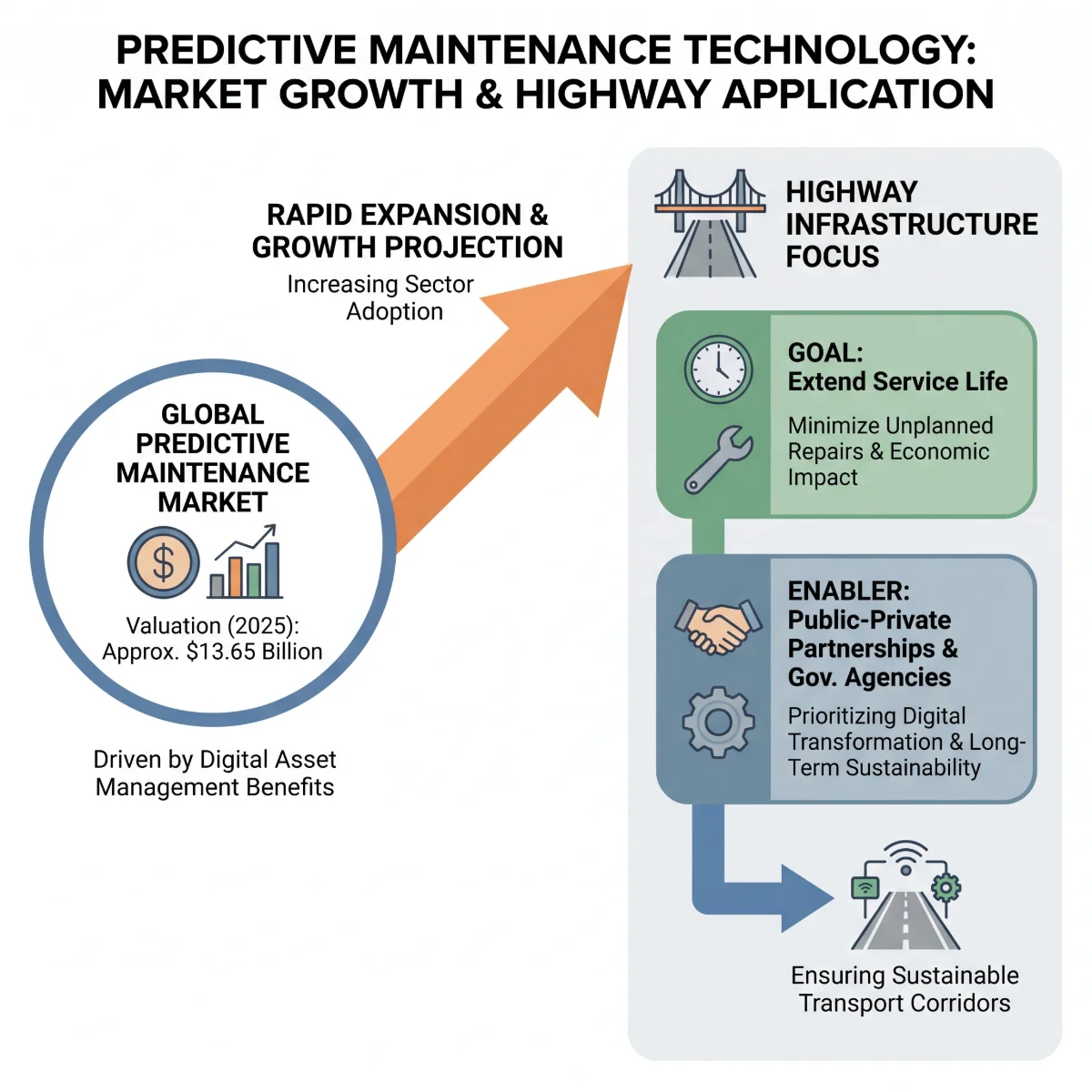
The market for predictive maintenance technology has seen rapid expansion as the benefits of digital asset management become more apparent. The global predictive maintenance market was valued at approximately 13.65 billion dollars in 2025, and it is projected to grow significantly as more sectors adopt these solutions. In the context of highway infrastructure, this growth is fueled by the need to extend the service life of existing bridges and pavements while minimizing the economic impact of unplanned repairs. Public-private partnerships and government agencies are increasingly prioritizing digital transformation to ensure the long-term sustainability of their transport corridors.
At the core of these advanced systems is the use of high-resolution sensors and computer vision to collect real-time data on the physical condition of the road. Autonomous inspection vehicles equipped with LiDAR and specialized cameras can traverse thousands of kilometers, capturing detailed information on surface cracking, rutting, and drainage performance. This data is then processed using machine learning algorithms that can detect patterns of deterioration that are invisible to the human eye. These algorithms can predict when a specific section of pavement is likely to reach a critical threshold, allowing maintenance teams to intervene before a pothole forms.
Industrial Shifts and Developments
- Bentley Systems: A leading innovator in digital twin solutions, the company highlighted in October 2024 how its AI-powered mapping technology identifies critical roadway assets, including guardrails and speed signs, to streamline maintenance and safety workflows. By generating high-fidelity digital replicas of highway systems, Bentley enables operators to simulate lifecycle maintenance scenarios and strategically prioritize high-impact interventions under tight fiscal constraints.
- Trimble: Providing integrated hardware and software for complete infrastructure lifecycle management, the company synthesizes surveying, mapping, and monitoring streams into a unified asset health platform. Trimble equips field teams with high-precision execution tools to ensure repairs are done right on the first pass, while its emphasis on data interoperability eliminates departmental silos to drive cross-agency operational efficiency.
- Hexagon AB: Specializing in advanced geospatial and industrial enterprise software, Hexagon delivers continuous monitoring of structural movement and environmental factors across large-scale assets. The company leverages visual intelligence, combining 3D modeling and augmented reality, to help engineers pinpoint latent structural vulnerabilities across complex, hard-to-inspect assets like bridges and tunnels without the safety hazards of conventional physical inspections.
Benefits of Predictive Maintenance of Highways
One of the most significant advantages of a predictive approach is the ability to synchronize maintenance activities across different asset types. For instance, when a section of highway is scheduled for resurfacing based on pavement data, the system can also flag any necessary updates to the underlying drainage infrastructure. Advanced drainage systems can be integrated into the maintenance schedule to ensure that water management remains effective as the road profile changes. This holistic coordination prevents the need for repeated lane closures and ensures that all components of the highway are functioning at their optimal level.
The financial impact of predictive maintenance is substantial, as it allows road authorities to move away from expensive worst-first repair strategies. Instead of spending a majority of the budget on fixing the most severely damaged sections, agencies can invest in lower-cost preventative treatments that keep the rest of the network in good condition. This shift leads to a higher overall network health for every dollar spent. Furthermore, the reduction in unplanned emergency repairs lowers the indirect costs associated with traffic delays and vehicle damage, providing a broader economic benefit to the community.
Sustainability is also a key driver for the adoption of predictive analytics. By extending the life of existing pavements and structures, these technologies reduce the need for the carbon-intensive production of new materials like cement and asphalt. The optimization of maintenance routes and the reduction of traffic congestion also contribute to lower greenhouse gas emissions from construction vehicles and general traffic. Many transportation agencies are now including the carbon savings from digital asset management in their annual environmental reports.
Moving Towards Self-Monitoring Infrastructure
Future developments in this field are likely to involve the integration of vehicle-to-infrastructure communication. As connected vehicles become more common, they can act as mobile sensors, providing a constant stream of data on road roughness and environmental conditions. This crowdsourced data could supplement dedicated inspection vehicles, providing a much higher frequency of updates across the entire network. Machine learning models will continue to evolve, incorporating more complex variables such as climate change projections and changing urban development patterns.

The move toward autonomous and semi-autonomous construction equipment will also be guided by predictive analytics. Robotic paving machines and bridge repair systems can be programmed to perform repairs based on the precise coordinates provided by the monitoring system. This level of automation will further improve the safety and efficiency of maintenance activities, particularly on high-speed expressways where human workers are at high risk. The combination of digital intelligence and physical automation will define the future of highway operations.
Ultimately, the goal of highway predictive maintenance analytics is to create a self-monitoring infrastructure that can communicate its own needs. This vision is becoming a reality as major global technology firms and construction companies collaborate to build the next generation of transport networks. Transport Advancement believes that by embracing these digital solutions today, road authorities can ensure that their ageing networks remain functional and resilient for decades to come, supporting the mobility and economic needs of a growing global population.
References
- “AI Takes the Wheel in Highway Repairs” – Bentley Systems
- “Predictive Maintenance Market Size, Share | Report 2034” – Fortune Business Insights
- “Predictive Maintenance Market size is projected to grow at a 26.72% CAGR” – Market Research Future
- “Bentley Systems to Announce Third Quarter 2026 Results” – Bentley Systems
- “Press Release: Advanced Drainage Systems Announces Fourth Quarter and Fiscal Year 2026 Results” – Advanced Drainage Systems
