















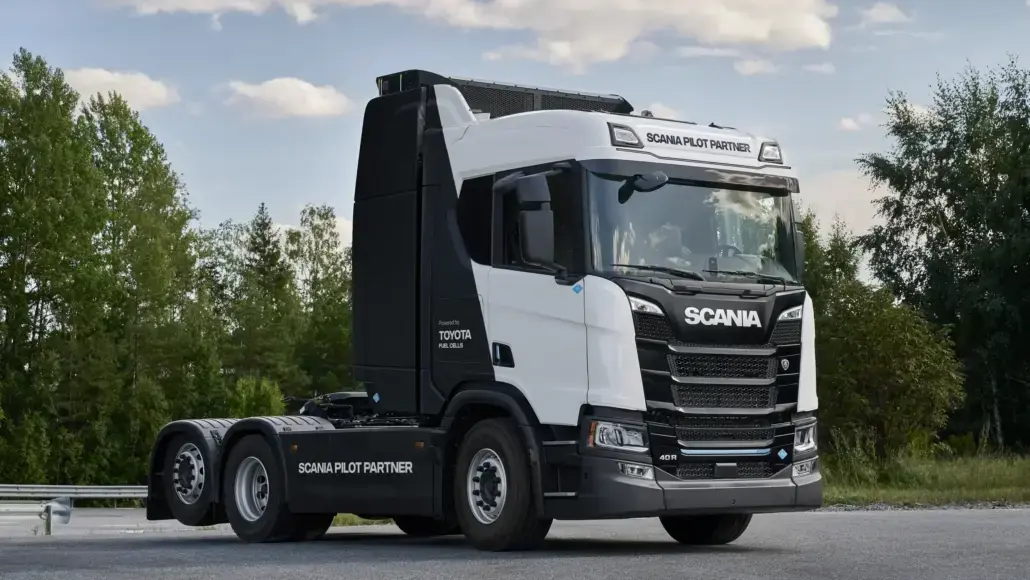
Scania has formed a new partnership with Toyota focused on the development of hydrogen-powered trucks, with the collaboration aimed at advancing hydrogen fuel cell solutions for heavy-duty mobility through real-world logistics operations. Under the agreement, Toyota will supply fuel cell systems for 40 heavy-duty vehicles participating in Scania’s Pilot Partner programme. The programme enables Scania to work with selected customers to assess a broad range of sustainable transport technologies, including the hydrogen fuel cell system, in actual operating conditions.
The partnership is intended to assess the technical performance, operational efficiency and total cost of ownership of zero-emissions heavy-duty fuel cell applications as their use continues to expand. By incorporating Toyota’s hydrogen fuel cell technology into Scania’s Pilot Partner programme, the companies will examine the role fuel cell electric trucks can play in demanding heavy-duty transport operations.
Toyota’s Third-Generation Fuel Cell System
The 40 vehicles involved in the programme will use Toyota’s latest, third-generation fuel cell system. The system provides 300kW of power in a highly compact design developed for heavy-duty applications as well as a wide range of other use cases. The collaboration will therefore provide an opportunity to assess the hydrogen fuel cell system as part of logistics operations carried out under real operating conditions.
Toyota is also an equal shareholder in hydrogen fuel cell venture Cellcentric, alongside Daimler Truck and Volvo. Cellcentric is focused on developing, producing and commercialising fuel cell systems for heavy-duty on- and off-road transport and other heavy-duty applications. The first Scania hydrogen fuel cell electric trucks are scheduled to begin operating during the first quarter of 2027.
Companies Highlight Heavy-Duty Applications
Hiroki Nakajima, executive vice president, Toyota Motor Corporation, said, “We believe heavy-duty transport is key to building hydrogen demand and infrastructure. Furthermore, we believe hydrogen is the right solution for demanding heavy-duty applications, where long range, high utilisation and operational efficiency are essential.”
“By bringing Toyota’s third-generation fuel cell system into Scania customers’ logistics operations, we are taking an important step together towards enabling hydrogen-powered mobility to play a larger role across Europe’s heavy-duty transport industry,” he added.
Sara Forsberg, chief technology officer, Scania, added, “We are pleased to partner with Toyota to explore how fuel cell technology performs in demanding real-world transport operations. Through our Pilot Partner programme, we work with selected customers to test new technologies in actual use cases, learn from their experience and develop our solutions further.”
“This collaboration will give us valuable insights into the opportunities and challenges associated with hydrogen fuel cell technology in heavy-duty transport,” she added.
