


















Precision drop technology is the defining innovation of modern aerial resupply, representing a monumental shift from the dumb gravity drops of the past to the sophisticated, guided systems of today. This technology is built upon the convergence of global positioning systems (GPS), advanced aerodynamics, and autonomous control surfaces, all working in harmony to ensure that vital supplies reach their destination with surgical accuracy. In an era where logistics often dictate the success of complex missions—be they humanitarian, commercial, or military—the ability to deliver a payload within meters of a target from thousands of feet in the air is a game-changer. Transport Advancement notes that the precision drop technology has effectively removed the hope factor from the airdrop equation, replacing it with a data-driven process that guarantees results in even the most challenging environments.
The necessity for such precision has never been greater. Whether it is delivering cold-chain medical supplies to a remote mountainous region or resupplying a forward-deployed tactical unit, the margins for error are razor-thin. Traditional airdrops rely on calculated release points based on wind patterns, but sudden gusts or shifts in atmospheric pressure can easily blow a pallet off course, sometimes by miles. Precision drop technology addresses this by treating the cargo not just as a falling object, but as a guided vehicle. Once the cargo is released from the aircraft, the guided system takes over, steering the parachute and the pallet through the air to a pre-programmed set of coordinates. This capability is not just an incremental improvement. It is a total transformation of the logistics pipeline.
The Architecture of GPS-Guided Cargo and Smart Parachutes
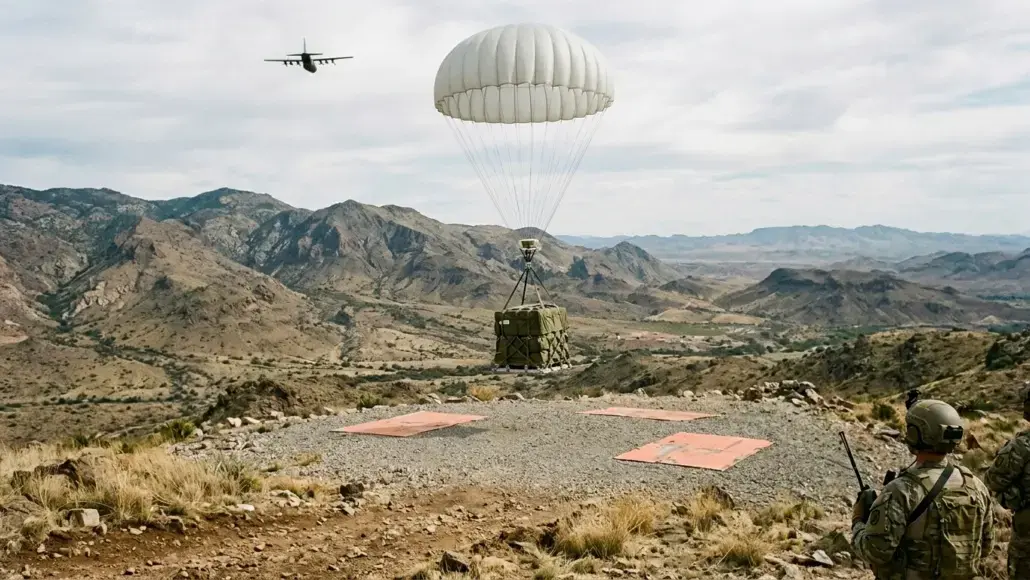
At the core of precision drop technology is the Joint Precision Airdrop System (JPADS) or its commercial equivalents, which utilize a combination of GPS receivers and steerable parachutes. The system begins with a mission planning tool where coordinates and atmospheric data are entered. Once the cargo is ejected—often with the help of an extraction parachute to clear the aircraft safely—the onboard computer initializes. This computer acts as the brain of the pallet, constantly comparing its current GPS position with the target coordinates. By calculating the required glide path, the system then sends commands to small electric actuators that manipulate the risers of a steerable ram-air parachute.
This steerable parachute, which looks more like a paraglider than a traditional round chute, provides the lift and maneuverability needed to navigate. By pulling on specific lines, the system can turn the cargo, slow its descent, or even hold its position in a holding pattern to wait for a clear landing window. This level of control is what allows for offset drops, where the aircraft can release the cargo from a safe distance—perhaps even ten or twenty miles away from the target—and the system will glide its way in. This is a critical safety feature for pilots, as it allows them to stay well clear of hostile terrain or dangerous weather while still ensuring the supplies reach their destination.
The Role of the Extraction Parachute in High-Altitude Precision Drops
While much of the focus in precision drop technology is on the steering phase, the initial exit from the aircraft is equally critical. This is where the extraction parachute plays a vital role. In many high-precision missions, the cargo is released from a high altitude to maximize the glide range. An extraction parachute is used to pull the heavy pallet out of the cargo hold quickly and cleanly, preventing it from tumbling or striking the tail of the aircraft. This rapid extraction ensures that the cargo enters the airstream in a stable orientation, which is essential for the steering computer to begin its calculations.
Moreover, the extraction parachute system is often integrated with the primary guided chute. In some advanced configurations, the extraction chute serves as a drogue during the initial descent, stabilizing the load before the larger, steerable ram-air canopy is deployed. This multi-stage process ensures that the cargo remains under control from the moment it leaves the ramp until it touches the ground. The reliability of the extraction parachute is therefore a foundational element of the entire precision drop workflow, providing the necessary force to initiate a successful delivery sequence. Without this initial yank, the entire precision system would be at risk of a messy and uncontrolled departure.
Operational Flexibility and Aerial Resupply in Remote Regions
One of the most profound impacts of precision drop technology is the level of operational flexibility it provides to logistics planners. In the past, an airdrop required a large, clear drop zone to account for the inevitable drift of the cargo. This limited aerial resupply to flat, open areas, often far from the people who actually needed the supplies. With precision drop technology, the drop zone can be as small as a rooftop or a narrow clearing in a forest. This allows for direct delivery to the point of need, drastically reducing the time and effort required by ground crews to recover and transport the supplies.
In remote or disaster-stricken regions, this capability is invaluable. Following an earthquake or a flood, roads and bridges are often destroyed, making ground transport impossible. Precision drop technology allows aid organizations to deliver food, water, and medicine directly to isolated communities with zero ground footprint. Because the systems are autonomous, they can operate in zero-visibility conditions or at night, ensuring that aid can flow 24/7. This independence from ground infrastructure is the ultimate expression of a resilient supply chain, and it is made possible by the incredible accuracy of modern guided airdrop solutions.
Military Logistics and the Tactical Advantage of Precision Airdrops
In the context of military logistics, precision drop technology is more than a convenience; it is a tactical necessity. Modern warfare is increasingly decentralized, with small units operating in dispersed and often isolated locations. Keeping these units supplied without putting large convoys or landing aircraft at risk is a major challenge. Precision airdrops allow for the stealthy resupply of these units. Because the cargo can be dropped from high altitudes and then glide to a target, the sound and visual signature of the delivery aircraft are minimized, making it much harder for an adversary to track the supply chain.
Furthermore, the ability to drop multiple pallets from a single aircraft that then guide themselves to different targets allows for a massed delivery without a massed target. An aircraft could fly a single pass and drop supplies for five different units scattered across a mountain range. Each pallet would steer itself to its respective unit, ensuring that no one is left without essential supplies. This efficiency is a massive force multiplier, allowing a single airlift mission to accomplish what would have previously required multiple dangerous ground convoys or low-level flight passes. The extraction parachute, the GPS guidance, and the steerable canopy all work together to create a logistical shield around the warfighter.
Future Innovations: AI and Collaborative Cargo Systems
As we look toward the future of precision drop technology, the next frontier is the integration of artificial intelligence (AI) and collaborative swarming behavior. Future systems will not just be programmed with a single set of coordinates; they will be able to think for themselves. For instance, an AI-enabled cargo pallet could use onboard cameras and machine learning to identify the safest landing spot in real-time, avoiding obstacles like trees or power lines that were not on the map. This vision-based navigation would provide a backup to GPS, which can be jammed or degraded in certain environments.
Furthermore, we are moving toward a concept of collaborative cargo, where multiple pallets dropped at the same time can communicate with each other. They could coordinate their glide paths to avoid collisions and ensure they land in a specific order or pattern. This would be particularly useful for delivering complex modular systems, such as a field hospital or a communications hub, where the pieces need to land close to each other to be quickly assembled. The combination of precision drop technology and AI will turn the cargo hold of an aircraft into a deployment center for intelligent, self-organizing systems that can build infrastructure from the sky.
Conclusion: The New Standard for Global Logistics
In conclusion, precision drop technology has set a new standard for the global logistics industry. Transport Advancement believes that by transforming cargo from a passive load into a guided, autonomous vehicle, it has solved the age-old problem of airdrop accuracy. The synergy between GPS navigation, steerable parachutes, and reliable extraction parachute systems ensures that supplies are delivered exactly where they are needed, regardless of altitude, weather, or terrain. This technology is not just about improving the military’s reach. It is about creating a more responsive and humanitarian world where geography is no longer an obstacle to the delivery of life-saving aid.
As these systems continue to evolve, they will become more affordable and accessible, allowing for even wider adoption across the commercial sector. The vision of a truly global, ‘anywhere, anytime’ delivery network is becoming a reality, and precision drop technology is the engine driving it forward. We are entering an era where the sky is not just a transit route, but a precision delivery platform that connects the world in ways we are only beginning to imagine. The future of logistics is here, and it is falling from the sky with incredible accuracy.
