



















Smart-chute Internet of Things (IoT) is revolutionizing the field of aerial logistics by embedding advanced sensor technology and connectivity directly into the fabric of extraction parachute systems. This integration transforms a traditionally passive mechanical device into an intelligent node within a wider digital supply chain. In the past, once a parachute was released from an aircraft, it became a black box—logistics planners had little to no real-time data on its performance, the stresses it was under, or the exact trajectory of the cargo it was extracting. Smart-chute IoT addresses this information gap by providing a continuous stream of telemetry from the moment of deployment until the cargo is safely on the ground. This digital nervous system not only enhances the safety and precision of individual drops but also provides the big-data insights needed to optimize entire global delivery networks.
The rise of the Internet of Things (IoT) in the aerospace sector is a response to the demand for higher accountability and transparency in high-value cargo operations. Whether it is a multi-million dollar piece of medical equipment or a critical shipment of military supplies, stakeholders need to know exactly how that cargo was handled during the most violent phase of its journey: the extraction. Smart-chute IoT provides this assurance by monitoring variables such as canopy inflation speed, extraction force, temperature, humidity, and atmospheric pressure. Transport Advancement notes that by correlating this data with GPS location, the system creates a complete digital twin of the mission, allowing for real-time adjustments and comprehensive post-delivery analysis.
The Architecture of Connected Parachutes and Sensor Technology
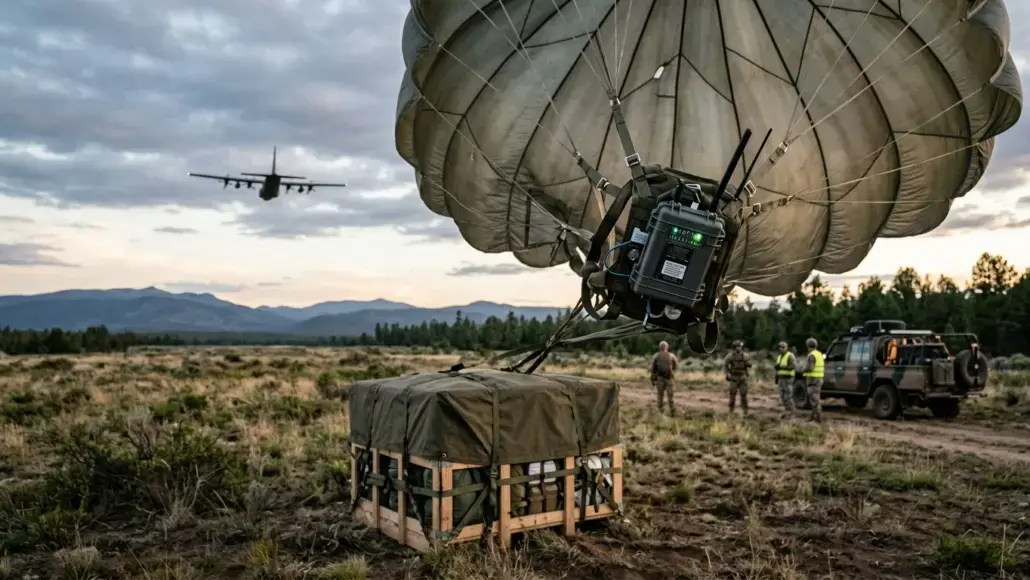
The technical architecture of smart-chute IoT involves the integration of miniaturized, ruggedized sensors into the parachute’s risers, canopy, and deployment bag. These sensors are designed to withstand the extreme G-forces and vibrations associated with a low-altitude extraction. The data from these sensors is aggregated by an onboard gateway unit—a small, lightweight device that processes the raw signals and transmits the information via satellite or long-range radio to a centralized command center. This connectivity is what makes the system smart, as it allows for the remote monitoring of every parachute in a fleet, regardless of where they are in the world.
One of the most critical sensor types in the smart-chute IoT ecosystem is the load-cell sensor, which measures the tension in the parachute lines. This data is vital for ensuring that the extraction parachute is operating within its structural limits and that the force applied to the cargo is not exceeding safe thresholds. Accelerometers and gyroscopes provide information on the pallet’s orientation and stability, allowing the system to detect if a load is beginning to tumble or if the parachute has failed to open correctly. This real-time diagnostic capability is a major leap forward from traditional post-mortem inspections, enabling ground crews to prepare for a potentially damaged load before it even touches down.
Real-Time Cargo Monitoring and Predictive Maintenance
The primary benefit of smart-chute IoT is the ability to perform real-time cargo monitoring during the descent. For logistics managers, this means being able to see the cargo through the eyes of the parachute. If a sudden gust of wind knocks the pallet off-course, the IoT system can immediately update the predicted landing zone on a digital map, allowing recovery teams to reposition themselves instantly. This reduces the search and recovery time, which is often a major bottleneck in remote logistics operations. Furthermore, for sensitive payloads, the system can monitor for excessive shock or vibration, providing an immediate red-flag if the cargo’s integrity has been compromised during the drop.
Beyond individual missions, smart-chute IoT is a powerful tool for predictive maintenance. Parachutes are subject to significant wear and tear, and their performance can degrade over time due to factors like UV exposure, moisture, and mechanical stress. By tracking the flight history of every chute in a fleet—including the total number of deployments and the cumulative stresses they have endured—the IoT system can accurately predict when a parachute is nearing the end of its safe operational life. This allows for a condition-based maintenance schedule, where parachutes are retired or repaired based on actual data rather than arbitrary time intervals. This not only improves safety but also maximizes the return on investment for expensive extraction parachute systems.
Enhancing Operational Intelligence in IoT Logistics
The integration of smart-chute IoT is a key component of the broader shift toward intelligent or self-aware logistics. In an IoT logistics environment, every asset is connected and communicates its status to a central brain. For aerial delivery, this means that the parachute, the aircraft, the cargo, and the ground recovery team are all synchronized. For example, a Smart-Chute can communicate its exact landing time to an autonomous ground vehicle (AGV) that is waiting to pick up the cargo. This level of synchronization eliminates the dead time between different stages of the supply chain, resulting in a much faster and more efficient delivery process.
Moreover, the data collected by thousands of smart airdrops can be used to train AI models that optimize future delivery missions. By analyzing how different parachute designs perform in various weather conditions and altitudes, engineers can refine their designs to be more stable and efficient. This creates a cycle of continuous improvement where each mission makes the next one smarter. This operational intelligence is what will ultimately allow the industry to move toward fully autonomous, lights-out aerial delivery systems. smart-chute IoT is the foundational layer of this intelligent infrastructure, providing the raw data that fuels the entire ecosystem.
Safety Protocols and Intelligent Extraction Performance
In high-stakes environments, such as military transport or emergency medical delivery, safety protocols are paramount. Smart-Chute IoT enhances these protocols by providing a fail-safe digital monitoring layer. If the system detects a critical failure—such as a torn canopy or a malfunctioning release latch—it can automatically trigger emergency procedures. This might include deploying a backup parachute or sending an immediate distress signal to nearby search and rescue assets. This active safety approach is far superior to traditional mechanical systems, as it can respond to a wider range of failure modes with greater speed and precision.
Intelligent extraction parachute performance also means being able to adjust the softness of the landing. By using the real-time sensor data to control small actuators on the parachute’s risers, a smart system can perform a flare maneuver just before ground contact, similar to how a human skydiver lands. This reduces the vertical impact speed and ensures that the cargo touches down with as little shock as possible. This capability is essential for the delivery of fragile high-tech equipment, such as satellite components or modular data centers, that would otherwise be destroyed by a traditional high-impact landing.
The Future of Connected Parachutes: 5G and Beyond
As we look toward the future, the connectivity of smart-chute IoT will be further enhanced by the rollout of global 5G networks and low-earth orbit (LEO) satellite constellations like Starlink. These technologies will provide the low-latency, high-bandwidth communication needed for even more complex real-time applications. Imagine being able to stream high-definition video from a camera mounted on the parachute directly to a VR headset worn by a logistics manager thousands of miles away. This would allow for remote-piloted cargo drops, where a human expert can take control of a smart parachute to navigate it through a particularly difficult environment.
We may also see the development of collaborative smart parachutes that can communicate with each other in mid-air. A group of parachutes dropped in a swarm could coordinate their descent to ensure they all land in a specific order or pattern, avoiding mid-air collisions and optimizing the use of the landing zone. This level of coordination would be particularly useful for setting up complex infrastructure in remote areas, where the order of assembly is critical. The combination of smart-chute IoT, advanced robotics, and AI will turn the sky into a high-speed, intelligent delivery platform that is more capable than anything we have seen before.
Conclusion: Data-Driven Excellence in the Sky
In conclusion, smart-chute IoT represents a paradigm shift in the field of aerial logistics, moving the industry from a reliance on mechanical intuition to a future of data-driven excellence. By embedding intelligence and connectivity into the very fabric of extraction parachute systems, we are creating a more transparent, safe, and efficient global supply chain. The ability to monitor cargo in real-time, predict maintenance needs, and optimize delivery performance through big data is a game-changer for everyone from military commanders to humanitarian aid workers.
As these technologies continue to mature and become more affordable, the vision of a truly smart airdrop will become the global standard. We are entering an era where no cargo is ever lost in the sky, and where every delivery is a source of valuable data that makes the entire world more connected and resilient. Smart-Chute IoT is not just a technical upgrade; it is a commitment to a future where the air cargo industry is as intelligent and responsive as the digital world it serves. Transport Advancement believes that by giving the parachute a brain and a voice, we are ensuring that the future of logistics is bright, connected, and incredibly precise.
