










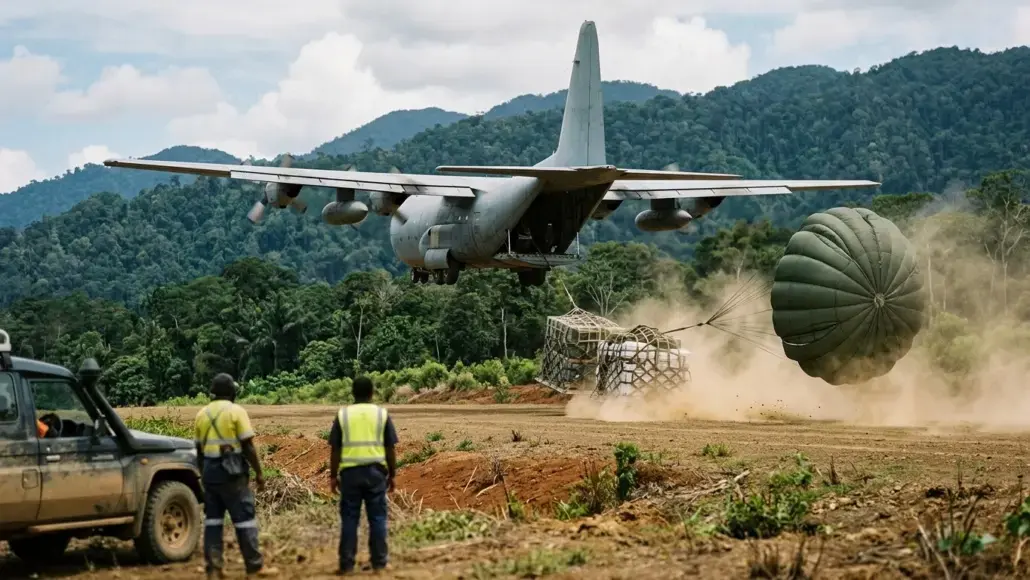
Commercial LAPES adoption is fundamentally reshaping the landscape of tactical cargo delivery by providing a high-speed, low-altitude solution that bridges the gap between traditional airdrops and ground-based offloading. The Low Altitude Parachute Extraction System, or LAPES, once a specialized military maneuver reserved for high-stakes combat zones, is now being viewed through a commercial lens as logistics providers seek ways to bypass infrastructure bottlenecks in remote or disaster-stricken regions. Transport Advancement notes that by utilizing a heavy-duty extraction parachute to pull palletized loads from the ramp of a low-flying aircraft, the system allows for the delivery of massive payloads without the need for a prepared runway or the time-consuming process of landing and taxiing. This shift represents a significant evolution in how we perceive aerial supply chains, moving away from static delivery points toward a more fluid and responsive tactical airlift capability.
The historical context of LAPES is rooted in the necessity of the Vietnam War era, where the C-130 Hercules was used to deliver supplies to besieged camps. In those high-threat environments, landing was often impossible or extremely dangerous. The solution was to fly just five to ten feet above the ground at high speeds, deploying a small pilot chute that would then inflate a much larger extraction parachute. This force would yank the cargo pallet off the roller tracks of the aircraft’s cargo floor, allowing it to slide along the ground until friction brought it to a halt. While the military has moved toward more precise GPS-guided systems in recent years, the commercial sector is rediscovering the raw efficiency of this method. For organizations involved in large-scale infrastructure projects, mining, or international aid, the ability to deliver twenty tons of equipment directly to a site in seconds is an unparalleled advantage.
The Technical Mechanics Behind Commercial LAPES Adoption
Understanding the mechanics of Commercial LAPES adoption requires a deep dive into the physics of aerodynamic drag and the structural integrity of both the aircraft and the cargo. The process begins with the synchronization of flight controls and the extraction system. As the aircraft approaches the drop zone, the pilot maintains a precise altitude and airspeed, typically around 130 knots. This low-level flight is the most critical phase, as any deviation in pitch or altitude could result in a catastrophic ground strike or a failed extraction. The extraction parachute is not a standard recovery chute; it is designed to withstand the immense instantaneous force required to overcome the inertia of a heavy pallet. When the pilot or loadmaster triggers the release, the chute catches the slipstream, generating tens of thousands of pounds of pull in a fraction of a second.
This immediate transfer of momentum is what makes the system so effective. Unlike gravity-based drops where cargo might drift miles off-target due to wind, LAPES ensures the cargo hits the ground exactly where the aircraft is positioned. The pallet is typically equipped with a “skid” bottom or a honeycombed energy-dissipating material to absorb the initial horizontal impact and reduce the risk of the cargo flipping. For commercial operators, this means that expensive machinery, fuel bladders, or modular housing units can be delivered with a high degree of confidence. The precision is such that multiple pallets can be dropped in a single pass, creating an “instant warehouse” effect on a flat patch of dirt or a dry lake bed.
Structural Requirements and Aircraft Compatibility
Implementing Commercial LAPES adoption is not as simple as attaching a parachute to a crate; it requires specialized aircraft configurations. The C-130 remains the gold standard for this operation due to its high-wing design and rear loading ramp, but other tactical airlifters like the C-27J Spartan and even converted civilian freighters are being evaluated for these roles. The floor of the aircraft must be equipped with high-strength roller systems that can handle the violent exit of the cargo. Furthermore, the airframe itself must be rated for the sudden shift in the center of gravity that occurs during extraction. As the weight moves toward the ramp, the nose of the plane naturally wants to pitch up, requiring the pilot to apply aggressive nose-down trim and elevator control to maintain level flight just feet above the ground.
This interplay between human skill and mechanical reliability is the hallmark of a mature logistics system. In the commercial world, where safety is paramount and insurance premiums are high, the training of aircrews for LAPES operations is a major undertaking. Specialized loadmaster certification and rigorous flight simulations are necessary to ensure that the risks are managed. However, the payoff is a logistics capability that can operate independently of the global port and airport network, which is often the first thing to fail during a crisis. By bypassing the need for cranes, forklifts, and paved roads, LAPES-enabled cargo delivery provides a “last-mile” solution that is actually a “last-thousand-mile” solution for the most unreachable places on earth.
Operational Benefits and the Future of Extraction Parachute Systems
The primary driver for Commercial LAPES adoption is the massive increase in operational tempo it provides. In traditional logistics, a cargo plane must land, find a parking spot, wait for ground crews to unload the belly or ramp, and then take off again. This process can take anywhere from thirty minutes to several hours. With LAPES, the aircraft never stops moving. It enters the drop zone, ejects the cargo, and is back at cruising altitude within minutes. This “touch-and-go” without the touch is revolutionary for high-volume supply chains. For example, during a humanitarian disaster, a fleet of three aircraft utilizing LAPES could deliver more tonnage in a day than a dozen planes relying on traditional landing and unloading procedures, especially if the local airport is damaged or congested.
Moreover, the safety profile of extraction parachute systems has improved dramatically with modern materials. Today’s parachutes are made from high-tenacity nylon and Kevlar blends that are lighter, stronger, and more predictable than their predecessors. Sensors embedded in the chute and the pallet can now provide real-time data on the extraction force and the descent profile, allowing for a post-delivery analysis that was previously impossible. This data-driven approach is what is making the commercial sector more comfortable with a maneuver that was once considered high-risk. We are moving toward a future where “precision” is not just about where the cargo lands, but how smoothly it transitions from the air to the ground, minimizing the stress on the contents.
Economic Impact and Supply Chain Resilience
From an economic perspective, Commercial LAPES adoption offers a compelling return on investment for specific industries. The cost of building and maintaining a temporary runway in a remote mining site can run into the millions of dollars. By using LAPES, a company can begin operations months earlier, delivering initial equipment and supplies via air while the ground infrastructure is still being developed. This acceleration of the project timeline can save significant capital and improve the overall viability of remote ventures. In the context of global supply chain resilience, having a diverse set of delivery methods ensures that an organization is not crippled by the closure of a single maritime lane or a regional hub.
Conclusion
As we look toward the future, Transport Advancement believes that the integration of autonomous flight controls with LAPES technology promises to further reduce the risk and cost. Imagine a fleet of unmanned cargo drones capable of performing low-altitude extractions with centimeter-level precision. This would eliminate the danger to human pilots while maintaining the high-speed delivery capabilities of the system. The convergence of aerospace engineering, material science, and digital logistics is creating a new paradigm where the sky is no longer a barrier, but a high-speed highway that leads directly to the doorstep of those in need. Commercial LAPES adoption is more than just a technical achievement; it is a commitment to a more agile, responsive, and robust global economy.
