




















The horizon of aviation is shifting from the distant contrails of high-altitude jets to the humming rotors of electric aircraft hovering just above our city skylines. For decades, the journey to the airport has been the most predictable bottleneck in the travel experience. Travelers often spend more time navigating suburban congestion than they do in the air for short-haul flights. However, the emergence of air taxi services is poised to solve this “last-mile” dilemma, and global aviation hubs are currently undergoing a radical transformation to accommodate this new era of flight.
Airport modernization is no longer just about longer runways or larger terminals for jumbo jets. Today, it is about the integration of Urban Air Mobility (UAM) into the existing fabric of international travel. This shift represents the most significant change in aviation technology since the dawn of the jet age. As electric Vertical Take-off and Landing (eVTOL) aircraft move from the testing phase to certification, Transport Advancement notes that airports are racing to build the physical and digital infrastructure necessary to support them.
The Evolution of Airport Infrastructure for eVTOL Operations
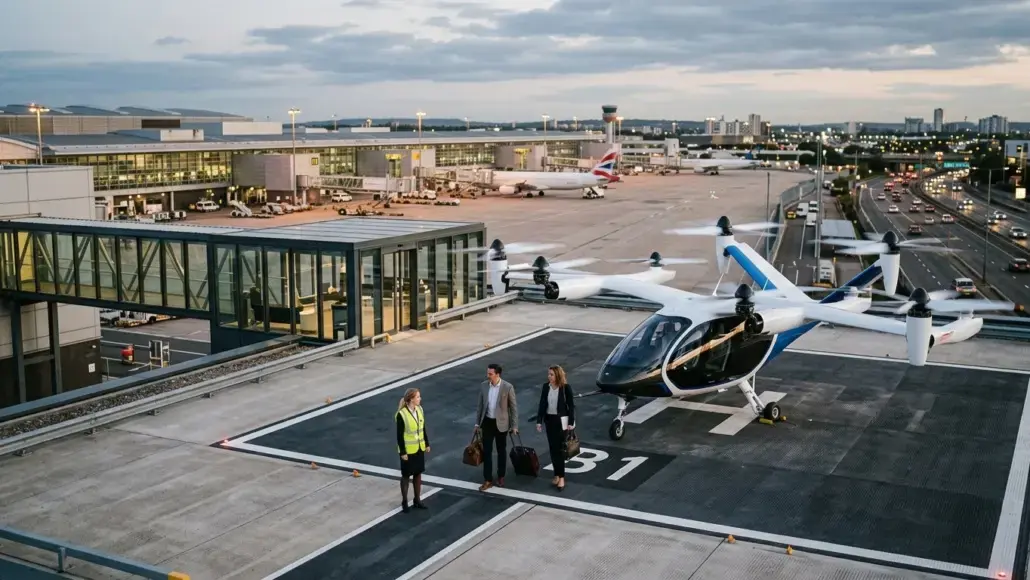
The traditional airport layout is designed for linear movement: a long runway leads to a taxiway, which leads to a gate. Air taxi services, however, require a more modular and vertical approach. This has led to the rise of the “vertiport,” a specialized facility designed specifically for eVTOL operations. Unlike a standard helipad, a vertiport must handle high-frequency departures and arrivals while providing rapid charging or battery-swapping capabilities.
Many major airports are identifying underutilized spaces within their perimeter to house these facilities. Parking garage rooftops, for instance, are being eyed as prime real estate for vertiports. By repurposing the top levels of these structures, airports can provide a seamless transition for passengers moving from their vehicles to an air taxi. This adaptive reuse of airport infrastructure minimizes the need for new ground-breaking construction and utilizes existing security perimeters.
However, the engineering requirements for these sites are substantial. Engineers must consider the structural load of multiple eVTOL aircraft, the acoustics of rotors operating near terminals, and the sophisticated fire suppression systems required for large-scale lithium-ion battery storage. This isn’t merely a facelift; it is a fundamental reimagining of how an airport utilizes its vertical footprint to enhance passenger mobility.
Grid Modernization and the Energy Challenge
Perhaps the most daunting hurdle in the rollout of air taxi services is the sheer demand for electrical power. eVTOL operations are predicated on fast turnaround times. For a service to be economically viable, an aircraft must be able to land, offload passengers, recharge, and take off again within a matter of minutes. This requires ultra-fast charging infrastructure that can deliver megawatts of power instantaneously.
Current airport power grids were never designed for this type of concentrated load. Consequently, airport modernization efforts now include massive investments in energy storage and grid upgrades. Some airports are exploring the implementation of microgrids—autonomous energy systems that use a combination of solar arrays, hydrogen fuel cells, and large-scale battery storage to power their vertiports without straining the local municipal grid.
This transition to advanced aviation is pushing airports to become energy hubs. In the near future, an airport might not just be a place where planes land, but a sophisticated power management center that balances the energy needs of electric ground transport, terminal operations, and a fleet of electric air taxis. The integration of sustainable energy sources is a critical component of making Urban Air Mobility a truly green alternative to ground-based transit.
Navigating the Digital Sky and Air Traffic Management
Integrating air taxi services into the world’s busiest airspace is a monumental task for air traffic controllers. Traditional radar-based systems are designed for large aircraft at high altitudes. eVTOLs, conversely, operate in the “low-altitude” environment, often sharing space with helicopters, drones, and general aviation.
To manage this, the industry is leaning heavily on new aviation technology known as Uncrewed Traffic Management (UTM) and modernized Air Traffic Management (ATM) systems. These digital platforms allow for automated deconfliction and real-time flight path adjustments. Airports are currently working with regulatory bodies like the FAA and EASA to establish “corridors” or dedicated flight paths that keep air taxi traffic separated from the approach and departure paths of commercial airliners.
The goal is a “digital handshake” between the air taxi and the airport’s central control tower. This level of automation is essential because the volume of air taxi flights is expected to far exceed that of traditional domestic flights. For passengers, this means a smoother ride with fewer delays, as the aircraft can dynamically navigate around weather or congestion using real-time data.
Transforming the Passenger Experience and Mobility
The ultimate success of air taxi services depends on how well they integrate into the broader passenger mobility ecosystem. An air taxi is only useful if it saves time, which means the transition from the “big plane” to the “small plane” must be frictionless. Airports are focusing on “curb-to-gate” synchronization, where a passenger’s biometric profile allows them to move through security and onto an eVTOL with minimal stops.
Imagine arriving on a long-haul flight from London to New York. As you clear customs, your smartphone notifies you that your air taxi is waiting at Vertiport Alpha, located just above the terminal. Because your luggage was tagged with a digital identifier, it is already being transferred to the eVTOL’s cargo hold. You walk five minutes to a lounge, board the aircraft, and seven minutes later, you land on a rooftop in Manhattan.
This level of connectivity requires a high degree of collaboration between airlines, airport authorities, and UAM operators. We are seeing the birth of multi-modal transit hubs where the distinction between “airport” and “city” begins to blur. Airports are no longer isolated fortresses on the edge of town; they are becoming the central nervous system of a regional transportation network.
Regulatory Alignment and Safety Standards
Safety is the bedrock of aviation, and the introduction of eVTOL operations requires a new set of standards. Airports are currently playing a vital role in the testing and validation of these safety protocols. From bird strike resilience to emergency landing procedures in dense urban environments, every aspect of the flight must be accounted for.
The collaborative effort between airports and manufacturers is focused on ensuring that vertiports meet the same rigorous safety standards as traditional runways. This includes specialized lighting, clear approach and departure paths, and emergency response teams trained specifically for electric aircraft incidents. Airport modernization plans now routinely include “UAM Annexes” that detail how these new vehicles will be safely marshalled on the ground and in the air.
Furthermore, public perception is a key factor. Airports are hosting community outreach programs and noise-testing demonstrations to prove that air taxi services will not be a nuisance to the surrounding neighborhoods. The quietness of electric motors compared to traditional combustion engines is a major selling point, but airports must still manage the logistics of frequent low-altitude flights over populated areas.
The Economic Impact of Advanced Aviation on Airports
Beyond the technological and logistical shifts, air taxi services represent a new revenue stream for airports. Traditionally, airports have relied on landing fees, retail, and parking for their income. As the automotive industry shifts toward ridesharing and autonomous vehicles, and as air taxis reduce the need for long-term airport parking, airports must find new ways to stay profitable.
Charging fees for eVTOLs, vertiport landing rights, and premium lounge services for UAM passengers offer a lucrative alternative. By positioning themselves as the primary nodes in a regional air taxi network, airports can capture a share of the burgeoning Urban Air Mobility market. This economic incentive is a powerful driver for the rapid pace of airport modernization we are seeing today.
Additionally, the development of these services creates jobs in new sectors, from eVTOL maintenance and battery technician roles to digital air traffic controllers. The airport of the future will be a high-tech campus that fosters innovation in aviation technology and sustainable transport, contributing significantly to the local and national economy.
A New Era of Flight
The integration of air taxi services is a testament to the resilience and adaptability of the global aviation industry. What began as a futuristic concept is rapidly becoming a concrete reality, etched into the master plans of the world’s most forward-thinking airports. By investing in vertiports, upgrading power grids, and embracing digital traffic management, airports are ensuring they remain relevant in an increasingly mobile world.
The journey toward advanced aviation is complex and filled with challenges, yet the potential rewards—reduced congestion, lower emissions, and unprecedented speed—are too great to ignore. As we look toward the 2030s, Transport Advancement believes the airport will no longer be seen as the end of a journey, but as a gateway to a seamless, multi-dimensional transit experience. The work being done today to prepare for air taxi services is laying the foundation for a world where the sky is truly open to everyone.
