























As the global rail industry transitions from legacy mechanical signaling to advanced, software-defined systems, the nature of railway safety is being fundamentally redefined. While ETCS (European Train Control System) has brought unprecedented improvements in operational efficiency and physical safety, its reliance on digital communication and interconnected networks has introduced a new frontier of vulnerability: the cyber threat. In the modern era, the interlocking is no longer a physical relay but a complex computer network that can, in theory, be targeted from anywhere in the world. Transport Advancement highlights that handling cybersecurity risks in ETCS-enabled railway networks has therefore become a mission-critical priority for operators and governments alike, requiring a sophisticated defense-in-depth approach to protect critical national infrastructure.
The Shift from Security by Isolation to Interconnectivity
Historically, railway signaling systems were considered secure by isolation. They were closed, proprietary systems that shared no connections with the outside world or the public internet. This air-gapped model provided a high level of protection against remote attacks. However, the modernization required for ETCS and Digital Railways has necessitated the use of standardized communication protocols (such as GSM-R and the upcoming FRMCS/5G) and connections to broader corporate networks for data analytics and maintenance. While this interconnectivity is the engine of the modern railway’s efficiency, it also creates potential entry points for malicious actors. In ETCS-enabled railway networks, the perimeter is no longer a physical fence. It is a complex digital interface that must be constantly monitored and defended.
Identifying the Unique Threat Landscape of ETCS
The cyber threats facing the rail industry are distinct from those in the traditional IT sector. While a bank might be targeted for financial gain, a railway network is often a target for sabotage or state-sponsored actors seeking to cause social and economic disruption. In ETCS-enabled railway networks, the primary concern is the integrity of the Movement Authority (MA). This is the digital signal that tells a train it is safe to proceed. If a cyberattacker were able to inject a false MA or modify a legitimate one, the consequences could be catastrophic. Other risks include Denial of Service (DoS) attacks on the radio communication network, which could bring an entire regional rail network to a standstill, or the compromise of maintenance systems to introduce backdoors into the train’s onboard software.
Protecting the Air Interface: GSM-R and the Move to FRMCS
The radio link between the trackside Radio Block Center (RBC) and the train is the most sensitive part of the ETCS architecture. Traditional GSM-R, based on 2G technology, has known cryptographic weaknesses that have been addressed through the implementation of Euroradio—a security layer that provides authentication and encryption for ETCS data. As the industry moves toward FRMCS (Future Railway Mobile Communication System), which utilizes 5G technology, the security model is being significantly upgraded. 5G provides native network slicing, allowing the safety-critical signaling data to be completely isolated from passenger Wi-Fi or other non-critical services. This ensures that even if one part of the network is compromised, the heart of the ETCS-enabled railway networks remains secure and functional.
Implementing a Defense-in-Depth Strategy
Effective cybersecurity for railways cannot rely on a single firewall or encryption key. Instead, it requires a defense-in-depth strategy that places multiple layers of security between the attacker and the critical assets. This includes Network Segmentation, where signaling systems are physically or logically separated from administrative networks. It also involves Endpoint Protection for the thousands of onboard computers and trackside sensors that make up the network. Every device must have a unique, cryptographically verifiable identity, ensuring that only authorized machines can communicate within the ETCS-enabled railway networks. Furthermore, constant Intrusion Detection Systems (IDS) are deployed to monitor network traffic for anomalies that might indicate a cyber probe or an ongoing attack.
The Human Element: Training and Operational Security
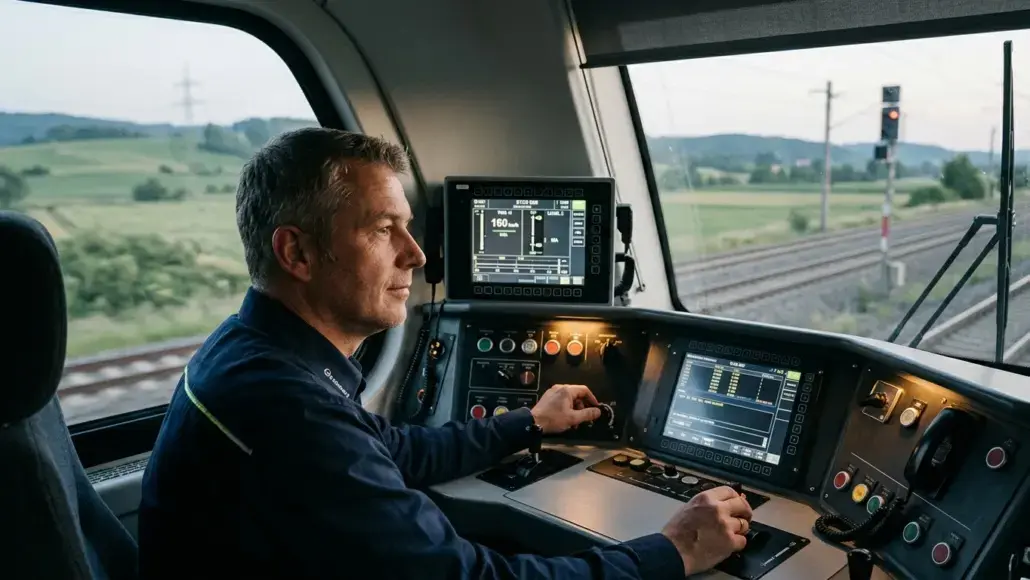
Technology alone is not enough to handle the risks in ETCS-enabled railway networks; the human factor is often the weakest link. Phishing attacks or compromised maintenance laptops can bypass even the most advanced firewalls. Therefore, a robust cybersecurity culture is essential. This includes specialized training for railway staff, from drivers to signal engineers, on how to recognize and report suspicious digital activity. Operational security (OPSEC) protocols must also be strictly enforced, ensuring that physical access to servers, cabinets, and onboard units is controlled and logged. In a digital railway, every technician with a USB drive is a potential security risk, necessitating strict zero-trust policies for all hardware and software updates.
Regulatory Frameworks and International Standards
The protection of ETCS-enabled railway networks is now governed by international standards such as IEC 62443 (for industrial automation) and the rail-specific CLC/TS 50701. These frameworks provide a structured approach to risk assessment, defining Security Levels for different parts of the network. National regulators are also increasingly mandating regular Penetration Testing and Cyber Audits for rail operators. These exercises involve ethical hackers attempting to find and exploit vulnerabilities in the system before malicious actors can do so. By making cybersecurity a mandatory part of the Safety Case for any new rail project, the industry is ensuring that digital security is baked into the design from day one, rather than being added as an afterthought.
Resilience and the Ability to Fail Safely
In the context of cybersecurity, resilience is the ability to maintain operations or fail safely even when under attack. A key design principle of ETCS-enabled railway networks is that the safety layer (the ATP) should be independent of the communication layer. If the digital network is compromised or jammed, the train’s onboard system is designed to detect the loss of communication and automatically bring the train to a safe stop. While this would cause a significant operational delay, it prevents a safety catastrophe. This graceful degradation is what separates a resilient industrial system from a standard IT network. The goal of cybersecurity in rail is not just to prevent attacks, but to ensure that an attack can never result in a loss of life.
Conclusion
As the backbone of national and international transport, ETCS-enabled railway networks are high-value targets in the digital age. However, through the combination of advanced technology, rigorous standards, and a culture of security awareness, the rail industry is proving that it can navigate these risks successfully. Transport Advancement believes that the future of the railway is undoubtedly digital, and by mastering the art of cybersecurity, we are ensuring that this future remains as safe as it is efficient.
