


















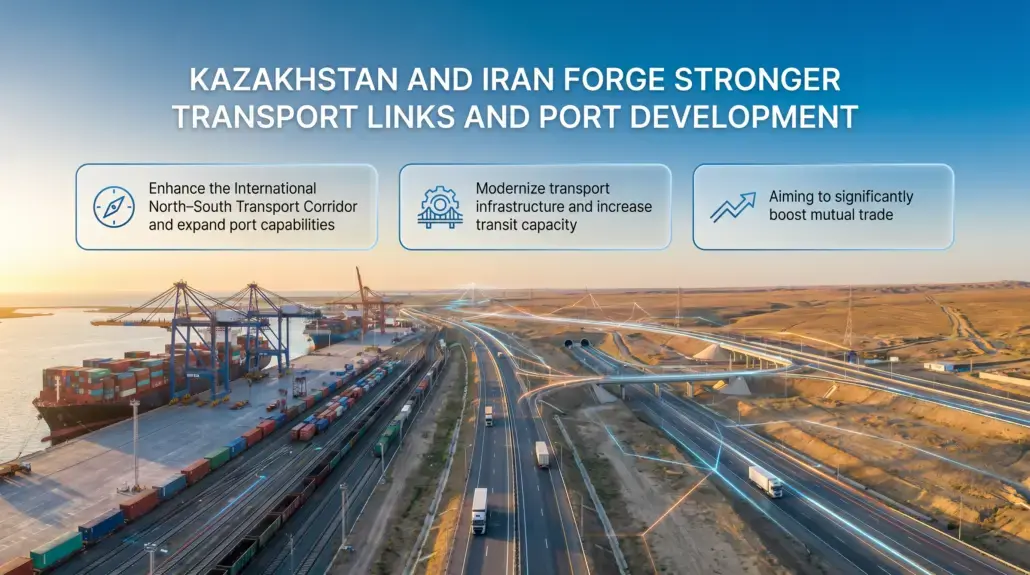
Kazakhstan and Iran have committed to accelerating the development of vital transport corridors and expanding port infrastructure, aiming to significantly boost mutual trade and enhance logistics cooperation. During a bilateral meeting, Kazakh Deputy Prime Minister and Minister of National Economy, Serik Zhumangarin, and Iran’s Minister of Roads and Urban Development, Farzaneh Sadegh, discussed the practical implementation of agreements previously made by their respective heads of state. A central theme was the further development of the International North–South Transport Corridor, alongside initiatives to expand port infrastructure and foster increased mutual trade.
Zhumangarin highlighted Iran’s position as a key trade and economic partner for Kazakhstan.
“Strengthening cooperation is a strategic objective set by our heads of state. In 2025, trade turnover between Kazakhstan and Iran rose by 26.4 percent, reaching $430.2 million. This reflects the substantial potential for further expansion, including under the roadmap to increase mutual trade to $3 billion and owing to the Iran-EAEU Free Trade Agreement,” Zhumangarin said.
Sadegh underscored the practical aims of her visit, focusing on bolstering transport and logistics cooperation, which she described as particularly critical for both nations given current geopolitical dynamics. The development of the International North–South Transport Corridor was a key point of discussion. Kazakhstan and Iran’s unique geographical locations, situated at the crossroads of North-South and East-West routes, present significant opportunities for transit growth.
In 2025, the freight volume along the North-South corridor saw a 12 percent increase, reaching 3.5 million tons. Rail freight between Kazakhstan and Iran experienced a remarkable 69 percent surge. To fully leverage this route’s potential, Zhumangarin proposed the creation of a joint roadmap for modernizing transport infrastructure. Such measures are anticipated to elevate the corridor’s annual capacity to 20 million tons, significantly enhancing trade flow.
Further strengthening regional connectivity, the meeting also acknowledged the significance of a recently signed five-party railway agreement involving China, Kazakhstan, Turkmenistan, Iran, and Türkiye. Additionally, an upcoming four-party tariff agreement between Kazakhstan, Russia, Turkmenistan, and Iran is expected to create further conditions for trade and transit expansion.
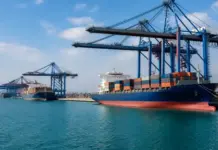
A crucial aspect of the discussions revolved around port infrastructure development. The Iranian delegation confirmed the finalization of a land plot allocation for Kazakhstan within the Port of Shahid Rajaee (Bandar Abbas), which will be transferred to Kazakhstan upon completion of necessary procedures. Iran also expressed readiness to grant Kazakhstan operational access to Chabahar Port, a gateway to markets in South and Southeast Asia. The Chabahar–Zahedan railway, reportedly over 90 percent complete and slated for an upcoming launch, will integrate Chabahar Port into the international railway network connecting the Indian Ocean, Central Asia, and Europe.
In reciprocation, Kazakhstan indicated its willingness to explore providing port space, berths, and terminals in its Aktau and Kuryk ports to Iranian companies for logistics activities on the Caspian Sea. This move aims to balance and enhance the logistics capabilities for both nations within the Caspian region.
Following the meeting, both sides reaffirmed their commitment to expedite the implementation of high-level agreements. They pledged coordinated efforts to attract investors and intensify the development of crucial transport and logistics infrastructure, solidifying their shared vision for enhanced regional connectivity and economic growth.
