























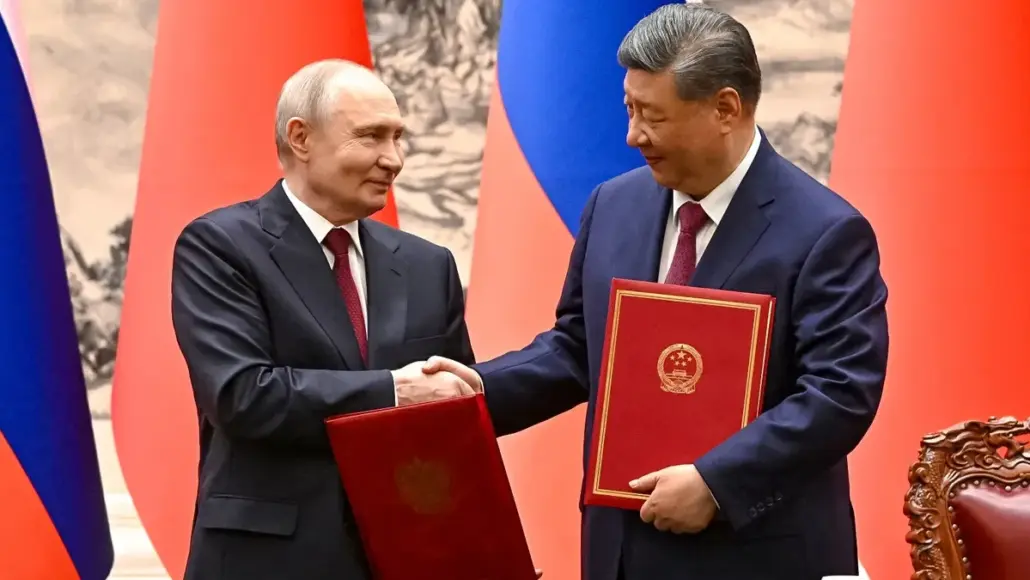
Officials from Russia and China formally signed an agreement in Beijing on 20th May 2026 to advance a major cross-border railway link project during a ceremony attended by Chinese President Xi Jinping and Russian President Vladimir Putin. The initiative centers on constructing a second railway line featuring Chinese standard gauge track at the border crossing between Zabaikalsk in Russia’s Far East and Manzhouli in China’s Inner Mongolia region. Russia’s Transportation Ministry had previously outlined the details of the plan earlier this year, highlighting the importance of the cross-border railway link in easing transportation pressures between the two countries.
According to the ministry in Moscow, the additional rail line is projected to raise annual freight capacity by 11 million tons by 2030. This means nearly 50 additional pairs of freight trains each day. The Zabaikalsk–Manzhouli route currently stands as the busiest rail checkpoint connecting Russia and China and remains a vital trade corridor for bilateral commerce. At present, cargo moving through the crossing must be shifted between Russia’s broader 1520-millimeter gauge wagons and China’s 1435-millimeter standard gauge system, a process that has contributed to long-standing logistical bottlenecks. The new cross-border railway link is expected to help address those constraints as freight volumes continue to rise.
Trade flows between the two countries have climbed sharply since 2022, increasing by more than 50% to exceed $200 billion annually after the Kremlin sent troops into Ukraine, prompting Western sanctions that strengthened Moscow’s dependence on China as an economic partner. Despite the rapid expansion in trade, railway infrastructure limitations have increasingly restricted cargo movement as volumes expanded. Russia has redirected a substantial portion of its commodity exports, including coal and aluminum, toward China over its rail network after the European Union imposed restrictions on imports from Russia and some international buyers avoided Russian materials. The growing importance of the cross-border railway link has therefore become central to supporting these redirected export flows.
