








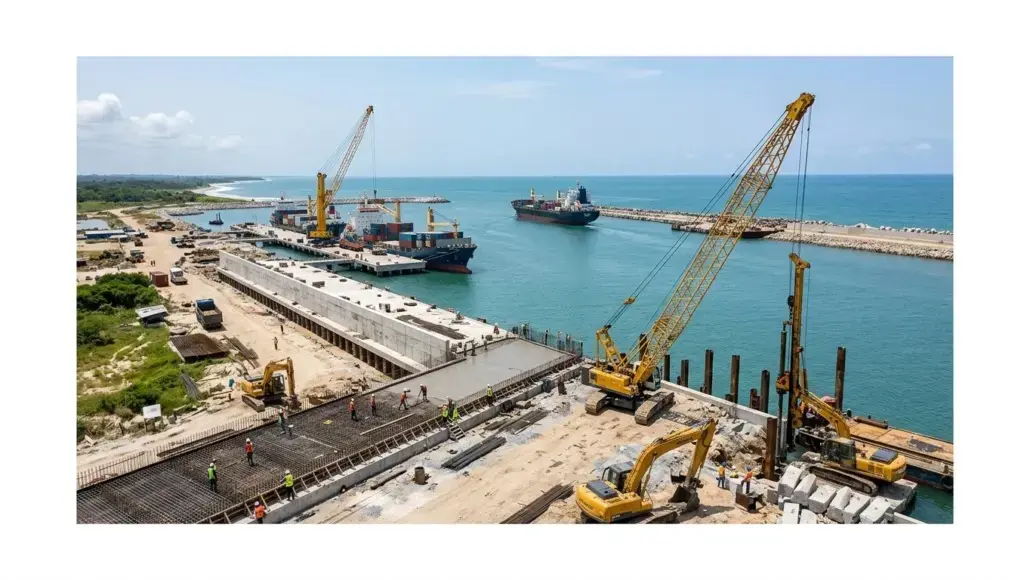
Dangote Industries Limited has embarked on foundational activities for the proposed Olokola Deep Seaport, a significant multibillion-dollar initiative in maritime and industrial infrastructure. This project is designed to bolster Nigeria’s export capabilities and further the conglomerate’s extensive industrial expansion strategy, aligned with its “Vision 2030” agenda. The planned Olokola Deep Seaport is slated to become one of Africa’s most substantial deep-sea ports, situated within the Olokola Free Trade Zone. This zone spans across the Ogun Waterside Local Government Area in Ogun State and extends towards the Ilaje Local Government Area in Ondo State, fronting the Gulf of Guinea coastline.
This undertaking represents a crucial step for the Dangote group in deepening its vertical integration across critical sectors including logistics, energy, manufacturing, and export infrastructure. The objective is to transform the conglomerate into a globally competitive industrial enterprise, with a strategic target of achieving annual revenues of $100 billion within the next decade. Company representatives have indicated that the proposed port will serve as a primary logistics gateway for an integrated industrial ecosystem. This ecosystem will facilitate the export of fertilizers, petrochemicals, and refined petroleum products. Furthermore, it is expected to accommodate future liquefied natural gas shipments and the large-scale importation of essential industrial equipment.
The substantial investment underscores the increasing drive by Nigeria’s leading industrial entities to mitigate dependence on the nation’s often-congested public port facilities. It also highlights a concerted effort to improve supply-chain efficiencies in the face of expanding regional trade opportunities presented by the African Continental Free Trade Area (AfCFTA).
Captain Jamil Abubakar, the managing director for Infrastructure and Logistics at Dangote Industries, led a delegation comprising company executives, surveyors, and environmental consultants to engage with host communities. He emphasized that the Olokola Port project is pivotal in enhancing Nigeria’s trade competitiveness and fostering long-term economic development throughout the region. During discussions with local community leaders, Abubakar stated, “The Olokola Port project is a major step in opening up Nigeria’s economic potential, strengthening trade, reducing pressure on existing ports and supporting industrial growth.”
“With its strategic location, Olokola would serve as a key gateway for exports and imports, boosting Nigeria’s competitiveness in regional and global trade,” he added.
The company anticipates that this venture will generate significant direct and indirect employment opportunities. It is also expected to stimulate further investment across various sectors, including logistics, manufacturing, marine services, and transport infrastructure. Industry analysts observe that the proposed facility could evolve into a strategic export corridor for Dangote Industries’ expanding downstream operations. This is particularly relevant as the group continues to scale up its production capacities in refining, petrochemicals, and fertilizer businesses.
The project also signals heightened competition among West African nations aiming to establish large-scale logistics hubs. Such hubs are crucial for more efficient handling of industrial exports and managing regional trade flows.
Economists suggest that the Olokola project could significantly fortify Nigeria’s non-oil export infrastructure. This development comes at a time when policymakers are actively seeking to diversify the nation’s foreign-exchange earnings, attract industrial capital, and enhance participation in intra-African trade. Beyond its maritime functions, the development is projected to position Olokola as a major industrial and logistics hub along the Gulf of Guinea. In the long term, this could lead to a reshaping of cargo flows and export activities across West Africa.
For Aliko Dangote, the proposed Olokola Deep Seaport represents a strategic extension of an industrial paradigm that increasingly integrates production, logistics, and export infrastructure within a unified commercial ecosystem. This integrated approach aims to enhance operational scale and broaden Africa’s industrial trade footprint.
