

























Shipping a bus, excavator, or industrial machine overseas involves more than finding available vessel space. Cargo dimensions, lifting requirements, and port facilities can determine whether a shipment proceeds as planned or faces unexpected costs and delays.
Breakbulk shipping provides an option for large vehicles and equipment that cannot be transported conveniently in standard containers. However, cargo owners must assess whether it is suitable for their particular shipment.
For importers, equipment dealers, and project contractors, the following six checks can help identify potential problems before booking a breakbulk shipment.
1. Check Whether Breakbulk Is the Right Shipping Method
The first decision is whether breakbulk shipping is necessary for the cargo.
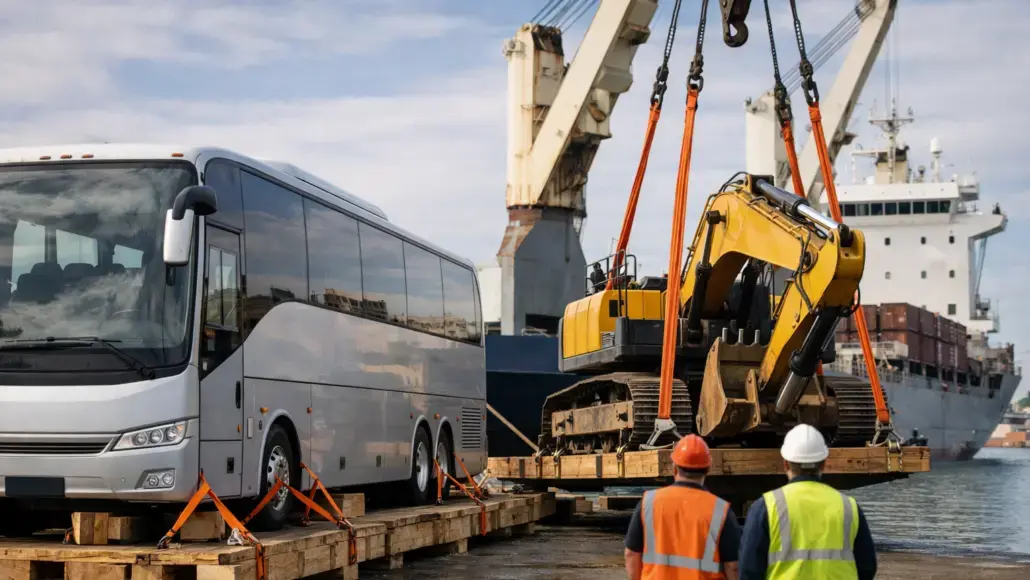
Large construction equipment, such as excavators, bulldozers, and cranes, may be suitable for breakbulk vessels when their dimensions or handling requirements make container shipping impractical. Industrial generators and other heavy machinery may also require individual lifting and stowage arrangements.
Buses and heavy trucks require a different assessment. If a vehicle is operational and a suitable RoRo service is available, it may be possible to drive the vehicle directly onto the vessel. Some non-operational equipment can also be transported on specialized rolling trailers, subject to carrier acceptance.
Breakbulk becomes an alternative when RoRo services are unavailable, vessel restrictions prevent loading, or the shipment requires a different handling arrangement.
Flat rack containers should also be considered for machinery that exceeds standard container dimensions but remains within the applicable equipment and carrier limits.
The decision should account for vessel availability, handling risks, transit time, and total transportation costs.
2. Confirm the Cargo’s Actual Shipping Dimensions and Weight
A manufacturer’s product specifications may differ from the dimensions of the cargo in its shipping condition.
An excavator may have its boom lowered and bucket repositioned for transportation. A mobile crane may require its attachments or counterweights to be removed. A bus may have external mirrors, rooftop equipment, or other components that affect its overall dimensions.
Before requesting a quotation, cargo owners should establish:
- Overall length, width, and height in shipping condition
- Gross shipping weight, including attached accessories
- Number of units and any separately shipped components
- Center of gravity and weight distribution
- Available technical drawings and recent cargo photographs
These details help carriers determine whether the cargo can pass through hatch openings, fit within the available stowage space, and be handled by the proposed lifting equipment.
For particularly heavy machinery, the center of gravity is critical. Two machines with similar dimensions and weights may require different lifting arrangements because their weight distribution differs.
Accurate measurements should therefore be confirmed before the cargo leaves the factory.
3. Review Lifting Points and Cargo Securing Requirements
Unlike vehicles loaded by driving onto a RoRo vessel, breakbulk cargo is commonly transferred onto the ship using cranes or other lifting equipment.
This introduces specific handling requirements.
Excavators and other construction machines may have designated lifting positions provided by the manufacturer. However, lifting points must be suitable for the actual shipping configuration and load.
Buses present additional challenges. Their long bodies, windows, and exterior panels require protection during lifting. A suitable lifting frame, cradle, or other engineered handling arrangement may be necessary, depending on the vehicle’s construction and available lifting points.
The lifting plan should establish the center of gravity, attachment positions, rigging configuration, and required equipment capacity.
Once the cargo is on board, it must also be secured against movement during the voyage.
The International Maritime Organization’s Code of Safe Practice for Cargo Stowage and Securing (CSS Code) provides guidance for the safe handling and securing of heavy cargo. Its recommendations cover cargo information, stowage planning, and securing arrangements.
Cargo owners should ensure that the proposed lifting and lashing methods have been reviewed by qualified personnel before loading begins.
4. Verify Vessel and Port Handling Capabilities
A vessel may have sufficient cargo space but still be unsuitable for a particular shipment.
Heavy equipment shipments require checks on lifting capacity, hatch dimensions, deck strength, and available securing arrangements.
For example, a tall construction machine may fit on an open deck but exceed the clearance available for under-deck stowage. A particularly heavy machine may require additional load-spreading arrangements to distribute its weight safely.
The choice between on-deck and under-deck stowage also affects cargo exposure. Machinery carried on an open deck may require additional protection against seawater, salt spray, and weather conditions.
Port facilities are equally important.
Some breakbulk operations depend on shore-based cranes, while others use the vessel’s own lifting equipment. The available lifting capacity must be assessed at the required working radius, rather than relying solely on a crane’s nominal maximum capacity.
Importers should verify the handling arrangements at both the loading and discharge ports. This is particularly relevant when equipment is destined for ports with limited heavy-lift facilities.
5. Understand the Complete Breakbulk Shipping Cost
Breakbulk freight quotations can vary significantly even when shipments have similar weights.
One reason is the method used to calculate freight.
Some breakbulk shipments are quoted on a weight-or-measurement basis (W/M), using the greater of the cargo’s metric tonnage or cubic volume as the chargeable quantity. Other shipments may be priced using a lump-sum rate or a vessel-space arrangement.
A large bus, for example, may occupy considerable space relative to its weight. A compact industrial machine may be much heavier but occupy less volume.
The final cost also depends on handling requirements and the proposed shipping route.
Cargo owners should review whether the quotation includes:
- Inland transportation from the factory to the port
- Origin terminal handling and storage charges
- Crane operations, lifting equipment, and cargo securing
- Ocean freight and applicable surcharges
- Destination terminal handling and discharge charges
- Customs-related services and cargo insurance, where required
The allocation of these charges depends on the shipping contract and agreed service scope.
A lower ocean freight rate does not necessarily mean a lower total shipping cost. Additional handling, port delays, or specialized equipment requirements can change the overall expense.
Comparing quotations on the same service basis helps importers make a more informed decision.
6. Coordinate Cargo Preparation, Booking, and Port Delivery
Breakbulk shipping requires coordination between the cargo supplier, freight forwarder, shipping line, and terminal operator.
For machinery purchased from China, this process should begin before the equipment is delivered to the departure port.
The supplier should confirm the cargo’s shipping condition and provide the available technical information. The freight forwarder can then assess vessel options, cargo handling requirements, and the proposed shipping schedule.
For shipments originating in China, specialist logistics providers such as Sinotraffic coordinate breakbulk arrangements for heavy machinery and vehicles, including cargo assessment, vessel booking, terminal handling, and loading and securing operations.
The shipment plan should also establish responsibility for cargo preparation, inland delivery, terminal acceptance, and documentation.
Used machinery may require additional cleaning, inspection, and preparation before export. Equipment containing fuel, batteries, or other regulated components may be subject to carrier-specific acceptance requirements.
Before dispatching cargo to the port, the parties should confirm the receiving window, documentation requirements, and availability of the agreed handling equipment.
Early coordination helps reduce the risk of cargo arriving at the terminal before it is ready for loading.
Conclusion
Breakbulk shipping can provide a practical solution for transporting buses, construction machinery, and oversized industrial equipment when conventional shipping arrangements are unsuitable.
Successful shipments depend on accurate cargo information, appropriate lifting and securing plans, suitable vessel and port facilities, and a clear understanding of the total transportation cost.
Completing these six checks before booking gives cargo owners a better basis for selecting a shipping method and preparing their equipment for international transport.
