







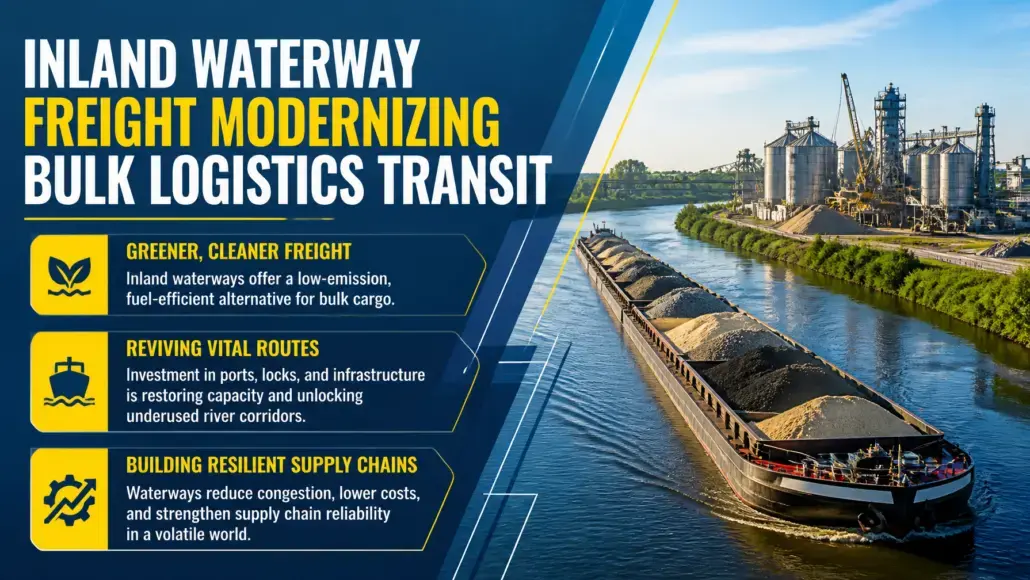
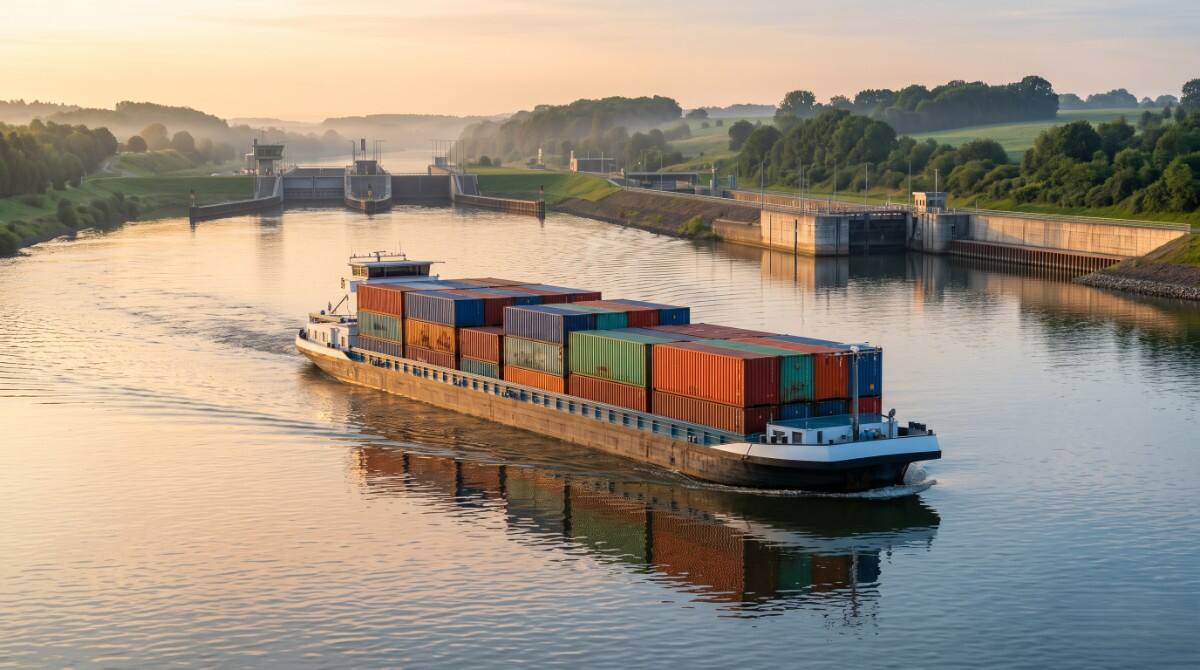
As global supply chains seek to de-risk and decarbonize, the world’s river networks are regaining their status as vital corridors for industrial commerce. For decades, the movement of bulk commodities, such as grain, chemicals, and construction materials, shifted toward rail and road, leaving many inland ports and lock systems to age without significant investment. However, the tide is turning. Transport Advancment observes that inland waterway freight modernization is now at the forefront of the logistical transition, driven by the need for low-emission transport and the increasing congestion on land-based networks.
The economic scale of the barge and inland shipping market is substantial. Global barge transportation was valued at over 137.7 billion dollars in 2025, with expectations for steady growth through 2035. In the European Union, inland waterways loaded and unloaded over 903 million tonnes of freight in 2025 alone.
Transitioning to Zero-Emission Propulsion
One of the primary drivers of inland waterway freight modernization is the move toward green energy. Because barges carry massive amounts of weight relative to their surface area, they are ideal candidates for alternative propulsion systems like hydrogen and electricity. Unlike long-haul ocean vessels, inland barges operate on predictable routes with frequent stops, making the installation of charging and bunkering infrastructure more manageable.
Major global companies are leading this energy transition. In September 2025, the Inland Terminals Group, Nedcargo, and Zero Emission Services launched the first fully emission-free container barge route in the Netherlands. This project utilizes a battery-swap model, where depleted battery containers are swapped for fully charged ones at terminal stops, eliminating the need for long charging delays. Similarly, in the North Sea region, hydrogen-powered vessels began commercial operations in late 2025, and China launched its first methanol-hydrogen hybrid electric inland cargo barge to serve the Pearl River Delta.
Infrastructure Modernization and Regulatory Support
The physical infrastructure of rivers, locks, dams, and terminals, is receiving its most significant upgrade in a generation. In the United States, the 2026 Water Resources Development Act (WRDA) was introduced to provide billions in funding for the modernization of the aging lock and dam systems on the Mississippi and Ohio rivers. This legislation is a response to the 2025 ASCE Infrastructure Report Card, which flagged aging infrastructure as a major risk to the 25,000-mile U.S. inland waterway network.
Key global developments in infrastructure include:
- The Ports of Duisburg and Rotterdam signed a letter of intent in October 2025 to develop a green hydrogen corridor for inland shipping along the Rhine.
- The Port of Rotterdam is investing in automated “autodocking” systems from Kongsberg Maritime to improve terminal safety and throughput.
- The U.S. Army Corps of Engineers (USACE) established the Inland Navigation Design Center to standardize the engineering of new lock systems.
- The European Union’s NAIADES III program is providing funding for the digitalization of waterway traffic management systems to improve coordination between barges and ports.
These investments are not just about fixing old walls. they are about embedding technology into the river itself. Smart sensors on locks and dams can now provide real-time data on water levels and structural health, allowing for predictive maintenance and reducing the risk of emergency closures that can paralyze a supply chain.
The Role of Autonomous and Remote Navigation
The labor shortage that has affected the trucking industry is also being felt on the water. Inland waterway freight modernization addresses this through the development of autonomous and semi-autonomous navigation. While fully unmanned vessels are still undergoing regulatory review, smart-crewing models are already being trialed. These systems use AI to handle routine navigation tasks, allowing a smaller crew to focus on high-risk maneuvers and maintenance.
Kongsberg Maritime has been a pioneer in this field, conducting successful live trials of autonomous autodocking and autocrossing systems in 2025. In Germany, the VDV association of insurers called for urgent regulatory action in January 2025 to enable the broader use of unmanned inland vessels. The goal is to improve safety, as human error is a factor in the majority of river accidents, and to make water transport more competitive with autonomous road transport solutions.
Modal Shift and Multimodal Integration
For inland waterways to reach their full potential, they must be seamlessly integrated into the broader multimodal network. This requires a digital bridge between the river and the road. The use of digital freight matching optimization allows shippers to easily compare the costs and carbon footprint of moving goods by barge versus truck. When a shipper can see that a barge move will save them 60 percent in carbon emissions with only a slight increase in lead time, the decision to shift modes becomes much easier. Modern barge operators are increasingly utilizing load consolidation algorithm to identify opportunities for bundling smaller bulk shipments into full vessel loads, maximizing capacity.
Barge operators like American Commercial Barge Line (ACBL) are increasingly positioning themselves as multimodal logistics providers rather than just vessel operators. By owning or partnering with inland terminals and drayage fleets, they can provide door-to-door service for bulk commodities. This holistic approach is essential for industries like agriculture and construction, where the product must move from a farm or quarry to a river terminal and eventually to an urban construction site.
- Inland container terminals allow for the hub and spoke distribution of goods from major seaports.
- Multimodal platforms provide real-time tracking of cargo as it moves from water to land.
- Consolidated bulk loading reduces the number of truck trips required to move a single barge’s worth of freight.
Future Outlook for Waterway Logistics
As we look toward 2027 and beyond, the focus of inland waterway freight modernization will be on scaling the green transition and the digitalization of the fleet. The introduction of standardized e-fuel bunkering and the growth of the autonomous vessel market will likely make river transport the preferred choice for a wider range of freight.
The ongoing commitment from global trade organizations and national governments suggests that the river is no longer an afterthought in logistics planning. Transport Advancement notes that by investing in modern infrastructure and cutting-edge propulsion technology, the industry is ensuring that inland waterways remain a resilient, sustainable, and vital component of the global supply chain for another century. This modernization is not just an environmental imperative. it is a strategic economic opportunity for any nation with a navigable river network.
References
- “Global Barge Transportation Market Analysis 2025” – GM Insights
- “Inland Waterway Freight Statistics 2025” – Eurostat
- “WRDA 2026 Modernization Funding Announcement” – U.S. Congress
- “Emission-Free Container Barge Route Debut” – Zero Emission Services
- “Rhine Green Hydrogen Corridor Letter of Intent” – Port of Rotterdam and Port of Duisburg
