














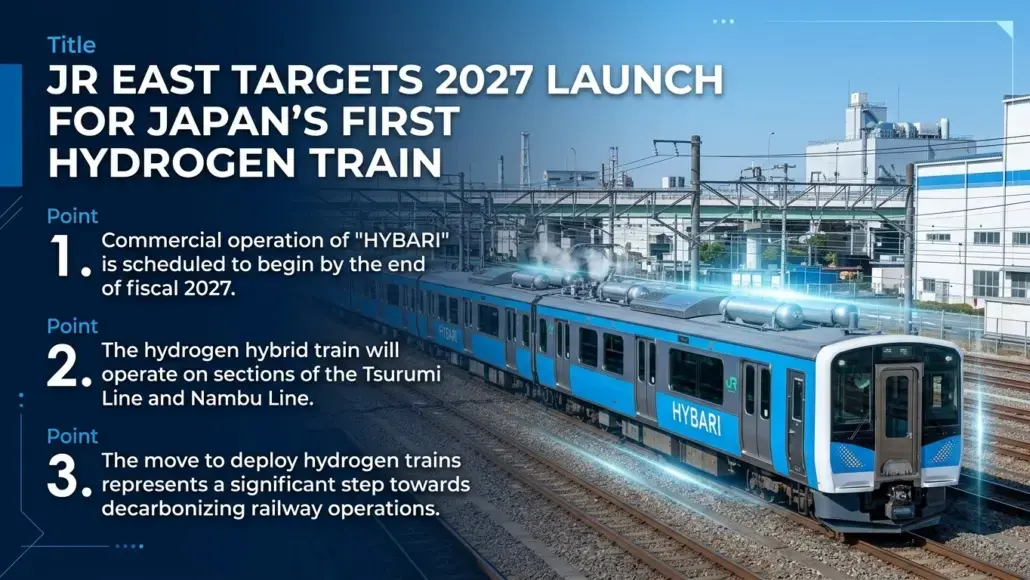
Japan’s railway company JR East announced that it will begin commercial operation of “HYBARI”, Japan’s first hydrogen hybrid train, by the end of fiscal 2027. The hydrogen train will operate on sections of the Tsurumi Line and Nambu Line, representing an important move in the company’s efforts to decarbonize railway operations.
The decision follows demonstration testing that has continued since 2022. During the trial program, JR East evaluated the vehicle’s core performance and confirmed the stability of its systems, leading the company to determine that the technology is suitable for practical commercial use.
“HYBARI” combines a hydrogen-powered fuel cell system with storage batteries. Hydrogen stored in onboard tanks is delivered to the fuel cells, where it reacts chemically with oxygen from the air to generate electricity.
That electricity powers the train’s motors, allowing operation with zero carbon dioxide (CO2) emissions. The train is capable of traveling approximately 140 kilometers on a single hydrogen refueling, making it suitable for short-distance route operations.
In 2021, JR East introduced its “Zero Carbon Challenge 2050” initiative, establishing a goal of achieving virtually zero CO2 emissions by fiscal 2050. Although much of the company’s railway electricity already comes from hydroelectric power and other renewable energy sources, diesel vehicles continue to serve non-electrified routes. The hydrogen train is positioned as a central solution for reducing emissions across those sections.
Infrastructure Preparation and Future Development Plans
With the commercial deployment now confirmed, JR East will move forward with preparations that include installing hydrogen fueling stations, finalizing operating schedules, and providing crew training. The company stated that “details will be announced as they are finalized,” while noting that the specific operating sections and service frequency will be determined in the future.
At the same time, JR East plans to continue developing next-generation hydrogen hybrid vehicles by building on the technical expertise gained through the demonstration program. Once hydrogen train technology becomes fully established, the company sees potential opportunities to expand its application to other domestic railway operators as well as overseas markets.
Globally, the practical deployment of hydrogen-powered railway vehicles remains limited, with companies such as Germany’s Siemens and France’s Alstom continuing to compete in the field. The entry of JR East’s “HYBARI” into commercial service could provide an opportunity for Japanese railway technology to strengthen its presence within the global hydrogen mobility sector. Although railway networks generally have a higher electrification rate than the automotive sector, many regional routes still operate without electrification.
Hydrogen trains offer the advantage of running on existing tracks without requiring ground-based infrastructure such as overhead catenary wires, helping reduce deployment costs. As the industry continues balancing environmental goals with economic considerations, broader adoption of the first hydrogen train technology is expected going forward.
