
















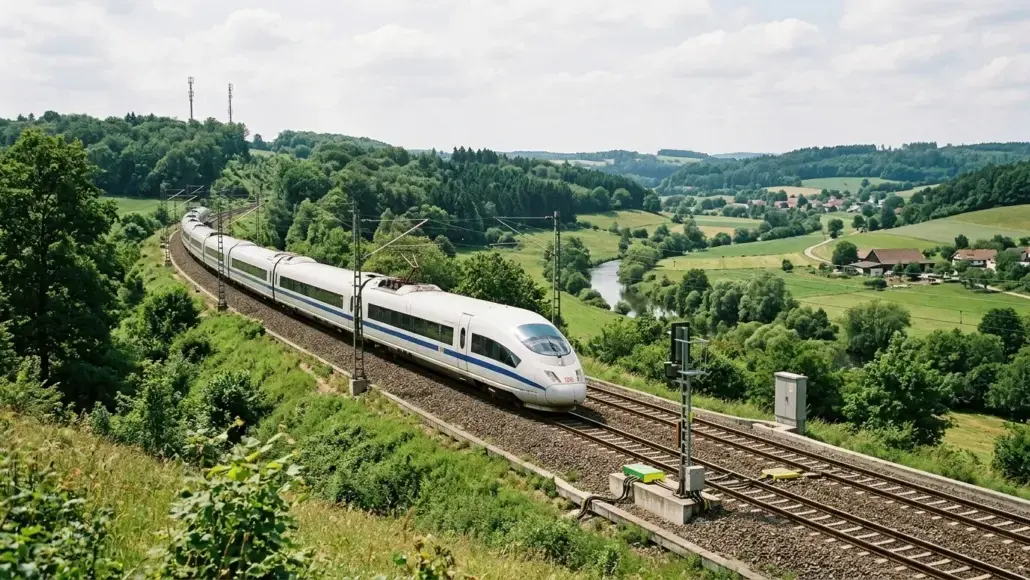
The global push for decarbonization has placed the transportation sector under intense scrutiny, as it remains one of the largest contributors to greenhouse gas emissions. While railways are already the most sustainable mode of long-distance transport, the industry is not resting on its laurels. To meet ambitious Net Zero targets, rail operators are seeking ways to further reduce their energy consumption and carbon footprint. ETCS Technology has emerged as a surprisingly powerful tool in this sustainability drive. Beyond its primary functions of safety and capacity, Transport Advancement highlights that the ETCS provides the digital infrastructure required for highly optimized, energy-efficient driving and network management, proving that the smartest railway is also the greenest railway.
The Physics of Rail Energy Consumption
To understand the impact of ETCS Technology on sustainability, one must first consider the energy dynamics of a train journey. A significant portion of a train’s energy is consumed during acceleration to overcome inertia. Conversely, when a train uses traditional friction brakes, much of its kinetic energy is wasted as heat. The most energy-intensive way to operate a railway is a stop-and-go pattern, where trains are frequently forced to slow down or stop due to signaling constraints or traffic congestion. ETCS Technology mitigates these inefficiencies by providing a continuous, real-time data flow that allows for velocity smoothing, ensuring that trains maintain a steady speed and minimize unnecessary braking and acceleration cycles.
Optimizing the Velocity Profile through Digital Signaling
In a legacy signaling system, a driver often has limited visibility of the track ahead. They might accelerate to full speed only to find a restrictive signal a few kilometers away, forcing them to brake hard. ETCS Technology eliminates this blindness. Because the system provides a continuous movement authority and speed curve directly to the driver’s display (or to the onboard computer in the case of ATO), the train’s speed can be adjusted gradually. If the control center knows there is a slight delay at the next junction, ETCS can advise the driver to coast or reduce speed slightly well in advance. This predictive driving can reduce energy consumption by as much as 10-15%, as it maximizes the use of the train’s momentum and minimizes energy-intensive restarts.
Integrating Driver Advisory Systems (DAS) with ETCS
A key component of sustainability in rail operations is the Driver Advisory System (DAS). When integrated with ETCS Technology, DAS provides real-time eco-driving advice to the driver. It calculates the most energy-efficient speed profile based on the current timetable, the characteristics of the rolling stock, the track topography, and the real-time position of other trains. By following these digital prompts, drivers can ensure they arrive at their destination exactly on time while using the minimum amount of electricity or fuel. This synergy between the human operator and the ETCS backbone turns every journey into a masterclass in energy efficiency, regardless of the driver’s individual experience level.
Enhancing Regenerative Braking Efficiency
Modern electric trains are equipped with regenerative braking, which allows the traction motors to act as generators during deceleration, feeding electricity back into the overhead lines or into onboard storage. However, for regenerative braking to be effective, there must be another train nearby on the same electrical sub-section to absorb that energy, or the grid must be capable of accepting it. ETCS Technology supports this process by coordinating the movements of multiple trains across the network. By aligning the braking of one train with the acceleration of another, the digital control system maximizes the internal recycling of energy within the rail network, further reducing the total draw from the external power grid.
Reducing the Need for Carbon-Intensive Infrastructure
Sustainability in the rail sector also involves the embodied carbon of infrastructure. Building new tracks, tunnels, and bridges requires vast amounts of steel and concrete—industries that are notoriously difficult to decarbonize. As a digital solution, ETCS Technology allows rail operators to increase the capacity of their existing lines by up to 40%. By running more trains on the same infrastructure, we can meet the growing demand for transport without the environmental cost of massive new construction projects. This asset optimization is a core tenet of circular economy principles in the transport sector, ensuring that we get the maximum possible utility out of our existing physical resources.
Shifting Freight and Passengers from Road to Rail
The greatest contribution of ETCS Technology to global sustainability is its role in facilitating modal shift. To achieve climate goals, a significant percentage of freight and passenger traffic must move from high-emission modes like trucking and aviation to low-emission rail. However, for this to happen, rail must be competitive in terms of reliability, speed, and frequency. By improving the performance and punctuality of international rail corridors, ETCS makes rail the obvious choice for logistics managers and travelers. Every additional ton of freight moved by an ETCS-enabled train represents an approximate 75% reduction in CO2 emissions compared to road transport, making ETCS a vital lever for continental-scale decarbonization.
Supporting the Transition to Alternative Traction
As the rail industry moves away from diesel, ETCS Technology is playing a role in supporting alternative traction systems like hydrogen and battery-powered trains. These technologies often have limited energy storage capacity compared to diesel. Therefore, every watt of energy saved through optimized driving is critical for extending the range and viability of these zero-emission trains. ETCS provides the precision control required to manage the power output of these new systems effectively, ensuring that they can perform on complex, real-world routes without the risk of running out of energy before reaching a charging or refueling station.
Conclusion
The modernization of the world’s railways through ETCS Technology is proof that digital innovation and environmental stewardship go hand in hand. By turning the railway into a highly intelligent, coordinated, and data-driven network, we are not just making it faster and safer. we are making it the most sustainable transport system the world has ever seen. In the race to save our climate, Transport Advancement believes ETCS is the green signal the rail industry needs to lead the way into a future where railways promotes sustainability.
