




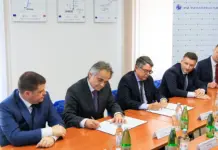




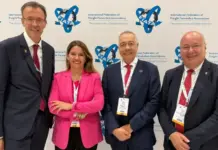



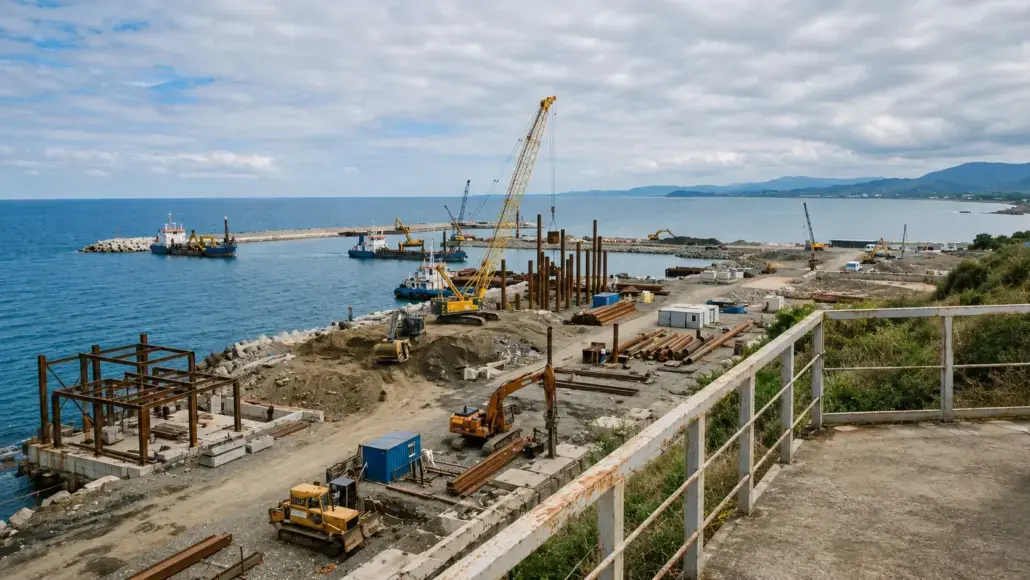
Georgia’s Minister of Economy Mariam Kvrivishvili introduced Uzbekistan’s Minister of Investments, Industry and Trade Laziz Kudratov and Minister of Transport Ilhom Makhkamov to the country’s strategic maritime infrastructure during their official visit to Georgia. As part of the programme, the Uzbek delegation toured the construction site of the Anaklia deep-sea port and visited several major facilities in Poti, including the APM Terminals Poti container terminal, the new Pace Group seaport, and the Poti Free Industrial Zone.
According to Georgia’s Ministry of Economy, the delegation received an overview of both the country’s existing port infrastructure and projects under development, demonstrating Georgia’s preparedness to accommodate increasing freight traffic moving through the Middle Corridor.
Construction activities at the Anaklia deep-sea port are currently centered on major offshore works being undertaken by Belgian dredging company Jan De Nul in partnership with a Georgian contractor. The first phase of the development is scheduled for completion in 2029. Once operational, the port will have the capacity to handle at least 600,000 TEU each year while accommodating Panamax-class vessels that are currently unable to call at Georgia’s existing ports.
Poti Development Projects Support Expanding Bilateral Cooperation
During the visit to Poti, Kvrivishvili also presented ongoing development initiatives within the Poti Free Industrial Zone, which is being evaluated as a potential site for joint logistics and manufacturing projects involving both countries.
The visit follows the recent state visit to Georgia by Uzbek President Shavkat Mirziyoyev, during which Georgia and Uzbekistan signed a declaration establishing a strategic partnership. Under the new framework for bilateral cooperation, transport and logistics have been identified as one of the principal areas of collaboration.
Uzbekistan, as a landlocked country, considers Georgia an important gateway to the Black Sea and European markets through the Middle Corridor. Discussions between the two countries include plans to establish a trade, logistics and manufacturing hub within the Poti Free Industrial Zone, while also expanding broader industrial cooperation.
Trade and Investment Agenda Continues to Grow
Economic relations between Tbilisi and Tashkent have strengthened considerably in recent years. Bilateral trade totaled $268 million in 2025, and both countries are targeting an increase to $1 billion over the coming years. To achieve that objective, the focus is expected to shift beyond trade toward joint investment, manufacturing activities, and improved access to third-country markets.
