






World’s First Narrow-gauge Hydrogen Train
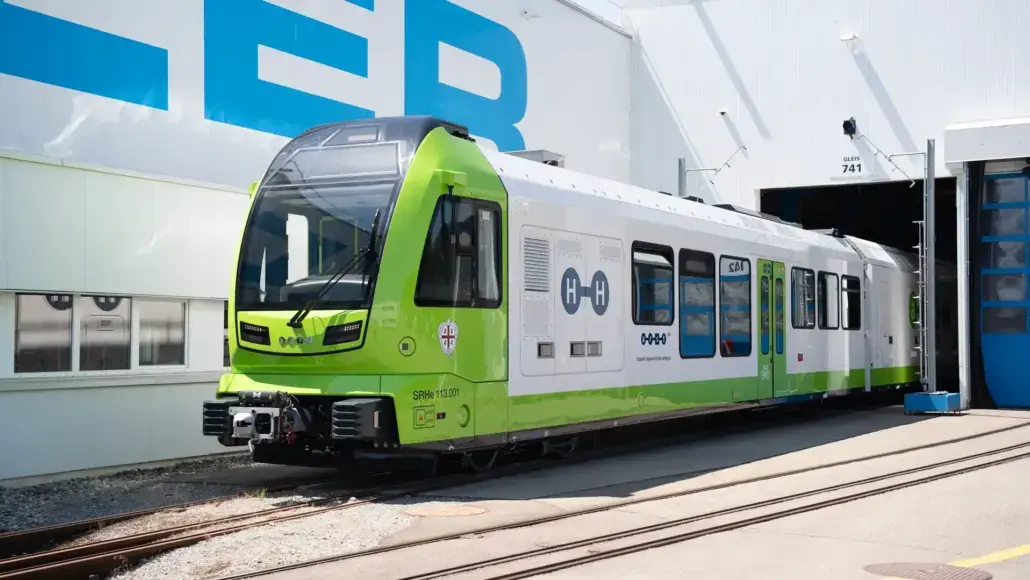
Stadler and ARST (Trasporti Regionali della Sardegna) have presented what they describe as the world’s first narrow-gauge hydrogen train, marking a significant development in sustainable railway transportation. The unveiling took place on 19th June 2026 at the commissioning centre in Erlen, where the new Class SRHe 113 HMUs were officially introduced.
The vehicles are scheduled to begin carrying passengers from 2028 on routes operated by ARST, including Alghero Airport – Mamuntanas, Sassari – Alghero and Sassari – Sorso. With the introduction of the narrow-gauge hydrogen train, the two companies aim to advance a new phase of environmentally focused regional rail services in Sardinia. According to project estimates, the fleet of ten HMUs will reduce carbon emissions by more than 2,100 tonnes of CO₂ annually when compared with diesel-powered trains, an amount equivalent to approximately 450 car journeys around the world.
Renewable Hydrogen to Power Trains
A defining characteristic of the narrow-gauge hydrogen train is its propulsion technology, which combines fuel cells with hydrogen storage tanks. The system is installed within the central car, known as the Power Pack, where hydrogen is converted into electrical energy. This energy powers the train while simultaneously recharging its traction batteries. The hydrogen itself is produced using electricity generated entirely from solar power, ensuring the trains operate on sustainable hydrogen. As a result, the project establishes a fully integrated zero-emission solution for narrow-gauge railway operations, covering the entire chain from renewable energy generation through to train propulsion.
“These vehicles, developed in collaboration with Stadler, are a central element of the decarbonisation strategy for the narrow-gauge network. It is the first step in ARST’s evolution from a transport operator to an energy company capable of powering its own network of services. As already demonstrated by the active construction sites in Mandas, Alghero and Macomer, we are integrating technological innovation in vehicles with the autonomous production of clean energy. Working in full synergy with regional institutions, ARST is bringing to fruition a model of sustainable and fully self-sufficient public transport,” said Carlo Poledrini, Central Director of ARST.
Design to Facilitate Narrow-gauge Operations
Before entering commercial service, the Class SRHe units will undergo extensive testing to satisfy the requirements established by Italy’s National Agency for the Safety of Railways and Road and Motorway Infrastructure (ANSFISA).
The design of the new trains has been tailored to the unique operational requirements of Italy’s narrow-gauge railways. Because these networks can only accommodate vehicles with a particularly low axle-load, Stadler developed the units using lightweight materials and a specially adapted profile. The trains are equipped with air-conditioned interiors designed to provide a bright and comfortable environment, complemented by large panoramic windows.
Accessibility has also been incorporated through low-floor entry systems that facilitate boarding for passengers with reduced mobility. Compared with conventional diesel trains, the new units generate less vibration and operate more quietly, improving overall travel comfort. Dedicated crew facilities have also been included, featuring a separate access door and an independent air-conditioning system.
Italy’s Efforts Towards Sustainable Rail Transport
The project stems from the Framework Agreement signed by ARST and Stadler in 2023, which provides for the delivery of ten vehicles for regional and local transport services in Sardinia. The initiative forms part of a broader programme promoted by the Italian government and the Ministry of Infrastructure and Transport to decarbonise rail transport across Italy.
Through the deployment of the narrow-gauge hydrogen train, the programme seeks to introduce hydrogen technology to narrow-gauge routes and support the development of a new generation of sustainable rail vehicles. Beyond Sardinia, Stadler is also supplying hydrogen-powered trains to other Italian operators. Nine units are currently under construction for Ferrovie della Calabria (FdC), while two additional trains are being produced for Ferrovia Circumetnea (FCE) in Sicily. All of the vehicles are being manufactured at Bussnang.
