



















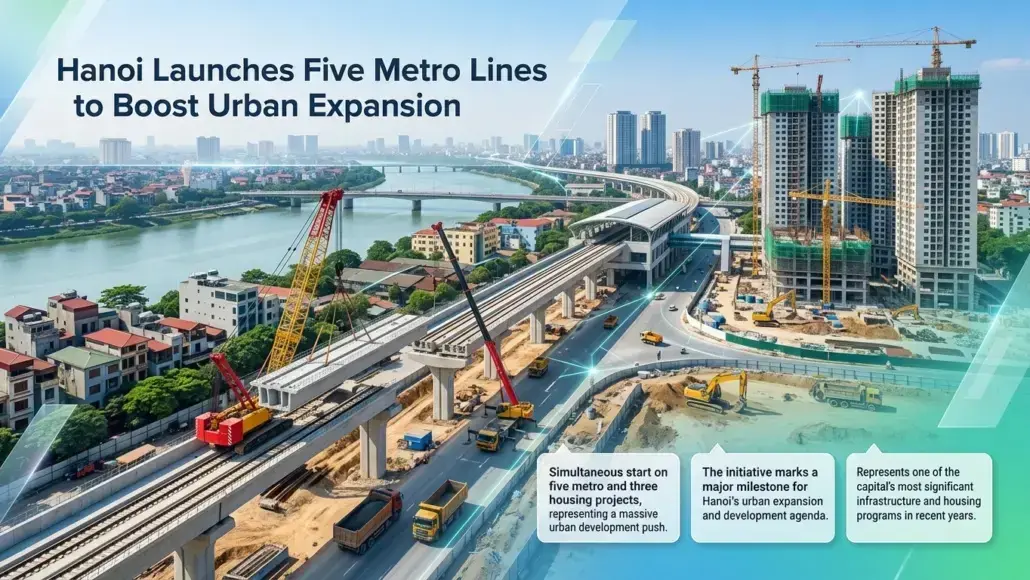
Vietnam’s capital city Hanoi marked a major milestone in its urban development agenda on 22nd June 2026 with the simultaneous commencement of construction on five metro lines and three rental housing projects. The initiative represents one of the most significant infrastructure and housing development programs undertaken by the capital in recent years.
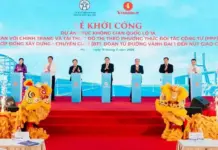
The launch ceremony took place at the principal site of the city’s rental housing project in Viet Hung Ward and was linked online to additional project locations in Long Bien Ward and the Phap Van–Tu Hiep urban area. Prime Minister Le Minh Hung attended the event alongside numerous senior officials.
The start of work on the five metro lines is expected to play a central role in strengthening Hanoi’s public transportation network while supporting the city’s broader urban expansion objectives over the long term.
- Under the plan, Metro Line 1 will extend from Hung Vuong Stadium through the Railway Industrial Zone, Ngoc Hoi, Hanoi Railway Station, Yen Vien, Thu Lam Urban Area and Noi Bai International Airport. The route has been designed as a major north-south transport corridor connecting important domestic and international transportation hubs.
- Metro Line 2 will link Noi Bai International Airport with Tran Hung Dao Street, Thuong Dinh and Hung Vuong Stadium, creating a strategic connection between the airport and the city centre.
- Metro Line 8 will run through Hoa Lac, Son Dong, Mai Dich, Ring Road 3, Linh Nam and Duong Xa, with the aim of improving east-west connectivity and strengthening links between Hoa Lac Hi-Tech Park and key industrial and logistics centres in eastern Hanoi.
- Meanwhile, Metro Line 10 is planned to connect Co Loa, Vo Chi Cong Street, Ring Road 3, Ring Road 2.5, Times City and Co Loa. The line is expected to contribute to the growth of new urban development zones while easing congestion in central districts.
- Metro Line 14 will stretch from Thang Long Bridge through Hong Ha to Ocean Park, improving transport connections between western Hanoi and rapidly developing urban areas in the east.
According to city planners, the five metro lines will be implemented under the Transit-Oriented Development (TOD) model, combining public transportation and urban development to create new economic growth poles while maximising land-use efficiency along transportation corridors.
