



















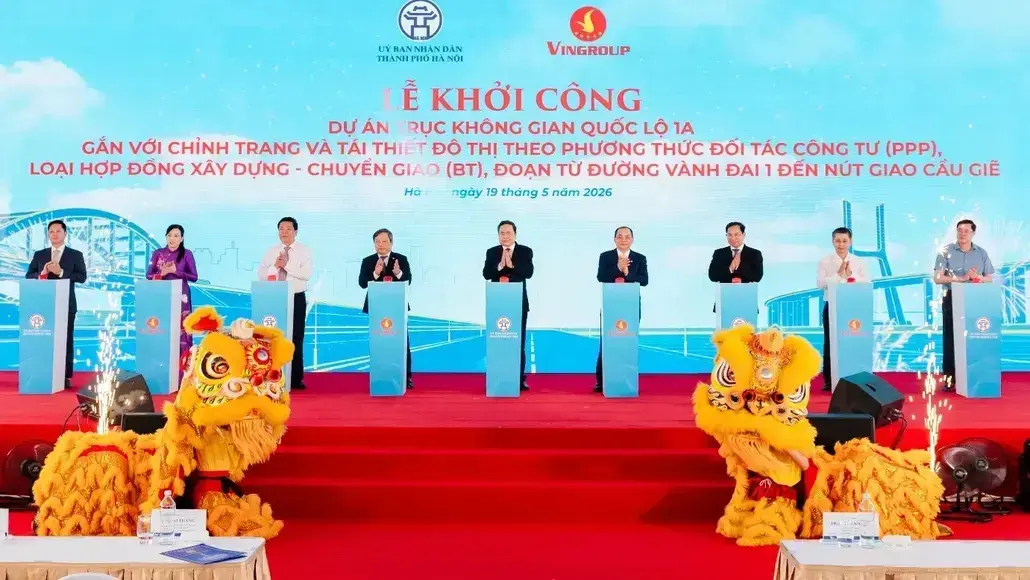
Vietnam’s capital Hanoi officially commenced construction on a significant urban transport corridor project along National Highway 1A on 19th May 2026 . The initiative represents a substantial investment, nearing VND162 trillion, which equates to approximately $6.2 billion. This pivotal development was jointly announced by the Hanoi People’s Committee and Vingroup, with the groundbreaking ceremony attended by Vietnam’s National Assembly Chairman Tran Thanh Man and other high-ranking officials from national ministries, government bodies, and local authorities.
This Hanoi urban transport corridor project is recognized for its strategic importance in shaping the capital’s long-term urban expansion and enhancing regional connectivity. The expansive route will traverse approximately 36.3 kilometers, passing through 18 wards and communes within Hanoi.
This ambitious infrastructure undertaking is being executed under a public-private partnership (PPP) framework, specifically employing a build-transfer (BT) contract structure. The corridor’s path begins near the Kim Lien tunnel in Kim Lien and Bach Mai wards, extending southwards to the Cau Gie interchange located in Chuyen My commune.
Project specifications detail a corridor width of up to 90 meters. This will include ten primary traffic lanes and six parallel service lanes positioned on either side. Authorities project that the primary construction phase for this vital infrastructure will be finalized by 2027. Officials anticipate that the new Hanoi urban transport corridor will play a crucial role in completing Hanoi’s comprehensive road network, aligning with the capital’s long-term urban master planning that extends for the next century.
Beyond the immediate improvements in traffic flow, the project is expected to significantly alleviate traffic congestion on existing ring roads and inner-city routes. It will also bolster connections between the central districts of Hanoi, southern urban areas, and neighboring provinces. The redevelopment effort is also geared towards facilitating urban renewal along the existing National Highway 1A corridor and stimulating economic activity in the surrounding districts.
Hanoi People’s Committee Chairman Vu Dai Thang underscored the urban transport corridor project’s significance, describing it as a foundational element for the capital’s forthcoming urban expansion. “A modern transport corridor not only serves mobility demand but also creates new development space, stimulates commerce, services and logistics, and enhances urban competitiveness,” he said.
He further noted that Hanoi is entering a new developmental phase necessitating urban restructuring towards a model that is more modern, green, smart, and highly interconnected. The southern region of Hanoi has been identified as a strategic gateway, vital for linking the capital with key economic hubs across the nation. For years, however, the section of National Highway 1A passing through Hanoi has been plagued by persistent traffic congestion, which has impeded traffic capacity, logistics operations, and the efficiency of urban planning.
Representing Vingroup, Nguyen Viet Quang expressed the company’s aspiration for the project to contribute to the comprehensive transformation of a modern and integrated urban corridor, thereby redefining the southern entrance to Hanoi.
