













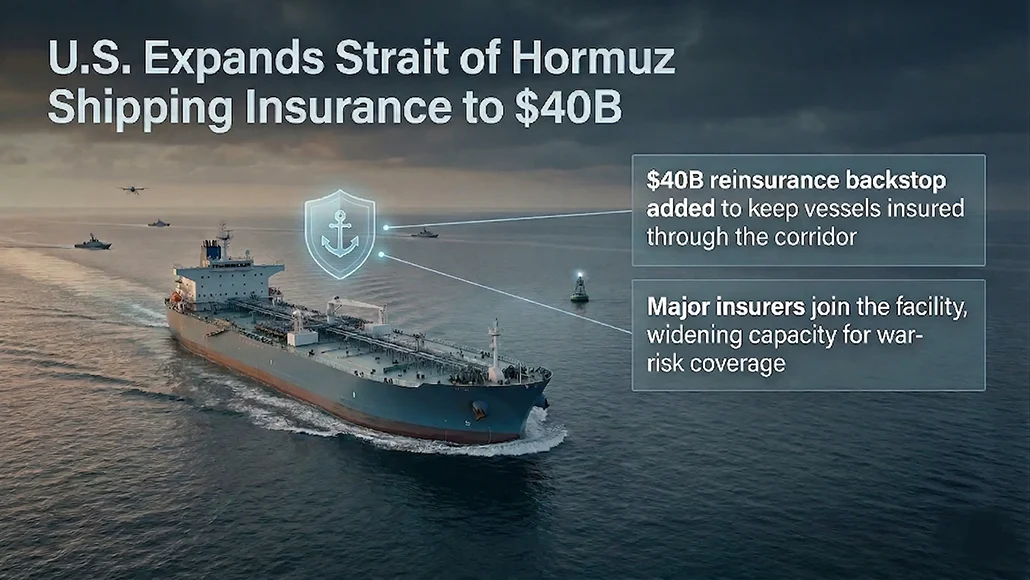
The United States of America has significantly expanded its Strait of Hormuz insurance initiative, increasing its commitment to $40 billion in reinsurance guarantees aimed at supporting vessels transiting the critical maritime corridor. This development follows the inclusion of new insurance partners such as AIG and Berkshire Hathaway, reinforcing Washington’s push to stabilize shipping flows through the region. Announced on 3rd April 2026, the move forms part of a broader effort to counter mounting security concerns and revive maritime traffic despite an ongoing five-week war and what has effectively become an Iranian blockade.
The initiative builds upon an earlier step taken in March 2026, when the U.S. International Development Finance Corp. (DFC) unveiled a $20 billion reinsurance framework. In its latest update on 3rd April 2026, the agency confirmed that Travelers, Liberty Mutual Insurance, Berkshire Hathaway, AIG, Starr and CNA will join Chubb to provide an additional $20 billion in backing for its maritime facility. This marks the first detailed disclosure of the program since its inception nearly a month ago. The disruption of the strait, which typically handles around one-fifth of global oil and liquefied natural gas flows, has intensified the global energy crisis and unsettled supply chains.
Despite the expanded Strait of Hormuz insurance coverage, shipping operators remain cautious about resuming regular operations in the region. Concerns persist over crew safety, as Iranian forces continue to pose threats through drone strikes, missile attacks, and water mines. Although President Donald Trump has pledged protection for vessels, uncertainty remains a major deterrent for shipowners considering a return to the route.
The DFC has also outlined strict eligibility criteria for participation in the Strait of Hormuz insurance program. Applicants must provide detailed disclosures, including the vessel’s origin and destination, ownership structures, cargo ownership, and financing arrangements. Restoring confidence among shippers is a top priority for the United States, particularly as the disruption has driven up global energy costs and strained supply for major importers such as India, the world’s third-largest oil consumer. However, even with the expanded financial guarantees, the absence of naval escort assurances leaves lingering doubts about whether the initiative alone can fully revive traffic through the Strait of Hormuz Insurance framework.
