












The global transportation sector is undergoing a profound and necessary transformation, pivoting aggressively toward sustainable and highly efficient transit solutions. At the epicenter of this structural transition is the electric train market, which is currently experiencing a dynamic phase of technological advancement and widespread infrastructure development. As urban centers expand and environmental concerns intensify, electric trains have emerged not merely as a modern trend, but as a fundamental necessity in redefining how modern societies approach mass transit and long-distance freight. This comprehensive Global electric train market forecast 2025-2035 thoroughly analyzes the shifting paradigms, core drivers, and extensive growth forecasts shaping the industry over the coming decade.
Market Valuation and Growth Trajectory
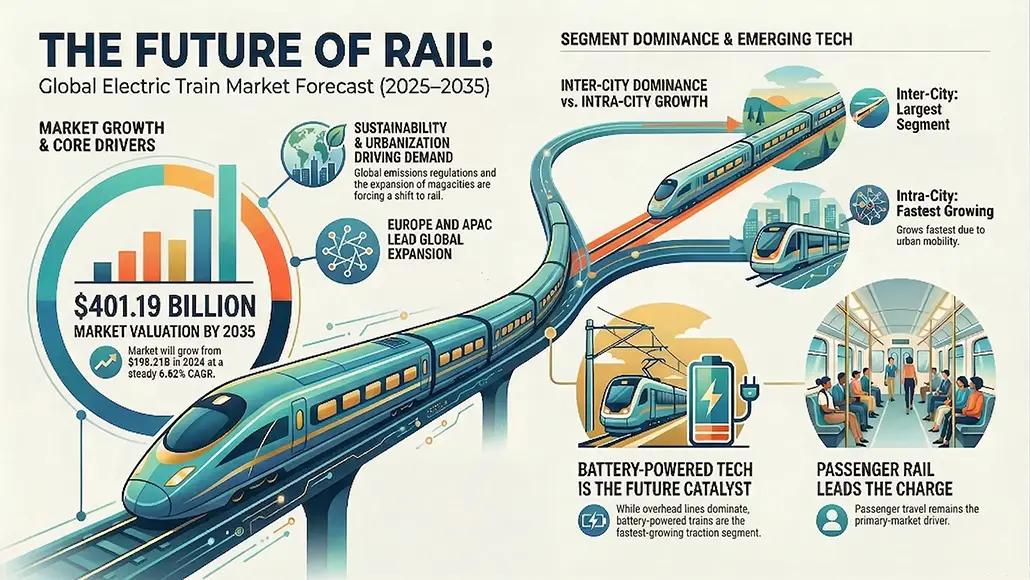
According to the latest industry forecast data, Transport Advancement believes the market is poised for robust, continuous expansion. The industry was evaluated at a substantial market size of 198.21 USD Billion in the base year of 2024. Moving into the forecast period, the market is projected to reach 211.33 USD Billion in 2025. Fueled by sweeping sustainability initiatives and immense capital investments globally, the electric train market is expected to achieve an impressive valuation of 401.19 USD Billion by the year 2035. This growth trajectory represents a solid Compound Annual Growth Rate (CAGR) of 6.62% during the 2025 to 2035 forecast period.
Core Market Drivers Propelling Expansion
The accelerating growth of the electric train market is underpinned by several critical macroeconomic and environmental drivers:
- Government Support and Strategic Investments: Many international governments increasingly recognize the undeniable necessity of sustainable public transit, leading to massive financial backing for rail projects. Global investments in electric rail infrastructure have surged dramatically, with several nations allocating billions of dollars to construct new rail lines and modernize existing legacy systems. This combination of public funding, combined with competitive policy incentives for operators, is fundamentally driving the sector’s expansion.
- Rapid Urbanization and Population Growth: As global populations migrate toward city centers, the demand for sustainable, high-capacity transportation intensifies. Electric transit offers a highly practical, scalable solution to the compounding challenges of urban traffic congestion and deteriorating air quality. City planners acknowledge that urban areas equipped with robust electric train networks consistently experience measurable reductions in traffic bottlenecks and vast improvements in localized air quality, prompting further investments to accommodate rising populations.
- Stringent Environmental Regulations: The market is heavily influenced by ambitious global environmental policies aimed at slashing carbon emissions. Regulatory bodies worldwide are enforcing strict mandates to lower transportation emissions, making zero-emission electric rail the premier alternative to heavily polluting diesel-powered fleets. This shift inherently aligns with international climate goals and appeals to a growing demographic of environmentally conscious commuters.
- Economic Factors and Fluctuating Fuel Costs: The volatile nature of fossil fuel prices is compelling rail operators to seek out cost-effective, long-term alternatives. Market analyses confirm that the total cost of ownership for electric trains is frequently lower than their diesel counterparts, especially when factoring in considerable fuel savings and lower routine maintenance costs. Economic incentives and government subsidies for green transit further cement the financial viability of electrified systems.
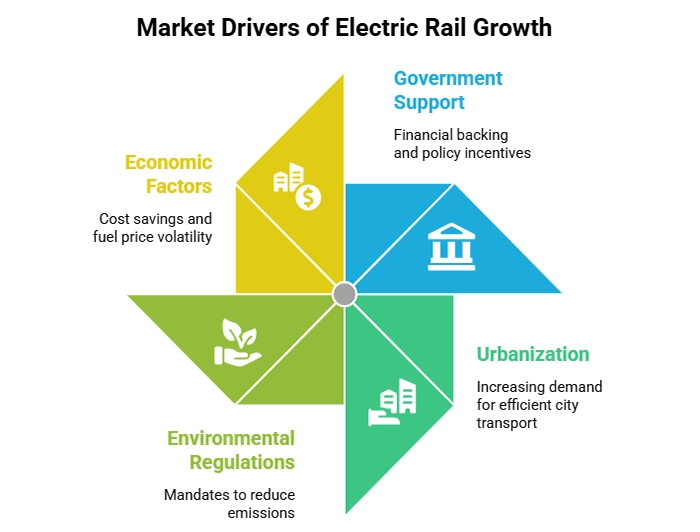
Core Market Drivers of Electric Rail Growth
Technological Innovations and Evolving Trends
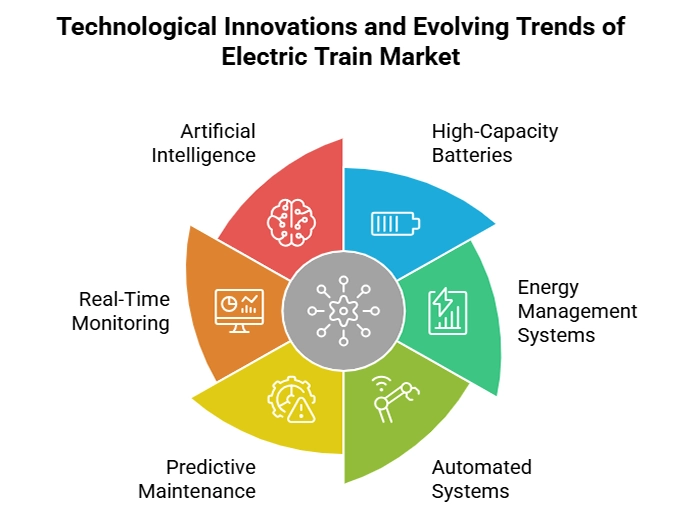
The operational capabilities within the market are being dramatically reshaped by continuous technological innovation. High-capacity battery developments and advanced energy management systems are effectively extending operational ranges and drastically reducing charging times. These enhancements are highly attractive to rail operators, as they directly translate to improved reliability and diminished overhead costs.
Furthermore, the widespread integration of smart technologies, such as automated systems, predictive maintenance, and real-time monitoring, is significantly enhancing both operational efficiency and the end-user passenger experience. As artificial intelligence becomes increasingly embedded into transit ecosystems, predictive maintenance will continue to mitigate downtime and streamline system-wide functionality.
Market Segmentation Insights and Strategic Shifts
To fully understand the changing landscape, it is crucial to analyze the market through its primary segments, which reveal unique operational shifts and future valuations.
By Application: Inter-City vs. Intra-City vs. Freight
The Inter-City application segment currently dominates the landscape, fueled by vast established infrastructures and a high global demand for seamless long-distance travel. However, the Intra-City segment is recognized as the fastest-growing category, spurred directly by rapid urbanization and the pressing need for sustainable commuter mobility. Concurrently, the Freight application segment is emerging as a vital logistical component, facilitating high-volume goods transportation while reducing supply chain emissions.
By Traction System: Overhead Line vs. Battery-Powered
When analyzing traction systems, Overhead Line Electrification maintains the largest market share due to its proven efficiency in high-speed and long-distance rail operations. Conversely, the Battery-Powered segment is rapidly emerging as the fastest-growing alternative, representing an innovative solution for shorter urban routes, non-electrified rural lines, and regions where traditional overhead infrastructure is financially prohibitive. Third Rail Electrification retains a smaller, localized market share, primarily operating within legacy regional transit infrastructures.
By Carriage Type: EMUs vs. DMUs vs. Locomotive-Hauled
Electric Multiple Units (EMUs) represent the largest and most prominent carriage segment, widely favored for their rapid acceleration, high-frequency service capabilities, and overall energy efficiency. Traditional Locomotive-Hauled trains remain a powerful and dominant force primarily utilized for heavy, long-distance transit. Diesel Multiple Units (DMUs) are experiencing growth as a highly flexible, lower-cost transitional alternative for operators servicing regions that currently lack extensive electrified rail extensions.
By Purpose: Passenger vs. Freight Transit
Divided by purpose, the Passenger segment captures the largest market share, driven globally by elevated ridership demands, improved convenience, and the unmatched speed of electrified public transit. By 2035, the Passenger purpose segment is projected to edge out freight with a valuation of about 201 USD Billion. Meanwhile, the Freight purpose segment is emerging closely behind, propelled by the logistics industry’s aggressive pivot toward green shipping solutions. Electric cargo transport is rapidly gaining traction, pushing the Freight purpose segment to an estimated 200 USD Billion valuation by 2035.
Regional Market Landscape and Geographic Expansion
The global forecast highlights distinct regional behaviors, localized investments, and specific market shares that dictate the international pace of the electric train market.
Europe: The Vanguard of Sustainable Transport
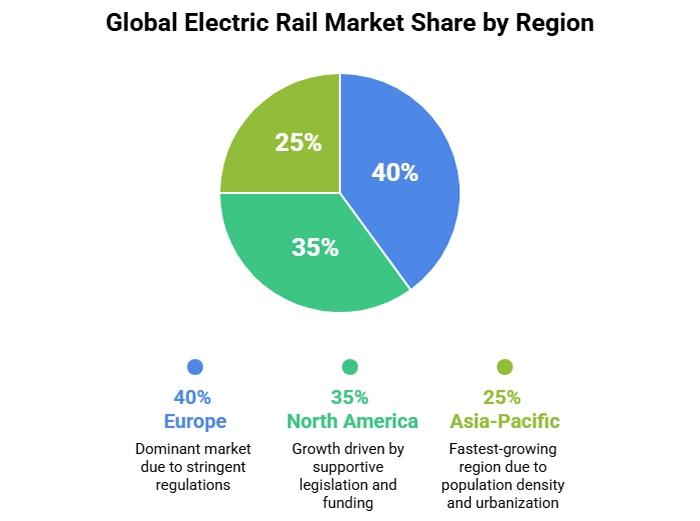
Europe leads the global market, accounting for approximately 40% of the total industry share. This dominant position is largely driven by incredibly stringent environmental regulations and aggressive international commitments to eco-friendly transport. The European Union’s Green Deal, which includes ambitious mandates to reduce total greenhouse gas emissions by 55% by the year 2030, is fundamentally forcing the rapid adoption and modernization of electric trains. Nations like Germany, France, the Netherlands, and Sweden are actively pioneering state-of-the-art rail networks through extensive public-private collaborations.
North America: Focused on Innovation and Upgrades
Holding approximately 35% of the global market share, North America is witnessing substantial, accelerated growth. The United States remains the largest single market within the region, followed by Canada. Growth in this sector is heavily catalyzed by supportive legislative actions, notably extensive funding initiatives from the Federal Railroad Administration aimed at widespread electrification and legacy rail modernization.
Asia-Pacific: The Fastest-Growing Frontier
The Asia-Pacific region, which holds about 25% of the market share, possesses unparalleled growth potential. This explosion in demand is intrinsically tied to immense population density and hyper-urbanization. China stands as the largest market in the region, largely due to governmental commitments to aggressively expand the nation’s high-speed rail networks and electrify aging conventional lines. Japan also plays a critical role in the region’s technological output, ensuring the Asia-Pacific market remains a highly competitive hotbed for next-generation transit innovations.
Middle East and Africa: Ground-Up Infrastructure Development
Holding an estimated 5% of the global market, the Middle East and Africa region is in a foundational phase of market development. Growth here is propelled by a broader strategic pivot away from fossil fuel reliance. South Africa is heavily investing in localized electrification projects to revitalize its aging networks, while the United Arab Emirates is focusing high-level capital on constructing brand-new, ultra-modern high-speed passenger rail systems.
Future Outlook and Strategic Opportunities
As the industry marches toward the 2035 projection, several lucrative opportunities are materializing. The relentless evolution of advanced battery technologies promises to unlock vastly longer operational ranges, effectively eliminating the geographical constraints of battery-powered transit. The deep integration of artificial intelligence will continue to streamline operational efficiency through flawless predictive maintenance protocols. Furthermore, Transport Advancement highlights the ongoing expansion of modernized rail networks deep into emerging markets offering unprecedented opportunities to capture massive, previously untapped commuter and commercial logistics bases.
Driven by an unyielding global demand for clean energy solutions, supportive regulatory frameworks, and rapid technological breakthroughs, the electric train market is undeniably poised for a decade of monumental, transformative growth.
