




















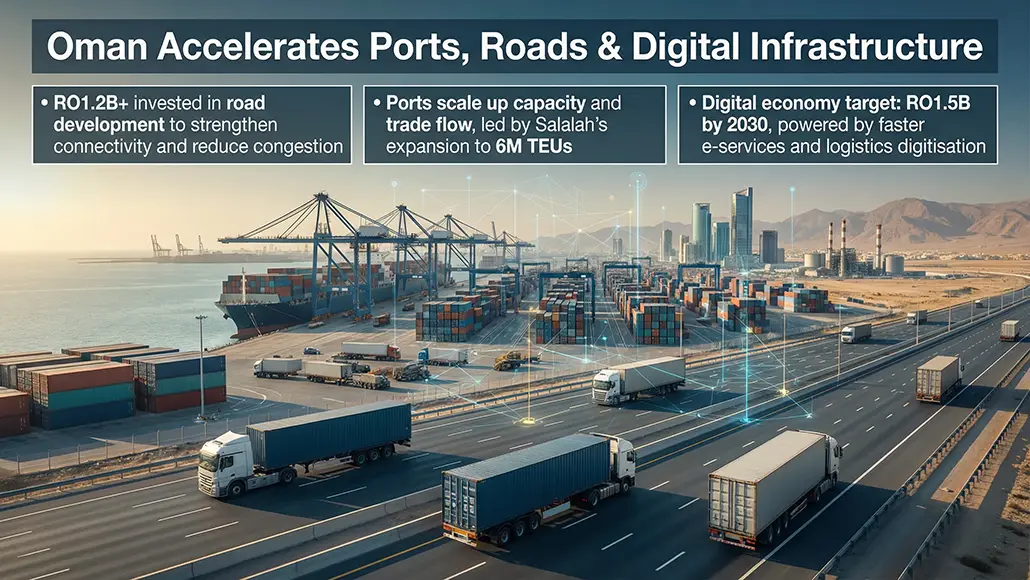
Oman is accelerating investment across transport, ports, and digital infrastructure as it advances into the next phase of its economic diversification strategy, with a strong emphasis on port and road development. More than RO1.2 billion ($3.1 billion) has been allocated to road projects, while the country is targeting an increase in the digital economy’s direct contribution to GDP to RO1.5 billion by 2030. These plans were presented by Oman’s Minister of Transport, Communications and Information Technology Saeed bin Hamoud bin Saeed al Maawali during a ministerial statement to the Shura Council, where progress under the 2021-2025 development plan was reviewed and priorities for 2026-2030 were outlined. Central to this roadmap is port and road development, aimed at strengthening connectivity and supporting broader economic activity.
According to the minister, more than 60 road projects have been launched or implemented during the current five-year period, focusing on enhancing regional links and reducing congestion. Several major road schemes are scheduled for completion in 2026, while expansion work on the Muscat Expressway is set to begin in the third quarter of the same year. The land transport sector has also demonstrated growth momentum, with revenue increasing by 18 per cent in 2025. Digital transformation within the sector has been notable, with the Naql platform processing more than 900,000 transactions between 2019 and 2025 and issuing over 290,000 licences in 2025 alone. Public bus services carried more than 5 million passengers, reflecting ongoing efforts to modernise transport systems. These developments further reinforce Oman’s commitment to port and road development alongside digital integration.
Ports have emerged as another key pillar of growth. In 2025, Omani ports handled over 143 million tonnes of cargo, while container throughput exceeded 5.1 million twenty-foot equivalent units (TEU). Salalah Port is undergoing expansion, increasing capacity from 4.5 million to 6 million TEUs, as part of wider initiatives to enhance the country’s logistics and trade capabilities. Additional projects include ship recycling, marine fuel services, and new concession agreements. Revenue from the ports sector rose 17.4 per cent in 2025, while maritime affairs revenue grew by 9.4 per cent. Looking ahead, the government’s 2026-2030 strategy prioritises competitive, lower-emission ports, green fuel initiatives, and the development of smaller and medium-sized facilities, further advancing port and road development objectives.
Investment in logistics reached around RO3.3 billion during the current plan, with 18 agreements worth over RO100 million signed in 2025. Future efforts will focus on integrating ports, airports, free zones, and land crossings, alongside improving multimodal connectivity and digitising supply chains. On the digital front, Oman has streamlined more than 3,166 government services and digitised 2,277 permits, with transactions surpassing 48 million in 2025.
With private investment in artificial intelligence exceeding RO79 million and e-commerce reaching RO288 million in 2025, Oman aims to grow its digital economy contribution to RO1.5 billion by 2030 and expand its technology ecosystem all while continuing to prioritise port and road development as a cornerstone of its Vision 2040 ambitions.
