












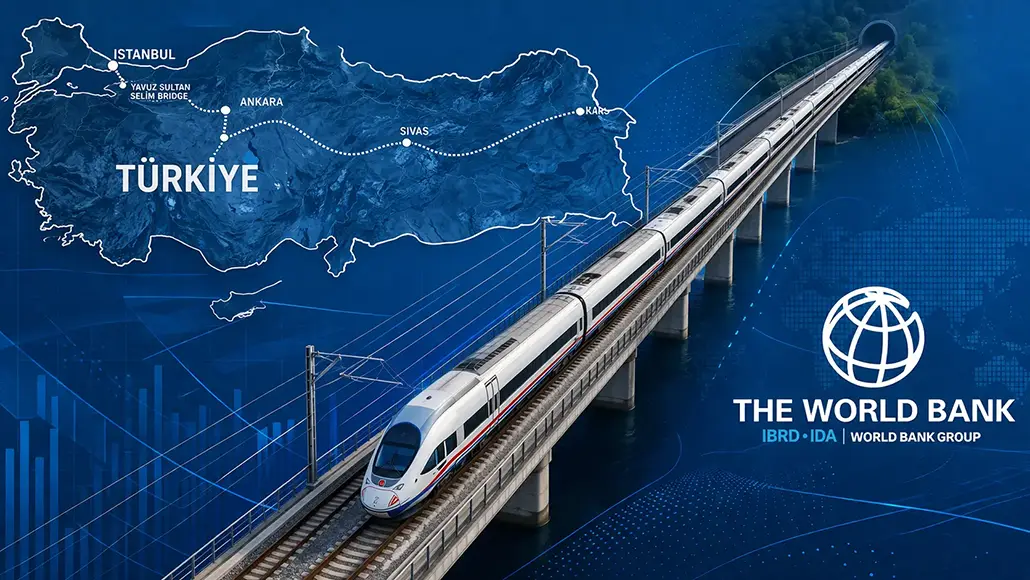
The World Bank has approved a $2 billion loan for the Istanbul North Rail Crossing Project (INRAIL). This financing forms part of a broader coordinated effort involving six Multilateral Development Banks, which are collectively set to provide $6.75 billion for the initiative. The Istanbul north rail project is positioned as a transformative infrastructure investment designed to enhance railway connectivity across the Istanbul Strait (Bosphorus) and reinforce Türkiye’s strategic role as a logistics hub linking Europe, Asia, and the Middle East.
At the core of the Istanbul north rail project is the construction of a 127-kilometer, electrified, high-capacity railway line that will establish a new overland crossing of the Bosphorus. The route will utilise the rail-ready Yavuz Sultan Selim Bridge while bypassing the Istanbul metropolitan area, enabling a substantial increase in both freight and passenger rail capacity. The project is also expected to lower logistics costs, improve reliability across major transport corridors, and strengthen connectivity between Istanbul’s two airports and the national rail network. Key routes set to benefit include the Trans-Caspian, Türkiye–EU, and Iraq Development Road corridors, all of which currently face capacity constraints at the Bosphorus crossing.
The new infrastructure is designed to address a critical bottleneck affecting Türkiye’s major rail corridors, including the Transcaspian Transport Corridor (TCTC) or Middle Corridor, the Iraq Development Road, and the Türkiye-EU corridor. By resolving this limitation, the Istanbul north rail project will enable uninterrupted, high-capacity rail operations while enhancing resilience against natural hazards. Approximately half of the railway alignment will run through tunnels, reducing exposure to extreme heat, flooding, strong winds, and wildfires. Once completed, rail freight capacity across the Bosphorus is projected to rise from around 3 million tons per year to as much as 50 million tons, significantly improving efficiency, reliability, and predictability for freight operators.
With a total estimated cost of approximately $8.3 billion, the project is being delivered through a coordinated international financing framework. Alongside the World Bank, participating institutions include the Asian Development Bank (ADB), Asian Infrastructure Investment Bank (AIIB), European Bank for Reconstruction and Development (EBRD), Islamic Development Bank (IsDB), and the OPEC Fund for International Development, all contributing toward the $6.75 billion financing package in support of the Government of Türkiye. Overall, the Istanbul north rail project aligns with Türkiye’s long-term transport strategy and national development priorities, with a focus on building resilient infrastructure and strengthening regional integration.
