











In the intricate tapestry of global commerce, the arteries through which goods flow are as vital as the products themselves. For centuries, these maritime pathways have dictated the rhythm of trade, connecting continents and fuelling economies. Yet, recent times have witnessed an unprecedented recalibration of these established channels, driven by a confluence of geopolitical instability, economic pressures, and environmental concerns. At the heart of this transformation lies a compelling narrative of shipping route shifts, most notably the pivot from the critical Suez Canal to the much longer, historic journey around the Cape of Good Hope. This reorientation is not merely a logistical inconvenience; it is a fundamental redrawing of global trade maps, sending ripples across maritime logistics, impacting freight costs, and creating significant shipping delays that resonate from factory floors to consumer doorsteps.
The Suez Canal Under Duress
The Suez Canal stands as an unparalleled feat of engineering and a cornerstone of global trade. By carving a path through the Isthmus of Suez, it dramatically shortened transit times between Europe and Asia, eliminating the arduous voyage around Africa. For well over a century, it has been the fastest, most economical conduit for global trade.
However, even the most enduring lifelines can face duress. The recent escalation of geopolitical tensions in the Red Sea region, particularly attacks on commercial shipping by Houthi rebels, has exposed the inherent vulnerability of this critical waterway. These incidents, following earlier disruptions such as the infamous grounding of the Ever Given in 2021 which paralyzed the canal for six days, have compelled shipping companies to confront an uncomfortable truth: reliance on a single, albeit efficient, chokepoint carries unacceptable risks. The spectre of Suez Canal disruption has become a tangible threat, forcing a radical re-evaluation of established global trade routes.
Geopolitical Volatility and its Immediate Impact
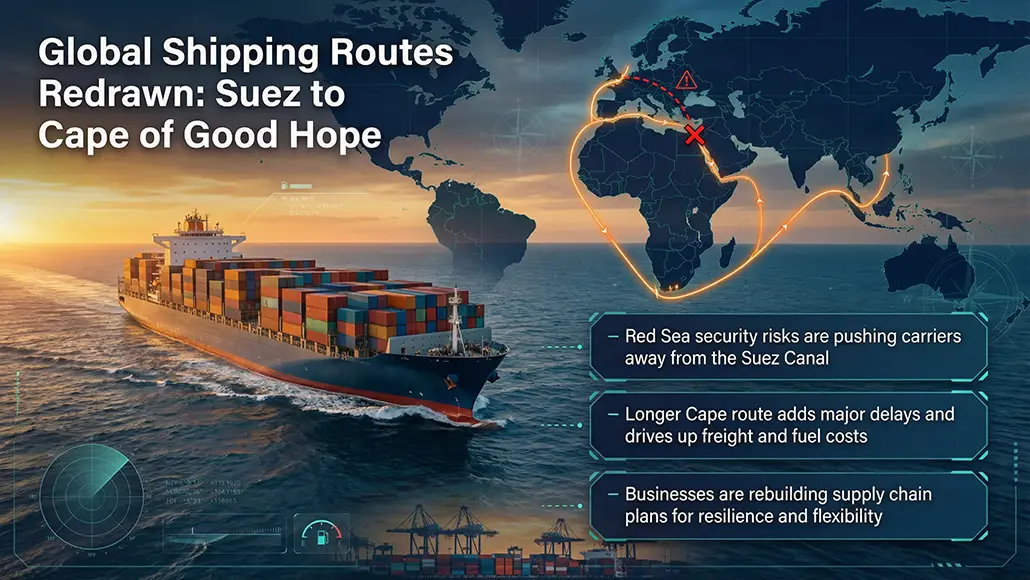
The current security crisis in the Red Sea has acted as the primary catalyst for the most recent and significant shipping route shifts. The threat of missile and drone attacks has rendered passage through the Bab-el-Mandeb Strait, leading into the Red Sea and then the Suez Canal, excessively risky for many commercial vessels. Insurance premiums have skyrocketed, and the safety of crews has become a paramount concern. Faced with these challenges, major shipping lines have made the difficult but necessary decision to suspend transits through the Suez Canal. This collective pivot underscores the gravity of the situation and the immediate, profound impact of regional instability on global commerce.
The Cape of Good Hope Route
With the Suez Canal’s viability compromised, the alternative, long-abandoned Cape of Good Hope route has resurfaced as the primary detour. This journey, circumnavigating the southern tip of Africa, was the default passage for centuries before the Suez Canal’s construction. Now, it represents a fallback option, a lifeline in times of crisis, but one that comes with a steep price.
The implications of this rerouting are substantial. The voyage around the Cape of Good Hope adds significant nautical miles to a typical Asia-Europe journey, translating into an additional 10 to 14 days of transit time. For vessels moving between Asia and the East Coast of the Americas, the extension can be even greater. This extended journey directly impacts several key aspects of maritime logistics:
The Economic Cost of the Long Haul
Firstly, fuel consumption rises dramatically. A longer journey at sea necessitates burning significantly more bunker fuel, leading to a direct surge in operational costs. Given the volatility of global oil prices, this additional expenditure can quickly erode profit margins for shipping companies. These increased fuel costs, combined with higher insurance premiums for vessels opting for the longer route, are inevitably passed on to consumers in the form of elevated freight costs. Every additional dollar spent on transport ultimately contributes to higher prices for imported goods, from electronics to clothing and perishable foodstuffs. This trickle-down effect impacts inflation rates and consumer purchasing power globally.
Secondly, the extended transit times create widespread shipping delays. For industries reliant on just-in-time inventory management, such as automotive manufacturing or fast fashion, these delays can be catastrophic. Production lines can grind to a halt awaiting crucial components, retail shelves may sit empty, and perishable goods face increased risks of spoilage. The ripple effect of a 10-day delay in shipping can disrupt entire supply chains for weeks or even months, creating bottlenecks at ports, straining warehousing capacity, and forcing businesses to absorb unexpected costs. The predictability that modern maritime logistics strives for is undermined, forcing companies to reconsider their entire operational framework.
Broader Repercussions for Global Trade Maps
These shipping route shifts are not isolated incidents; they have profound implications for the very structure of global trade maps. Beyond the immediate economic costs and delays, several other factors come into play.
Supply Chain Resilience and Diversification
The current scenario has underscored the critical need for enhanced supply chain resilience. Businesses are being forced to re-evaluate their over-reliance on single global trade routes and diversify their maritime logistics strategies. This could involve exploring multi-modal transport options, contracting with multiple carriers, or even considering nearshoring or friend-shoring initiatives to reduce dependence on distant and potentially unstable shipping lanes. The traditional pursuit of maximum efficiency is now being balanced with the imperative of robustness and adaptability. Companies are investing in better visibility tools and predictive analytics to anticipate and mitigate future disruptions, recognizing that the era of smooth sailing is far from guaranteed.
Environmental Footprint and Sustainability Goals
The shift to the Cape of Good Hope route also has significant environmental ramifications. Longer journeys mean increased greenhouse gas emissions from burning more fossil fuels. This directly conflicts with the maritime industry’s ambitious decarbonization targets and broader global efforts to combat climate change. While shipping companies are exploring greener fuels and more efficient vessel designs, the current rerouting presents an immediate challenge to these sustainability goals. It prompts a debate about the true cost of trade, extending beyond mere economic figures to include environmental impact.
Insurance and Risk Management in a Volatile Landscape
The insurance sector is another area experiencing significant turbulence. Risk assessments for different global trade routes are being continuously updated, leading to fluctuating and often higher premiums. Underwriters are grappling with unprecedented levels of uncertainty, particularly concerning war risk insurance. This translates into yet another layer of increased cost for shippers and ultimately for consumers. The due diligence required for risk management in maritime logistics has intensified, with companies needing to constantly monitor geopolitical developments and adjust their strategies accordingly.
Geopolitical and Economic Chessboard
The re-emergence of the Cape of Good Hope route also carries geopolitical implications. Countries along this extended route, particularly South Africa, may see an uptick in port calls, bunkering services, and other maritime support activities, potentially boosting local economies. Conversely, nations historically benefiting from the Suez Canal traffic, like Egypt, face a reduction in vital transit fees, impacting national revenue. The current situation highlights the inherent power dynamics associated with controlling critical global trade routes and the vulnerabilities of nations reliant on them. It’s a stark reminder that trade is not just an economic activity, but often an instrument of geopolitical influence. The weaponization of maritime chokepoints has become a serious concern, compelling international bodies and naval forces to enhance security operations in affected areas.
Adapting to a New Maritime Reality
Navigating this dynamic landscape requires foresight, flexibility, and robust strategic planning. For shipping companies, this means optimising vessel speeds, improving routing algorithms, and potentially investing in larger, more fuel-efficient ships capable of enduring longer voyages. For ports, it means preparing for potential shifts in traffic, managing increased demand at alternative hubs, and ensuring efficient turnaround times to mitigate further shipping delays.
Technology plays a crucial role in this adaptation. Advanced tracking systems, real-time weather intelligence, and AI-driven predictive analytics can help optimize routes, forecast delays, and provide crucial insights for decision-making. Collaboration across the entire supply chain – between shippers, carriers, port authorities, and government bodies – is essential to foster resilience and ensure the continued flow of goods. Long-term contracts may need renegotiation to build in greater flexibility for shipping route shifts and unforeseen disruptions. Furthermore, governments are increasingly recognizing the need to invest in maritime security and diplomatic efforts to de-escalate tensions in critical regions, understanding that global economic stability hinges on the safety of global trade routes.
The Enduring Fluidity of Global Commerce
The dramatic shipping route shifts witnessed from the Suez Canal to the Cape of Good Hope route represent more than a temporary deviation; they signify a potentially long-term recalibration of global trade maps. While the Suez Canal will undoubtedly remain a crucial artery when conditions permit, the current crisis has etched an indelible lesson into the minds of logistics professionals worldwide: no route is entirely immune to disruption.
This era demands unprecedented adaptability and a proactive approach to risk management. Businesses, governments, and international bodies must work in concert to forge more resilient maritime logistics networks, understand the intricate web of global trade routes, and mitigate the escalating freight costs and pervasive shipping delays. The fluidity of global commerce, once a quiet undertow, has now become a powerful current, reshaping the very contours of how the world trades. The journey around the Cape of Good Hope, once a symbol of antiquated travel, has become a poignant reminder of the enduring challenges and constant evolution inherent in connecting our interconnected world.
