










South Korea has launched a council to strengthen shipbuilding and shipping cooperation, focusing on technology, fleet expansion, and energy supply resilience.
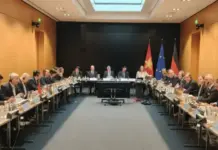
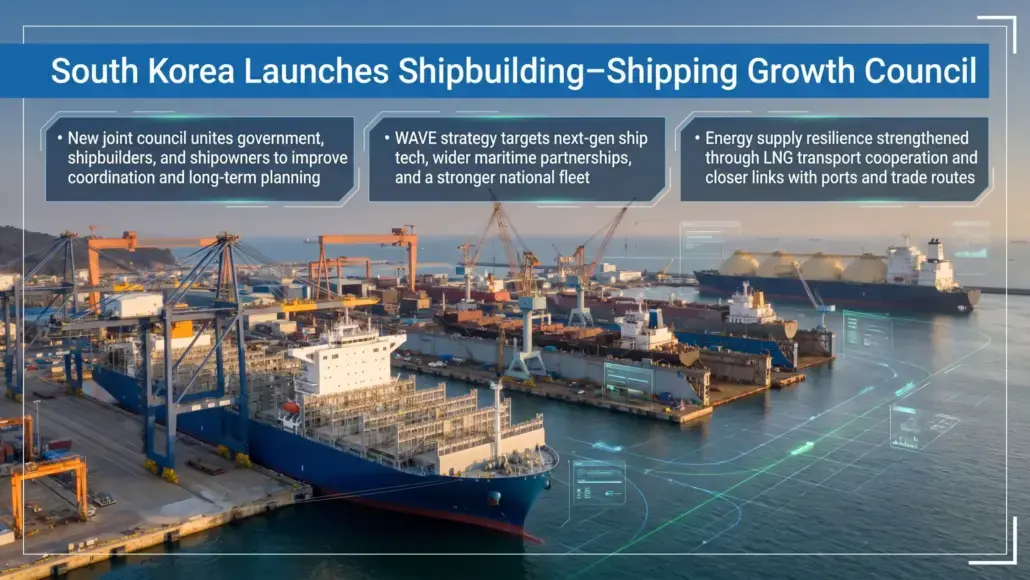
South Korea has moved to tighten alignment between its globally competitive maritime industries with the launch of a new joint platform focused on shipbuilding and shipping. The Ministry of Trade, Industry and Energy and the Ministry of Oceans and Fisheries on 28th April 2026 introduced a public-private council designed to address longstanding concerns about limited coordination between the two sectors. The initiative, formally named the Shipbuilding-Shipping Mutual Growth Strategy Council, was inaugurated at Lotte Hotel Seoul and brought together around 100 participants, including government officials, industry association leaders, and senior executives from major companies.
Attendees included representatives from Korea Gas Corp., the Korea Shipbuilding & Offshore Plant Association, and the Korea Shipowners’ Association, highlighting the broad institutional backing behind the effort.
Despite South Korea holding the world’s second-largest share of shipbuilding orders and ranking fourth globally in shipping capacity, critics have repeatedly flagged inefficiencies stemming from weak collaboration. These concerns have intensified amid rising geopolitical uncertainties, particularly those affecting energy supply chains due to disruptions linked to the conflict in the Middle East. Against this backdrop, the new council is positioned as a key mechanism to enhance synergy in shipbuilding and shipping.
Central to the initiative is a four-part framework known as WAVE, which sets out priorities to reinforce cooperation. The strategy emphasizes bridging technology gaps to achieve “world top class” capabilities, expanding partnerships across the maritime value chain, increasing the national fleet, and fostering a regional ecosystem that supports domestic shipyards. Authorities confirmed that a detailed implementation roadmap will be finalized by the end of the year, supported by expert task forces operating continuously and quarterly plenary sessions that will guide policy development. The broader objective is to create sustained momentum for integrated growth in shipbuilding and shipping.
During the launch event, the Korea Shipbuilding & Offshore Plant Association and the Korea Shipowners’ Association adopted a joint declaration advocating more coordinated vessel ordering practices to strengthen domestic procurement. The statement referenced recent orders, including Koryo Shipping’s six 1,900-TEU container ships and HMM’s 10 2,800-TEU vessels, both awarded to HD Hyundai Heavy Industries. In parallel, the three major shipbuilders, Korea Gas Corporation and the Korea Shipowners’ Association signed a memorandum of understanding to advance liquefied natural gas transport cooperation, reinforcing supply chain resilience. The ministries also announced plans to jointly invest 600 billion won ($406.93 million) this year in AI-enabled autonomous vessel technology while exploring an expansion of the Korea-U.S. MASGA initiative to include shipping and port infrastructure, further anchoring long-term collaboration in shipbuilding and shipping.
