


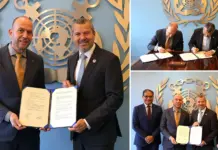




















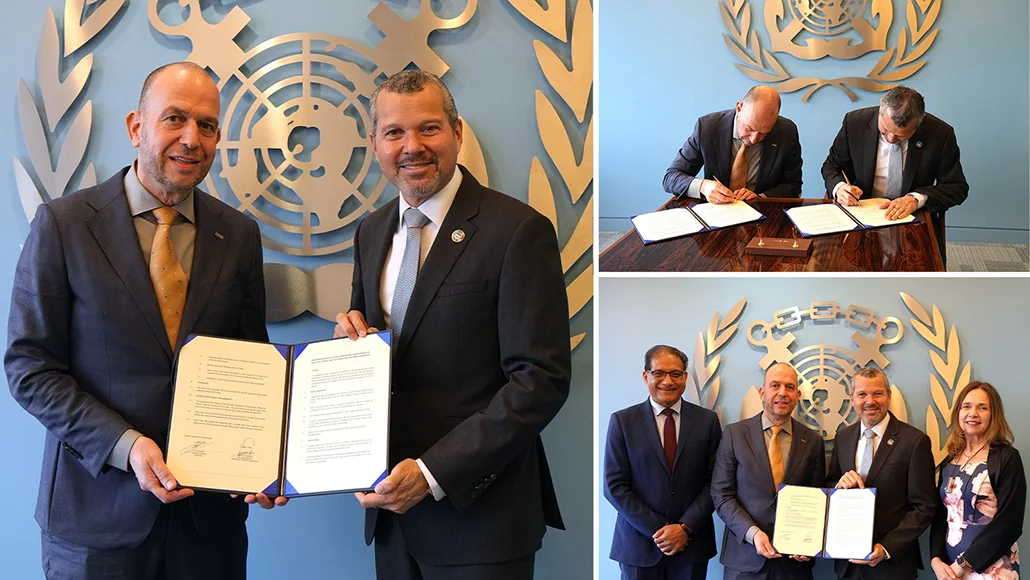
A new Port State Control agreement aimed at strengthening transparency and cooperation in maritime inspections has been formalized at the headquarters of the International Maritime Organization (IMO) in London. The updated data-exchange agreement was signed between IMO and the Paris Memorandum of Understanding on Port State Control (Paris MoU), marking a further step toward improving global coordination on ship inspections. The agreement was concluded by Arsenio Dominguez, Secretary-General of IMO, and Luc Smulders, Secretary-General of the Paris MoU. Through this Port State Control agreement, both organizations aim to enhance the sharing of inspection information and reinforce international collaboration in monitoring compliance with maritime standards.
The newly signed Port State Control agreement represents the sixth updated agreement reached between IMO and a regional PSC regime. Similar data-exchange arrangements were concluded in 2025 with the Secretariats of the Abuja, Indian Ocean, Tokyo, Mediterranean and Riyadh MoUs. These updated agreements expand the scope of data sharing to include full ship’s PSC inspection data under the framework of existing agreements with PSC regimes. By extending the exchange of information, the agreements are intended to strengthen data integrity and increase transparency in the reporting and monitoring of ship inspections worldwide.
Port State Control regimes operate as cooperative regional frameworks under which national maritime authorities inspect foreign-flagged vessels entering their ports. These inspections are carried out to confirm compliance with internationally recognized safety, security and environmental standards established through IMO instruments. The Port State Control agreement supports further development of the PSC module within IMO’s Global Integrated Shipping Information System (GISIS), particularly its integrated inspection database and related web services. Through this system, Member States can share full ship inspection records more efficiently. The PSC module gathers and displays inspection data submitted by PSC MoUs and Agreements, assisting Member States in implementing IMO regulations and meeting their reporting requirements. The platform also allows flag States to provide comments on inspection reports concerning their vessels, promoting transparency and ensuring due process within the inspection system.
By improving cooperation between regional inspection regimes, the Port State Control agreement is expected to benefit a wide range of maritime stakeholders and contribute to the harmonization of inspection practices across the industry. At present, ten PSC regimes operate globally, consisting of eight regional Memoranda of Understanding, one regional Agreement, and the United States Coast Guard acting as the tenth regime. These frameworks include Europe and the North Atlantic (Paris MoU), Asia and the Pacific (Tokyo MoU), Latin America (Acuerdo de Viña del Mar), the Caribbean region (Caribbean MoU), West and Central Africa (Abuja MoU), the Black Sea (Black Sea MoU), the Mediterranean Sea (Mediterranean MoU), the Indian Ocean (Indian Ocean MoU), the Persian Gulf (Riyadh MoU), along with the United States Coast Guard.
Some Member States participate in more than one PSC regime, while all regional PSC organizations hold observer status at IMO as intergovernmental organizations.
